25 Essential Decision Tree Interview Questions for Data Science and Machine Learning
Introduction
Decision trees are among the most important and widely used models in data science and machine learning. As a fundamental technique for both classification and regression problems, decision trees are prized for their simplicity, interpretability, and ease of use.
While more advanced models like deep neural networks tend to dominate the headlines, decision trees remain an invaluable tool in the data scientist‘s toolkit. In fact, many cutting-edge models like gradient boosted trees and random forests are built upon the basic decision tree algorithm.
For aspiring data scientists and machine learning engineers, a solid understanding of decision trees is essential. This article presents 25 must-know decision tree interview questions, covering everything from the fundamentals to advanced techniques and practical applications. Whether you‘re preparing for a technical interview or just looking to deepen your knowledge, read on to level up your decision tree skills.
Decision Tree Fundamentals
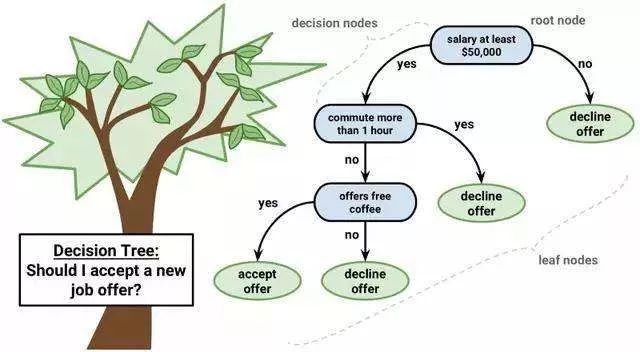
At its core, a decision tree works by recursively partitioning a dataset into smaller subsets based on feature values. The goal is to create a model that predicts the value of a target variable by learning simple decision rules inferred from the features.
Here are some key terms to know:
- Root Node: The topmost node in a tree that represents the entire population or sample
- Decision Nodes: Internal nodes that represent a feature or attribute test, with each branch representing the outcome of the test
- Leaf Nodes: Terminal nodes that represent a decision or prediction on the target variable
- Splitting: The process of dividing a node into two or more sub-nodes based on a given feature
- Information Gain: A metric used to select the best feature for splitting at each node, based on how well the feature separates the classes or reduces impurity
- Gini Impurity: An alternative metric to information gain used in the CART algorithm
There are several popular decision tree algorithms, each with its own approach to attribute selection:
- ID3 (Iterative Dichotomiser 3) uses information gain as its splitting criterion
- C4.5 is an improvement on ID3 that uses gain ratio to reduce bias towards multi-valued attributes
- CART (Classification and Regression Trees) uses Gini impurity as the splitting criterion
To visualize how a decision tree works, consider a simple example of predicting whether a customer will buy a product based on their age and income. The tree might look something like this:
             Root
              |
         Age < 30?
        /         \
       Yes        No
       |           |
 Income > 50k?     Buy
   /       \     /    \
  Yes      No  Yes    No
  |        |
 Buy     Don‘t Buy
By following the decision rules at each node, the tree can predict the outcome for any new customer based on their age and income. The beauty of decision trees is that the logic is transparent and easy to interpret, unlike black box models such as neural networks.
Decision Tree Interview Questions
Now that we‘ve covered the basics, let‘s dive into some common decision tree interview questions.
Q1. What are the main advantages and disadvantages of decision trees compared to other machine learning models?
Advantages:
- Easy to understand and interpret, even for non-technical stakeholders
- Requires little data preparation (no normalization or scaling needed)
- Handles both categorical and numerical data
- Performs well with large datasets and high dimensionality
- Robust to outliers and missing values
- Nonparametric approach that does not rely on assumptions about the data distribution
Disadvantages:
- Prone to overfitting, especially with small datasets
- Small changes in the data can result in large changes to the tree (high variance)
- Greedy algorithm that may not find the globally optimal tree
- Biased towards attributes with many levels or categories
- Struggles with non-linear relationships and interactions between features
Q2. How do decision trees handle different types of features? What about missing values?
Decision trees can handle both categorical and numerical features directly, with no need for encoding or scaling. For categorical features, each unique value can become a branch in the tree. For continuous features, the tree will find an optimal split point to maximize information gain or minimize impurity.
Most decision tree implementations also have built-in support for missing values. When a value is missing, the instance can be split into pieces, with each piece traveling down a different branch of the split and contributing to different child nodes. This is known as "surrogate splitting".
Alternatively, missing values can be handled in preprocessing by either removing instances with missing data or imputing the missing values (e.g. with the mean, median, or mode of the feature).
Q3. What is overfitting and how can it be addressed in decision trees?
Overfitting occurs when a model learns the noise in the training data to the extent that it negatively impacts its performance on unseen data. In decision trees, overfitting often results from growing the tree too deep and creating overly complex rules that don‘t generalize.
There are several techniques for preventing overfitting in decision trees:
- Pre-pruning: Stop growing the tree earlier by setting a threshold on metrics like max depth, min samples per leaf, or min impurity decrease
- Post-pruning: Grow the full tree but then trim back or collapse nodes that don‘t improve performance on a validation set
- Ensemble methods: Combine multiple decision trees to reduce variance and overfitting (e.g. random forests, gradient boosted trees)
- Use domain knowledge to limit the tree depth or inform stopping criteria
Q4. Explain the difference between a decision stump and a full decision tree.
A decision stump is a one-level decision tree that makes a prediction based on a single feature. It consists of a root node and two leaf nodes, each representing a class or value. Decision stumps are often used as weak learners in ensemble methods like AdaBoost.
In contrast, a full decision tree can grow to an arbitrary depth and use multiple features for splitting. While full trees are more expressive and can model complex relationships, they are also more prone to overfitting compared to stumps. The choice between a stump and full tree depends on the complexity of the problem and the size of the training data.
Q5. How does the depth of a decision tree impact bias and variance?
Bias refers to the error introduced by approximating a real-world problem with a simplified model, while variance refers to the model‘s sensitivity to small fluctuations in the training set.
In decision trees, increasing the depth tends to decrease bias but increase variance. A deeper tree can learn more complex relationships and make finer-grained distinctions, reducing bias. However, it also becomes more prone to overfitting the training data, resulting in higher variance.
Conversely, limiting the depth of a tree increases bias but reduces variance. A shallower tree makes coarser predictions and may underfit the data, but it is less sensitive to noise and outliers.
The goal is to find the right balance of depth that minimizes both bias and variance. This is typically done through techniques like cross-validation and pruning.
Advanced Decision Tree Techniques
While basic decision trees are powerful on their own, several advanced techniques can improve their performance and scalability.
Ensemble Methods
Ensemble methods combine multiple decision trees to make predictions, which often results in better performance than any single tree. Two popular ensemble methods are:
-
Random Forests: Build many decision trees on random subsets of the data and features, then aggregate their predictions through voting or averaging. This reduces variance and overfitting.
-
Gradient Boosted Trees: Build a sequence of shallow trees, each trying to correct the errors of the previous one. This is done by fitting the residuals (actual – predicted values) at each step. Gradient boosting often produces state-of-the-art results on structured data.
Recent implementations of gradient boosting like XGBoost and LightGBM have become extremely popular due to their speed and performance. They use advanced techniques like parallelization, regularization, and optimized data structures to train models efficiently on massive datasets.
Oblique Decision Trees
Traditional decision trees make axis-aligned splits, meaning they only consider one feature at a time. Oblique decision trees, on the other hand, use a linear combination of features to make splits. This allows them to learn more complex decision boundaries and capture interactions between features.
Some examples of oblique decision tree algorithms include:
- OC1 (Oblique Classifier 1)
- CART-LC (CART with Linear Combinations)
- Random Rotation Ensembles
While oblique trees are more expressive than axis-aligned trees, they are also more computationally expensive to train and less interpretable.
Decision Trees in Practice
To put decision trees into practice, let‘s walk through a simple example using Python and scikit-learn.
Suppose we have a dataset of customer churn, with features like age, income, and length of tenure. Our goal is to predict whether a customer will churn or not.
First, we‘ll load the data and split it into training and test sets:
from sklearn.datasets import make_classification
from sklearn.model_selection import train_test_split

X, y = make_classification(n_samples=1000, n_features=4, n_informative=2, n_redundant=0, random_state=42)
X_train, X_test, y_train, y_test = train_test_split(X, y, test_size=0.2, random_state=42)
Next, we‘ll train a decision tree classifier on the training set:
from sklearn.tree import DecisionTreeClassifier

clf = DecisionTreeClassifier(max_depth=3, random_state=42)
clf.fit(X_train, y_train)
Finally, we‘ll evaluate the model on the test set and visualize the tree:
from sklearn.metrics import accuracy_score
from sklearn.tree import plot_tree

y_pred = clf.predict(X_test)
print(f"Test accuracy: {accuracy_score(y_test, y_pred):.2f}")

plot_tree(clf, filled=True, feature_names=[‘age‘, ‘income‘, ‘tenure‘, ‘product_usage‘])
This simple example illustrates the basic workflow of training and evaluating a decision tree model. In practice, you would also want to:
- Preprocess the data (handle missing values, encode categorical variables, scale features)
- Tune hyperparameters using cross-validation or a validation set
- Evaluate the model using multiple metrics (precision, recall, F1 score, ROC AUC)
- Interpret the model by examining feature importances and decision rules
- Compare the decision tree to other models (logistic regression, random forest, etc.)
Decision trees are used in a wide variety of real-world applications, such as:
- Healthcare: Diagnosing diseases based on symptoms and lab results
- Finance: Detecting fraudulent transactions or assessing credit risk
- Marketing: Segmenting customers and predicting churn
- Manufacturing: Identifying faulty products on an assembly line
- Education: Predicting student performance and dropout risk
Conclusion
Decision trees are a fundamental concept in data science and machine learning. They offer a simple yet powerful way to model complex relationships and make predictions based on interpretable decision rules. By mastering decision trees, you lay the foundation for more advanced techniques like ensemble methods and oblique splits.
To deepen your understanding of decision trees, I recommend the following resources:
- "An Introduction to Statistical Learning" by James, Witten, Hastie, and Tibshirani
- "Hands-On Machine Learning with Scikit-Learn, Keras, and TensorFlow" by Aurélien Géron
- "Applied Predictive Modeling" by Max Kuhn and Kjell Johnson
- "Decision Trees and Random Forests" (machine learning course) by Brandon Rohrer
With practice and experimentation, you‘ll develop intuition for when to use decision trees, how to tune them effectively, and how to interpret their results. Happy learning!