A Comprehensive Guide to Text Classification in Python
Introduction
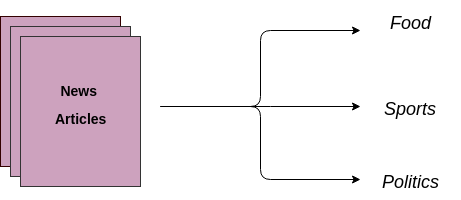
Text classification is a fundamental task in Natural Language Processing (NLP) with a wide range of applications. The goal is to automatically assign predefined categories to free-text documents. Some common use cases include:
- Sentiment analysis: Classifying text as positive, negative, or neutral
- Topic classification: Assigning topics like sports, politics, technology to articles
- Spam detection: Identifying and filtering out spam emails
- Intent detection: Routing customer queries to the appropriate department based on the identified intent
At a high level, a machine learning approach to text classification consists of the following steps:
- Prepare and preprocess the text data
- Transform the text into numerical feature vectors
- Train a classification model on the feature vectors
- Evaluate the model and make predictions on new data
This guide will walk through each of these steps in detail and demonstrate how to implement text classification in Python.
Preparing the Data
The first step is to gather a labeled dataset to train and evaluate the text classification model. The data should consist of text documents along with their assigned category labels. Some common sources of data include:
- Websites like news sites, blogs, and forums
- Databases of customer reviews, support tickets, or other company data
- Public datasets from research organizations or universities
- Crowdsourcing labels using platforms like Amazon Mechanical Turk
Once you have the raw data, some preprocessing is usually required before it‘s ready for machine learning. This may include:
- Cleaning: Remove HTML tags, special characters, and other unwanted content
- Tokenization: Split text into individual words or tokens
- Normalization: Convert all text to lowercase and handle misspellings
- Filtering: Remove stopwords, punctuation, and infrequent words
- Stemming/Lemmatization: Reduce words to their base or dictionary form
The goal is to standardize the text and remove any noise that may interfere with the classification task. Popular Python libraries for text preprocessing include NLTK, spaCy, and gensim.
Feature Engineering
After cleaning and preprocessing the text data, the next step is to convert it into a numerical representation that can be used as input to a machine learning model. Some common approaches are:
Bag of Words
In this approach, each document is represented as a vector where each element corresponds to a word in the vocabulary. The value of each element is the count of how many times that word appears in the document.
For example, consider the sentence "John likes to watch movies. Mary likes movies too." The bag-of-words representation would be:
John: 1
likes: 2
to: 1
watch: 1
movies: 2
Mary: 1
too: 1
The size of the vectors is the number of unique words across all documents. A major drawback is that bag-of-words ignores word order and context. The vectors can also get very large and sparse.
TF-IDF
TF-IDF (Term Frequency-Inverse Document Frequency) is an extension of bag-of-words that weights each term by how common it is across documents. The intuition is that words appearing in many documents are less informative than rare words.
TF-IDF is calculated as the product of two metrics:
- Term Frequency (TF): The count of a word in a document
- Inverse Document Frequency (IDF): The inverse of how many documents contain the word
So words with a high TF-IDF score appear frequently in a document but rarely in other documents. This helps surface more distinctive words for each document.
Word Embeddings
Word embeddings are a more advanced approach that maps words to dense vector representations. The key idea is that semantically similar words should have similar vectors.
Popular word embedding models like Word2Vec and GloVe learn these vectors by predicting a word based on its surrounding context. The learned embeddings often capture interesting relationships, such as king – man + woman = queen.
For text classification, the word embeddings for each word in a document can be averaged together to produce a fixed-length vector for the entire document. This incorporates more semantic information compared to bag-of-words.
Custom Features
Depending on the specific application, it can be helpful to engineer custom features based on domain knowledge. For example:
– Character-level features: Character n-grams, proportion of capital letters, punctuation counts
– Syntactic features: Part-of-speech tags, extracted noun phrases
– Metadata features: Document length, timestamp, author
– Features from knowledge bases: Named entities, Wikipedia categories
The right features to use depend on the characteristics of the text data and the classification task. It often takes experimentation to find a good set.
Model Training and Evaluation
With the feature vectors in place, the next step is to train a machine learning model to predict the category labels. There are many types of classification algorithms, with some popular ones being:
Naive Bayes
Naive Bayes is a probabilistic model that predicts the most likely class based on the joint probabilities of each feature. It "naively" assumes that the features are conditionally independent. Despite this simplification, Naive Bayes works well for many text classification tasks.
Logistic Regression
Logistic regression predicts the probability of the target class as a linear combination of the features. It‘s well-suited for binary classification and produces interpretable coefficients for each feature. Logistic regression is also a good baseline to try before more complex models.
Support Vector Machines (SVM)
SVMs find a hyperplane that maximally separates the classes in a high-dimensional space. They work well with sparse data and can handle non-linear decision boundaries using kernel functions. SVMs are a popular choice for text classification.
Decision Trees and Random Forests
Decision trees learn a series of rules to split the data into increasingly pure subsets. They are intuitive to understand but prone to overfitting. Random forests remedy this by training an ensemble of trees on random subsets of data and features. They often achieve better performance than individual decision trees.
Neural Networks
Neural networks consist of layers of interconnected nodes that learn hierarchical representations from data. They have achieved state-of-the-art performance on many NLP tasks in recent years. Some popular architectures for text classification include:
– Convolutional Neural Networks (CNNs): Slide filters over the text to extract local features
– Recurrent Neural Networks (RNNs): Process text sequentially and maintain an internal state to capture long-term dependencies
– Transformers: Use attention mechanisms to model relationships between all words in a document
Training deep neural networks often requires a large amount of labeled data and compute resources. Transfer learning, which fine-tunes pretrained language models on a specific task, has emerged as an effective way to reduce this burden.
To train and evaluate the models, the labeled data is typically split into a training set and a test set. The training set is used to fit the model parameters, while the test set is held out to give an unbiased estimate of performance on unseen data. Evaluation metrics for multi-class classification include:
- Accuracy: Fraction of examples predicted correctly
- Precision: Fraction of predicted positives that are actual positives
- Recall: Fraction of actual positives predicted correctly
- F1 score: Harmonic mean of precision and recall
It‘s important to benchmark several different models and features to see what works best for a given dataset and task. Hyperparameter tuning can further optimize performance.
Example Implementation
Let‘s walk through an example of building a text classifier in Python to detect spam emails. We‘ll use the classic SMS Spam Collection dataset, which contains 5,574 messages labeled as spam or ham.
First, load the necessary libraries:
import pandas as pd
from sklearn.model_selection import train_test_split
from sklearn.feature_extraction.text import TfidfVectorizer
from sklearn.naive_bayes import MultinomialNB
from sklearn.metrics import classification_report
Next, load the dataset and check the class distribution:
data = pd.read_csv(‘spam.csv‘, encoding=‘latin-1‘) data.head()data[‘v1‘].value_counts() ham 4825 spam 747
We see that ham (non-spam) makes up ~87% of messages. To avoid any issues with special characters, let‘s also convert the text to ASCII:
data[‘v2‘] = data[‘v2‘].str.encode(‘ascii‘, ‘ignore‘).str.decode(‘ascii‘)
Now split the data into training and test sets:
X_train, X_test, y_train, y_test = train_test_split(data[‘v2‘], data[‘v1‘], test_size=0.2, random_state=42)
Convert the messages into TF-IDF vectors:
vectorizer = TfidfVectorizer()
X_train_tfidf = vectorizer.fit_transform(X_train)
X_test_tfidf = vectorizer.transform(X_test)
Train a Naive Bayes classifier on the training set:
model = MultinomialNB()
model.fit(X_train_tfidf, y_train)
Finally, evaluate the model‘s predictions on the test set:
y_pred = model.predict(X_test_tfidf)
print(classification_report(y_test, y_pred))
              precision    recall  f1-score   support
     ham       0.99      1.00      0.99       965
    spam       0.97      0.91      0.94       150

accuracy                           0.99      1115
macro avg       0.98      0.95      0.97      1115

weighted avg       0.99      0.99      0.99      1115
The results show that the Naive Bayes classifier achieved 99% accuracy in distinguishing spam from ham emails. Precision and recall are also high for both classes. Not bad for a simple model!
There are many ways to improve this baseline classifier, such as:
- Experiment with more advanced features like word embeddings
- Preprocess the text data more carefully
- Tune the model hyperparameters
- Try other algorithms like logistic regression or SVMs
- Analyze the errors to identify potential issues
Best Practices and Tips
To wrap up, here are some general tips and best practices for text classification projects:
-
Understand your data: Explore the distribution of classes, document lengths, vocabulary, and other properties. This informs decisions on preprocessing, feature engineering, and model selection.
-
Start simple: Begin with basic models and features to establish a baseline. Gradually increase complexity and track results.
-
Preprocess thoughtfully: Preprocessing steps have a big impact on downstream performance. Make sure to handle issues like encoding, misspellings, and class imbalance.
-
Use informative features: Go beyond raw word counts and experiment with n-grams, TF-IDF, word embeddings, and domain-specific features. The right representation is often more important than the choice of model.
-
Evaluate rigorously: Use an appropriate test set and multiple metrics to assess performance. Look beyond top-line accuracy and dig into class-wise errors.
-
Tune hyperparameters: Settings like regularization strength, learning rate, and architecture can significantly affect results. Systematically search for the optimal values.
-
Interpret the models: Aim to understand what the model is learning by looking at important features, misclassified examples, and generated text. This builds trust and helps catch potential biases.
-
Deploy and monitor: Consider challenges like latency, throughput, and memory when deploying to production. Have monitoring in place to track performance over time.
Text classification is a powerful application of NLP and machine learning. By following the steps and best practices outlined in this guide, you‘ll be well-equipped to tackle text classification problems and build robust models.
The field is evolving rapidly with new architectures and training paradigms. Some exciting areas to watch include few-shot learning with prompts, multimodal models that incorporate text and other data types, and large language models with in-context learning capabilities.
As you dive deeper into NLP, I encourage you to experiment with different datasets, stay up-to-date with the latest research, and participate in the vibrant community. Happy learning and coding!