Aurora and Continental Unveil Game-Changing Autonomous Truck Design for CES 2024
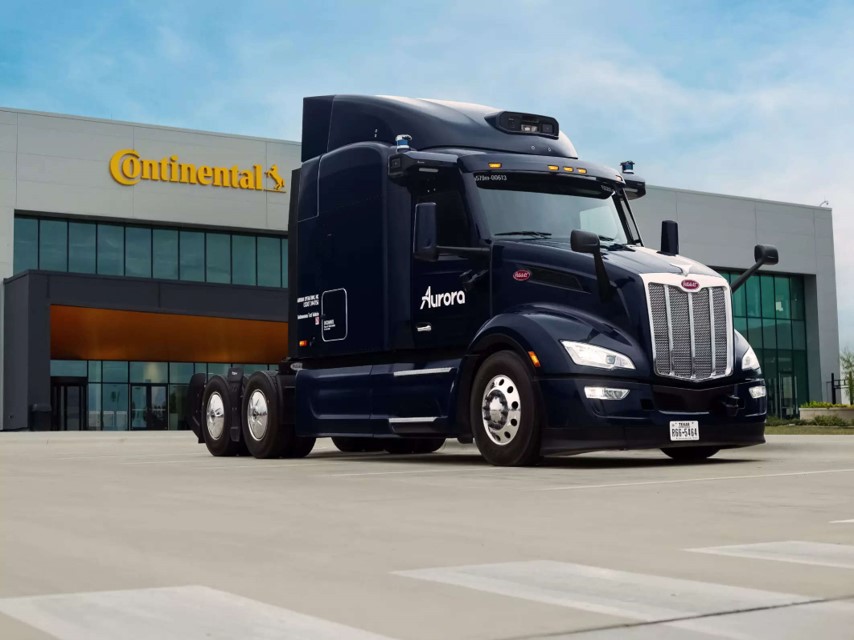
In a groundbreaking partnership set to revolutionize the trucking industry, self-driving technology company Aurora has joined forces with automotive manufacturing giant Continental to design a cutting-edge autonomous truck. The fruits of their collaboration will be unveiled at the highly anticipated Consumer Electronics Show (CES) in 2024, offering a tantalizing glimpse into the future of freight transportation.
The $300 million project marks a significant milestone in the commercialization of self-driving trucks, with the companies aiming to mass-produce the necessary hardware and deploy thousands of autonomous trucks on U.S. roads by 2027. This ambitious endeavor promises to transform the logistics landscape, ushering in a new era of efficiency, safety, and sustainability.
The Anatomy of an Autonomous Truck
At the heart of Aurora and Continental‘s achievement lies the successful completion of the design and system architecture for an autonomous vehicle hardware kit. This comprehensive package comprises a suite of advanced technologies, each playing a crucial role in enabling the truck to perceive, understand, and navigate its environment.
Sensor Suite: The Eyes and Ears of the Autonomous Truck
The autonomous hardware kit features a robust sensor suite that includes high-resolution radar, cameras, and lidar. The radar system, operating at 77 GHz, provides precise object detection and tracking capabilities, enabling the truck to identify and respond to obstacles at long ranges and in various weather conditions.
The camera system, consisting of multiple high-resolution cameras, serves as the primary visual perception tool. With advanced computer vision algorithms, the cameras can detect lane markings, traffic signs, and other critical road features, allowing the truck to maintain proper lane positioning and adhere to traffic rules.
Lidar, short for Light Detection and Ranging, is a key component of the sensor suite. By emitting laser pulses and measuring the time it takes for the light to bounce back, lidar creates a highly detailed 3D map of the truck‘s surroundings. This enables precise localization and obstacle detection, even in low-light conditions.
Computing Power: The Brains Behind the Operation
To process the vast amounts of data generated by the sensor suite, the autonomous hardware kit features high-performance computing systems. These systems, powered by advanced AI accelerators and GPUs, run the complex machine learning algorithms that enable the truck to interpret its environment and make real-time decisions.
The computing architecture is designed to handle the demanding workloads of autonomous driving, with redundant systems to ensure fail-safe operation. The primary computer is responsible for processing sensor data, running perception and planning algorithms, and controlling the vehicle‘s actuation systems. In the event of a primary system failure, a secondary fallback computer seamlessly takes over, ensuring uninterrupted operation and maintaining the highest levels of safety.
The Role of AI and Machine Learning
Artificial Intelligence (AI) and Machine Learning (ML) are the driving forces behind the development of the Aurora Driver, the self-driving software that powers the autonomous truck. The Aurora Driver relies on a combination of advanced ML techniques, including deep learning and reinforcement learning, to continuously improve its performance and adapt to new situations.
Deep learning, a subset of ML that uses artificial neural networks to model complex patterns in data, plays a crucial role in the perception system. Convolutional Neural Networks (CNNs) are used to process the camera and lidar data, enabling the truck to detect and classify objects, such as vehicles, pedestrians, and road signs, with high accuracy.
Reinforcement learning, another key ML technique, allows the Aurora Driver to learn from its own experiences and improve its decision-making capabilities over time. By simulating millions of driving scenarios and rewarding the system for making safe and efficient decisions, reinforcement learning enables the autonomous truck to handle a wide range of driving situations, including edge cases that may not be encountered during normal operation.
The Aurora Driver‘s ML models are trained on vast amounts of data collected from real-world driving and simulation. This data, which includes sensor readings, driver actions, and road conditions, is carefully annotated and used to train the models to recognize patterns and make accurate predictions. As the autonomous truck accumulates more data during operation, the models are continuously updated and refined, ensuring that the system remains at the forefront of autonomous driving technology.
The Economic and Environmental Impact of Autonomous Trucking
The adoption of autonomous trucking has the potential to bring about significant economic and environmental benefits. According to a report by the American Transportation Research Institute, the trucking industry is expected to experience a shortage of 100,000 drivers by 2023 [1]. Autonomous trucks could help alleviate this shortage by reducing the need for human drivers and enabling 24/7 operation.
In addition to addressing the driver shortage, autonomous trucking could lead to substantial cost savings for the industry. A study by the University of Michigan Transportation Research Institute estimates that self-driving trucks could reduce operating costs by 45%, primarily through savings on labor and fuel [2]. These cost reductions could translate into lower prices for consumers and increased competitiveness for businesses.
Autonomous trucking also has the potential to significantly reduce greenhouse gas emissions and improve air quality. The Environmental Protection Agency (EPA) states that heavy-duty trucks are responsible for 23% of all transportation-related greenhouse gas emissions in the United States [3]. By optimizing routes, reducing idling time, and enabling platooning (where multiple trucks travel closely together to reduce aerodynamic drag), autonomous trucks could substantially reduce fuel consumption and emissions.
The Regulatory Landscape and Safety Considerations
The deployment of autonomous trucks on public roads is subject to a complex regulatory landscape. In the United States, the National Highway Traffic Safety Administration (NHTSA) is responsible for regulating the safety of self-driving vehicles. While the NHTSA has released guidelines for the development and testing of autonomous vehicles, there are currently no federal laws specifically governing their operation.
At the state level, regulations vary widely. As of 2021, 29 states and Washington, D.C. have enacted legislation related to autonomous vehicles [4]. These laws range from permitting the testing of self-driving vehicles to establishing liability frameworks for accidents involving autonomous trucks.
To ensure the safe deployment of autonomous trucks, it is crucial to establish standardized safety and performance metrics. The Society of Automotive Engineers (SAE) has defined six levels of driving automation, with Level 0 representing no automation and Level 5 representing fully autonomous operation [5]. Aurora and Continental‘s autonomous truck is designed to operate at Level 4, meaning that it can perform all driving tasks under certain conditions, such as on highways and in fair weather.
As the industry progresses towards Level 5 autonomy, it will be essential to develop robust testing and validation procedures to ensure that autonomous trucks can operate safely in a wide range of conditions. This will require close collaboration between technology companies, manufacturers, regulators, and other stakeholders to establish clear guidelines and best practices.
The Competitive Landscape and Future Outlook
Aurora and Continental are not alone in their pursuit of autonomous trucking. Several other companies, including Waymo, TuSimple, and Embark, are also developing self-driving truck technology. The table below provides a comparison of the key players in the industry:
| Company | Funding (USD) | Partners | Target Deployment |
|---|---|---|---|
| Aurora | $1.2 billion | Continental, Volvo | 2024 |
| Waymo | $3.2 billion | Daimler, Renault-Nissan | 2023 |
| TuSimple | $648 million | Navistar, Traton | 2024 |
| Embark | $117 million | Anheuser-Busch, Frigidaire | 2024 |
As the autonomous trucking industry matures, we can expect to see increased partnerships and consolidation among key players. For example, in 2021, Aurora announced a partnership with Volvo to develop and deploy autonomous trucks on the Volvo platform [6]. Similarly, TuSimple has partnered with Navistar and Traton to manufacture autonomous-ready trucks and provide logistics services.
First-mover advantage and network effects will likely play a significant role in determining the success of autonomous trucking companies. As firms deploy their technology and establish relationships with shippers and carriers, they will be able to collect valuable data and refine their systems, creating a virtuous cycle of improvement and adoption.
Conclusion
Aurora and Continental‘s groundbreaking partnership and the successful completion of their autonomous truck hardware design mark a pivotal moment in the industry‘s evolution. By leveraging cutting-edge AI and ML technologies, they are paving the way for a future where self-driving trucks revolutionize the logistics landscape, delivering unprecedented levels of efficiency, safety, and sustainability.
As the companies prepare to showcase their achievement at CES 2024, it is clear that the future of freight transportation is rapidly approaching. While challenges remain, including regulatory hurdles and the need for standardized safety metrics, the potential benefits of autonomous trucking are too significant to ignore.
With visionary companies like Aurora and Continental leading the charge, we can be confident that the destination is within reach. As the industry continues to evolve, it will be crucial for all stakeholders—technology companies, manufacturers, regulators, and the public—to collaborate and adapt to the changing landscape. Only by working together can we ensure that the autonomous trucking revolution delivers on its promise of a safer, more efficient, and sustainable future for all.
References
-
American Transportation Research Institute. (2021). Critical Issues in the Trucking Industry – 2021. Retrieved from https://truckingresearch.org/wp-content/uploads/2021/10/ATRI-Top-Industry-Issues-2021.pdf
-
University of Michigan Transportation Research Institute. (2018). The Potential Impacts of Autonomous Vehicles on the Trucking Industry. Retrieved from https://umtri.umich.edu/sites/default/files/UMTRI-2018-22.pdf
-
Environmental Protection Agency. (2021). Fast Facts on Transportation Greenhouse Gas Emissions. Retrieved from https://www.epa.gov/greenvehicles/fast-facts-transportation-greenhouse-gas-emissions
-
National Conference of State Legislatures. (2021). Autonomous Vehicles | Self-Driving Vehicles Enacted Legislation. Retrieved from https://www.ncsl.org/research/transportation/autonomous-vehicles-self-driving-vehicles-enacted-legislation.aspx
-
Society of Automotive Engineers. (2021). Taxonomy and Definitions for Terms Related to Driving Automation Systems for On-Road Motor Vehicles. Retrieved from https://www.sae.org/standards/content/j3016_202104/
-
Aurora. (2021). Aurora and Volvo Group Partner to Develop and Commercialize Autonomous Transport Solutions. Retrieved from https://aurora.tech/blog/aurora-and-volvo-group-partner-to-develop-and-commercialize-autonomous-transport-solutions