AutoML: The Future of Machine Learning is Automated
Machine learning has transformed industries and become one of the most in-demand skills of the 21st century. However, developing high-quality ML models remains a complex and time-consuming endeavor, requiring expertise in a wide range of domains from data preprocessing and feature engineering to model selection, hyperparameter tuning, and MLOps.
Enter automated machine learning, or AutoML – a rapidly evolving field that aims to make the power of state-of-the-art ML accessible to both expert practitioners and citizen data scientists alike. By automating many of the most tedious and skill-intensive tasks in the ML workflow, AutoML has the potential to supercharge productivity, democratize AI, and revolutionize how organizations leverage their data.
In this post, we‘ll take a deep dive into the world of AutoML, tracing its evolution from early grid search techniques to today‘s sophisticated systems that leverage meta-learning and neural architecture search. We‘ll explore some of the most prominent open-source AutoML libraries in Python, comparing their performance on benchmark datasets and sharing tips and best practices for getting started. Finally, we‘ll look towards the future, considering how AutoML may reshape data science roles and processes in the years to come.
The Rise of AutoML
The concept of automating aspects of the machine learning process has been around for decades, but the field of AutoML as we know it today began to take shape in the early 2010s. One key milestone was the release of the seminal paper "Auto-WEKA: Combined Selection and Hyperparameter Optimization of Classification Algorithms" by Thornton et al. in 2013. This paper introduced Auto-WEKA, a system that used Bayesian optimization to automatically search for the best model and hyperparameters for a given dataset, built on top of the popular WEKA machine learning workbench.
In the years since, interest in AutoML has exploded, driven by the increasing complexity of ML systems, the scarcity of data science talent, and the pressure for businesses to operationalize AI at scale. A 2019 survey by KDnuggets found that 49% of data scientists and ML practitioners were using or planned to use AutoML tools, up from just 35% the previous year.
Today, AutoML encompasses a wide range of techniques and systems, from simple grid search and random search to more sophisticated approaches like Bayesian optimization, genetic programming, and meta-learning. The goal of these systems is to automate as much of the end-to-end ML process as possible, from data preparation and feature engineering to model selection, hyperparameter tuning, and evaluation.
How AutoML Works
At a high level, AutoML systems work by taking a dataset and a target metric as input, and outputting a trained model that maximizes that metric. To get there, they typically perform some combination of the following steps:
-
Data Preparation: Cleaning and preprocessing the raw data, handling missing values, and encoding categorical variables.
-
Feature Engineering: Selecting relevant features, transforming variables, and generating new synthetic features.
-
Model Selection: Choosing an appropriate model family for the problem, such as decision trees, neural networks, or support vector machines.
-
Hyperparameter Optimization: Tuning the model‘s hyperparameters, such as learning rate, regularization strength, or number of hidden layers, to maximize performance.
-
Evaluation: Assessing the model‘s performance using appropriate validation strategies, such as k-fold cross-validation or hold-out testing.
-
Ensemble Construction: Combining multiple models together into an ensemble to improve robustness and accuracy.
-
Deployment: Packaging the final model pipeline for deployment into a production environment.
Historically, each of these steps required significant time, expertise, and manual experimentation to get right. The promise of AutoML is to automate this process as much as possible, allowing users to go from raw data to deployed models in a matter of hours or even minutes, rather than weeks or months.
Under the hood, AutoML systems leverage a variety of optimization and search techniques to efficiently explore the vast space of possible models and hyperparameters for a given dataset. Some common approaches include:
- Grid Search: Exhaustively searching through a predefined set of hyperparameter values.
- Random Search: Randomly sampling hyperparameter configurations from a defined distribution.
- Bayesian Optimization: Using probabilistic models to balance exploration and exploitation in the search for optimal hyperparameters.
- Genetic Programming: Evolving model pipelines using principles of natural selection and genetic recombination.
- Meta-Learning: Leveraging knowledge learned from previous datasets and tasks to guide the search process and warm-start optimization.
More recently, cutting-edge AutoML systems have begun to incorporate even more advanced techniques like neural architecture search and transfer learning to push the boundaries of what‘s possible in automated ML pipelines.
Prominent AutoML Libraries in Python
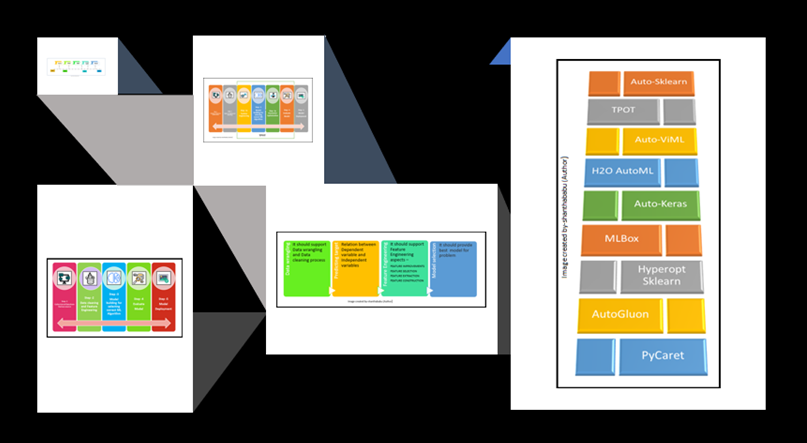
One of the key drivers behind the rise of AutoML has been the proliferation of powerful open-source libraries that make it easy for data scientists to leverage these techniques in their own workflows. In the Python ecosystem, some of the most prominent AutoML libraries include:
Auto-sklearn
Auto-sklearn is one of the most popular and widely-used AutoML libraries. It‘s built on top of the scikit-learn machine learning library and uses Bayesian optimization to automatically search for the best model and hyperparameters for a given dataset. Auto-sklearn supports a wide range of supervised learning problems, including classification, regression, and multi-label classification.
Under the hood, Auto-sklearn uses a meta-learning approach to warm-start the optimization process. It comes pre-trained on a large collection of datasets and leverages this knowledge to quickly identify promising model configurations for new datasets.
To give you a sense of Auto-sklearn‘s performance, here are some results from the AutoML Benchmark, which evaluates AutoML systems on a set of 39 diverse datasets:
| Metric | Auto-sklearn 2.0 | Random Forest | Logistic Regression |
|---|---|---|---|
| Accuracy | 0.823 | 0.778 | 0.775 |
| AUC | 0.869 | 0.825 | 0.821 |
| F1 | 0.657 | 0.600 | 0.597 |
As you can see, Auto-sklearn outperforms standard baseline models like Random Forest and Logistic Regression across a range of evaluation metrics.
If you‘re new to Auto-sklearn, I‘d recommend starting with their excellent documentation. It provides a gentle introduction to the library‘s API and walks through several end-to-end examples of using Auto-sklearn for classification and regression tasks.
TPOT
TPOT, short for Tree-based Pipeline Optimization Tool, is another popular open-source AutoML library in Python. It was developed by researchers at the University of Pennsylvania and uses genetic programming to automatically evolve machine learning pipelines for a given problem.
One of the key advantages of TPOT is its flexibility – it can construct complex pipelines that include data preprocessing, feature selection, and model stacking, in addition to model hyperparameter tuning. This allows TPOT to discover novel and creative solutions that might be missed by more narrowly focused AutoML systems.
TPOT has also shown impressive performance on a range of benchmarks. In a 2017 paper, the creators of TPOT evaluated it on 150 supervised classification tasks and found that it outperformed standard models like Random Forest and SVM on a majority of datasets.
To get started with TPOT, check out their Quickstart guide, which walks through the process of installing TPOT, loading data, and running the AutoML pipeline. One neat feature of TPOT is that it can export the final optimized pipeline as a standalone Python script, making it easy to integrate into your existing workflow.
H2O AutoML
H2O AutoML is part of the popular H2O open-source machine learning platform. Unlike Auto-sklearn and TPOT, which are focused primarily on traditional ML models, H2O AutoML supports a wide range of algorithms including gradient boosting machines, random forests, GLMs, and deep neural networks.
H2O AutoML uses a combination of random search and stacked ensembles to find optimal models for a given dataset. It also includes automated data preprocessing, feature generation, and model validation.
In terms of performance, H2O AutoML has consistently ranked among the top solutions in Kaggle competitions and industry benchmarks. In a 2020 benchmark of 30 Kaggle competitions, H2O AutoML achieved an average rank of 8.4, outperforming 91.6% of human competitors.
H2O provides extensive documentation and tutorials for getting started with their AutoML platform. One thing to note is that H2O uses its own proprietary data formats and APIs, so there may be a bit more of a learning curve compared to libraries like Auto-sklearn that integrate with familiar tools like pandas and scikit-learn.
The Future of AutoML
Despite the impressive advances in recent years, we‘re still in the early stages of AutoML‘s potential. As the field continues to evolve, here are some key trends and challenges to watch:
-
Scaling to Larger Datasets and Models: Many current AutoML systems struggle with very large datasets and complex model architectures. Improving the efficiency and scalability of search techniques is an active area of research.
-
Expanding Beyond Supervised Learning: Most AutoML libraries today focus on supervised tasks like classification and regression. Expanding to other problem domains like unsupervised learning, time series forecasting, and reinforcement learning is a natural next step.
-
Automating the Full ML Lifecycle: End-to-end AutoML pipelines that encompass data preparation, model building, deployment, and monitoring could help organizations achieve the full promise of AI operationalization.
-
Explainability and Interpretability: As AutoML systems become more complex and opaque, there‘s a growing need for techniques to explain and interpret their outputs. This is critical for building trust and meeting regulatory requirements.
-
Human-AI Collaboration: Rather than replacing data scientists entirely, the most successful AutoML systems will likely be those that enhance and empower human experts. Designing interfaces and workflows that support seamless collaboration will be key.
As these challenges are addressed, AutoML has the potential to revolutionize how organizations approach machine learning and AI. By democratizing access to state-of-the-art techniques and enabling experts to focus on higher-level strategy and problem formulation, AutoML could help unlock the full potential of data-driven insights and decision making.
Conclusion
AutoML represents an exciting frontier in machine learning, with the potential to accelerate and democratize the development of AI systems. By automating many of the most tedious and time-consuming aspects of the ML workflow, AutoML can help organizations achieve better results faster and at scale.
As we‘ve seen, Python users have access to a range of powerful open-source AutoML libraries, from scikit-learn-based tools like Auto-sklearn and TPOT to the more feature-rich H2O platform. While each library has its own strengths and use cases, they all share the common goal of making machine learning more accessible and effective.
Of course, AutoML is not a silver bullet, and there are still significant challenges and limitations to be addressed. Scaling to larger datasets, expanding to new problem domains, and improving explainability and human-AI collaboration are all active areas of research and development.
As a data scientist, I believe that AutoML is more likely to be an augmenting force than a replacing one. By abstracting away some of the low-level details of model tuning and selection, AutoML can free us up to focus on higher-level tasks like problem formulation, feature engineering, and results interpretation. Ultimately, the most successful organizations will be those that learn to combine the power of AutoML with the domain expertise and creativity of human experts.
If you‘re new to AutoML, I encourage you to dive in and start experimenting with some of the libraries we‘ve covered. Whether you‘re a seasoned ML practitioner or a business leader looking to harness the power of AI, AutoML offers a promising path forward. With the right tools and mindset, the future of machine learning is automated.