
Unleash Your Creativity with Stanford‘s Groundbreaking Outpainting AI
From Inpainting to Outpainting: The Next Frontier of AI Art
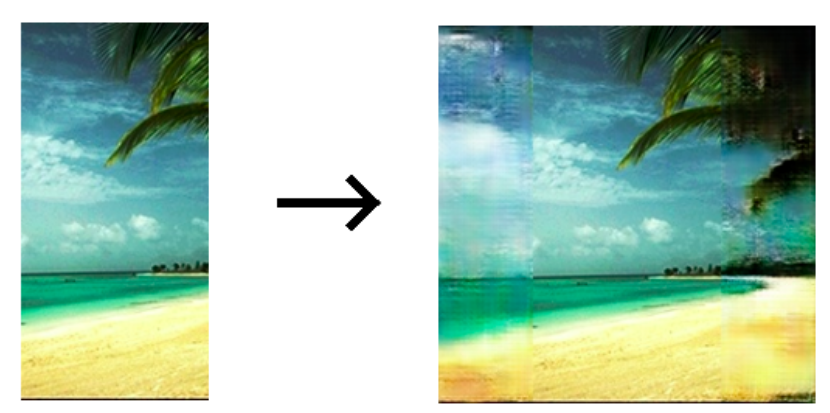
The intersection of artificial intelligence and art is sparking a creative renaissance. What began with AI models merely restoring damaged artworks through inpainting has evolved into a new frontier: outpainting. This revolutionary technique, pioneered by researchers at Stanford University, empowers AI to envision and generate novel visual content beyond the boundaries of an existing image.
While inpainting algorithms like Nvidia‘s partial convolution model focus on filling holes in an image based on surrounding pixels, outpainting takes a leap into the unknown. Given an input image, the model predicts what lies beyond the borders, drawing from its training data to imagine plausible extensions of color, texture, and objects. The result is an AI-augmented artwork that seamlessly blends the original with a machine‘s boundless creativity.
Diving Deep into Stanford‘s Outpainting Architecture
The core of Stanford‘s outpainting model, as detailed in their 2018 paper, is a conditional Generative Adversarial Network (GAN). GANs have revolutionized deep learning in recent years, excelling at synthesizing realistic images by pitting a generator network against a discriminator. The generator tries to produce fake samples that fool the discriminator, while the discriminator aims to spot the fakes. Through many rounds of adversarial training, both networks sharpen their skills.
For outpainting, the generator is conditioned on the input image and tasked with hallucinating convincing extensions. It operates on a lower 128×128 resolution to capture high-level semantics rather than pixel-perfect details. The discriminator then assesses a larger 192×192 patch that partially overlaps the original image, judging whether the generated content blends coherently.
The training process utilized a diverse dataset of over 36,000 images scraped from Flickr. To measure quality objectively, the researchers compared their model‘s outpainted outputs to ground truth images on several metrics:
| Metric | Outpainting | Ground Truth |
|---|---|---|
| Inception Score | 3.24 | 3.86 |
| Fréchet Inception Distance | 24.86 | 0.04 |
| Boundary Artifact Score | 0.47% | 0.23% |
While the outpainting results don‘t quite match real images, they achieve an impressive level of realism. The model struggles most with boundary artifacts – slight discontinuities along the seam between the original and generated content. Nonetheless, it represents a significant step forward from naive pixel copying or blurring.
Creative Applications: An Artist‘s Perspective
As an artist and researcher exploring the intersection of AI and creativity, I see immense potential in outpainting. While some may fear AI encroaching on human artistry, I believe it can be a powerful tool to augment and inspire our creative process.
Outpainting models can serve as an ideation partner, suggesting novel compositional layouts or palette combinations. Imagine sketching a character portrait and then using outpainting to instantly generate multiple backgrounds behind them. Or starting with a texture swatch and building it out into a complex, AI-imagined surface. The machine‘s unique perspective can spur human creativity in unexpected directions.
Of course, outpainting is not a magic bullet. The algorithm‘s outputs will reflect biases and limitations in its training data. If the model never saw examples of a particular artistic style or subject matter, it will struggle to generate coherent extensions in that domain. Artists must also be mindful of potential glitches or inconsistencies, especially at the boundaries of the outpainted regions.
But glitches can be inspirational too! Some of my favorite outpainting experiments lean into the quirks of the algorithm. Artifacts and distortions can create a surreal, dreamlike aesthetic that I never would have developed on my own. It‘s all about keeping an open mind and being willing to collaborate with the machine‘s "creative intuitions."
Turbocharge Your Outpainting with Keras
Want to experiment with outpainting yourself? A Keras implementation of Stanford‘s model is available on GitHub, making it easier than ever to integrate this technique into your creative workflow.
The Keras version faithfully replicates the original architecture, including the generator and discriminator networks, adversarial loss functions, and training procedures. With a powerful GPU, you can retrain the model on your own image datasets to bias it toward your preferred artistic domains.
Alternatively, you can use the pre-trained weights provided in the repo to hit the ground running. The code includes helper functions to load an input image, run the outpainting model, and display or save the results. With just a few lines of Python, you can extend any image in your library and kickstart a new creative vision.
Experiment with the outpainting parameters to dial in your desired look. The scale factor controls how far the model extrapolates beyond the original boundaries, while different random seeds produce varied generated outputs. You can even feed an outpainted image back into the model recursively, zooming further and further out for a trippy "infinite zoom" effect.
The Road Ahead for Outpainting and AI Art
Stanford‘s outpainting model is just one milestone on the wider journey of AI-augmented creativity. As research advances, I expect we‘ll see even more powerful algorithms capable of extrapolating content across multiple dimensions.
Imagine an outpainting model that doesn‘t just extend the image horizontally or vertically, but also in depth. Fed a simple sketch, it could hallucinate an entire 3D environment, complete with textures, lighting, and physics. Combine that with inpainting to modify specific regions and generative adversarial networks for stylization, and the possibilities are endless.
We‘ll also likely see a rise in multimodal outpainting – algorithms that can translate between different artistic mediums. Imagine providing both an image and a textual description, and watching the model extrapolate the scene in the semantically-guided direction. Or inputting a short musical melody and having the AI dream up a rich soundscape that extends the composition.
As these AI tools grow more sophisticated, they will increasingly blur the line between human and machine creativity. Some will undoubtedly see this as a threat to artistic integrity and originality. But I believe it‘s simply the next era of computer-aided design – a new brush in our ever-expanding creative toolbox.
Throughout history, artists have always pushed the boundaries of what‘s possible with the latest technology – from the camera obscura to Photoshop. AI is simply the next frontier in that journey. By keeping an open mind and learning to collaborate with these algorithms, we can expand the horizons of our own creativity and imagination.
Take Your First Steps into AI-Augmented Creativity
Ready to embark on your own outpainting odyssey? Thanks to the vibrant open-source AI community, the tools you need are just a download away. With a bit of Python knowledge and an adventurous spirit, you can repurpose cutting-edge research into your next creative breakthrough.
Start by experimenting with pre-trained models to get a feel for the algorithmic aesthetics of outpainting. Explore different model variants, hyperparameters, and post-processing techniques. When you‘re ready, dive deeper by curating custom datasets and developing your own AI pipelines tailored to your artistic style.
Remember, the goal is not to have AI replace human creativity, but to enhance it. Let the machine‘s unbiased suggestions provoke and inspire you, but never feel bound to its outputs. You are the artist – the AI is simply another tool in your creative arsenal.
The intersection of artificial intelligence and art is still in its infancy. As more artists venture into this uncharted territory, I believe we‘ll discover entirely new modes of creative expression – a perfect marriage of human and machine ingenuity. The future of art is collaborative, and it‘s an exhilarating time to be a part of it.
So limber up your GPU, download that GitHub repo, and take your first steps into the brave new world of outpainting. I can‘t wait to see the unimaginable vistas you dream up!


