The 10 Best Free Data Science Ebooks for 2026: An AI Expert‘s Picks

Data science is one of the fastest-growing and most in-demand fields today. According to the 2023 LinkedIn Jobs on the Rise list, data science roles like Machine Learning Engineer and Data Engineer are among the top 10 job titles with the highest growth rates over the past five years.
As the field evolves and the demand for data science skills continues to rise, it‘s more important than ever to stay up-to-date with the latest tools, techniques, and best practices. One of the best ways to do this is by learning from free online resources like ebooks.
In this post, I‘ll share my picks for the 10 best free data science ebooks for 2024, based on my experience as an AI and ML expert. Whether you‘re a beginner looking to learn the basics or an experienced practitioner seeking to deepen your knowledge, these ebooks offer comprehensive and practical guidance on key data science topics.
Why Free Ebooks are a Great Way to Learn Data Science
Before we dive into the top 10 list, let‘s discuss why free ebooks are such a valuable resource for learning data science:
-
Accessibility: Free ebooks are available to anyone with an internet connection, regardless of location or budget. This makes learning data science more accessible and inclusive.
-
Flexibility: With ebooks, you can learn at your own pace and on your own schedule. You can easily revisit concepts or jump ahead as needed.
-
Variety: There are free ebooks available on virtually every data science topic, from beginner-friendly intros to in-depth guides on advanced techniques. You can choose the ebooks that best fit your learning goals and skill level.
-
Hands-on learning: Many data science ebooks include code examples, exercises, and case studies to help you practice applying the concepts you learn. This hands-on approach is essential for building practical skills.
-
Trusted sources: By choosing ebooks from reputable authors and publishers, you can be confident that you‘re learning from reliable and high-quality sources.
Of course, ebooks are just one of many ways to learn data science. They can be a great complement to other resources like online courses, tutorials, projects, and textbooks. The key is to find the learning resources that work best for you and to keep practicing and applying what you learn.
How I Chose the Best Free Data Science Ebooks
To select the top 10 free data science ebooks for 2024, I considered the following criteria:
- Comprehensive coverage of key data science topics, from basics to advanced techniques
- Practical examples and hands-on exercises to reinforce learning
- Clear explanations and high-quality writing
- Trusted authors and publishers with expertise in data science and AI/ML
- Positive reviews and recommendations from the data science community
- Available formats like PDF, EPUB, and Jupyter notebooks for easy access
Based on these criteria, here are my top picks for the best free data science ebooks, along with a detailed review of each one.
1. Python Data Science Handbook by Jake VanderPlas

If you want to learn how to use Python for data science, the Python Data Science Handbook is the perfect place to start. Written by Jake VanderPlas, a data science expert and core contributor to the scikit-learn library, this free ebook provides a comprehensive introduction to the most essential tools in the Python data science stack, including:
- NumPy for numerical computing and array operations
- Pandas for data manipulation and analysis
- Matplotlib for data visualization
- Scikit-Learn for machine learning
What sets this book apart is its focus on real-world examples and hands-on coding. Each chapter includes Jupyter notebooks with code examples and exercises that you can run and modify yourself. This interactive format makes it easy to learn by doing and see the concepts in action.
Whether you‘re a beginner or an experienced Python user looking to apply your skills to data science, the Python Data Science Handbook is an invaluable resource. With clear explanations, practical examples, and engaging visualizations, it‘s no wonder this book has become a go-to reference for Python-based data science.
2. R for Data Science by Hadley Wickham and Garrett Grolemund

If you prefer using R for data science, R for Data Science is the free ebook for you. Written by Hadley Wickham and Garrett Grolemund, two leading experts in the R community, this book provides a comprehensive introduction to data science with R and the tidyverse.
The tidyverse is a collection of R packages designed for data science, including ggplot2 for data visualization, dplyr for data manipulation, and tidyr for data tidying. By focusing on these packages, R for Data Science teaches you a consistent and powerful approach to working with data in R.
The book covers the full data science workflow, from importing and tidying data to visualizing and modeling it. You‘ll learn how to:
- Wrangle data into a consistent format with tidyr and dplyr
- Explore data with visualizations using ggplot2
- Model data with statistical techniques like regression and clustering
- Communicate results with R Markdown reports and dashboards
With clear explanations, tons of examples, and exercises to test your knowledge, R for Data Science is the perfect resource for learning how to do data science with R. Whether you‘re new to R or an experienced user looking to take your skills to the next level, this book has something for you.
3. Interpretable Machine Learning by Christoph Molnar
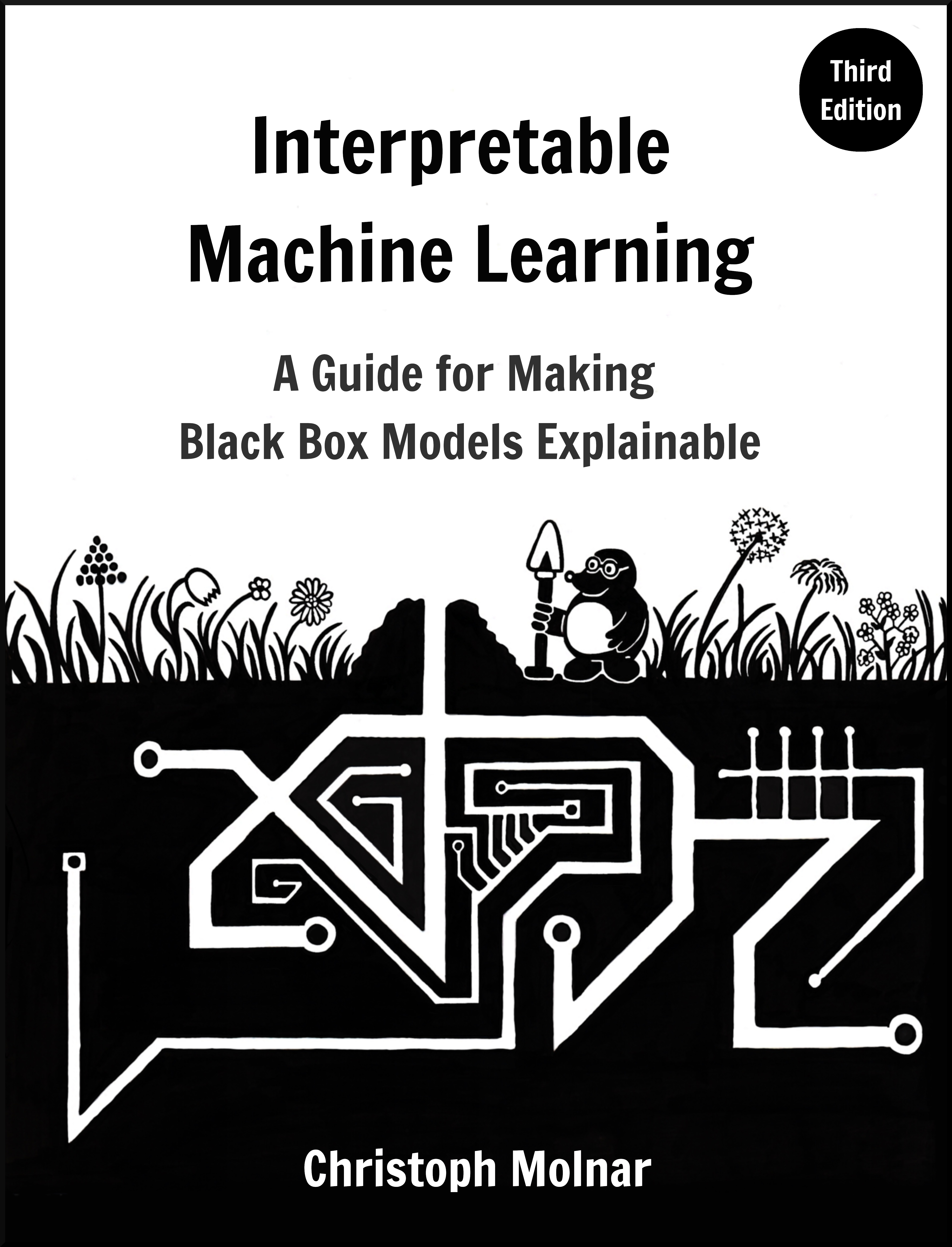
Machine learning models are increasingly being used to make high-stakes decisions in areas like healthcare, finance, and criminal justice. But many of these models are "black boxes" that are difficult to interpret and explain. This lack of transparency can lead to biased or unethical decisions and erode trust in AI.
Interpretable Machine Learning is a free ebook that tackles this challenge head-on. Written by Christoph Molnar, a researcher and consultant specializing in ML interpretability, this book provides a comprehensive guide to techniques for understanding and explaining complex machine learning models.
The book covers a wide range of topics related to interpretable ML, including:
- Model-agnostic methods like permutation feature importance and partial dependence plots that can be used with any type of ML model
- Model-specific methods like decision tree visualization and linear regression coefficients that are tailored to certain model types
- Example-based explanations like local interpretable model-agnostic explanations (LIME) and Shapley values that explain individual predictions
- Evaluation of interpretation methods and discussion of the trade-offs between interpretability and performance
- Guidance on how to communicate interpretations to stakeholders and use them to inform decision-making
With clear explanations, Python code examples, and references to the latest research, Interpretable Machine Learning is an invaluable resource for anyone working with ML models in high-stakes applications. Whether you‘re a data scientist, researcher, or policymaker, this book will help you understand and explain your models in a way that is transparent, accountable, and ethical.
4. Deep Learning by Ian Goodfellow, Yoshua Bengio, and Aaron Courville

Deep learning has revolutionized fields like computer vision, natural language processing, and robotics in recent years. If you want to understand the theory and practice of deep learning, the Deep Learning ebook is the ultimate free resource.
Written by three pioneers in the field – Ian Goodfellow, Yoshua Bengio, and Aaron Courville – this comprehensive textbook covers the foundations and advanced techniques of deep learning, including:
- Linear algebra and probability theory prerequisites
- Feedforward neural networks and backpropagation
- Convolutional networks for image recognition
- Recurrent networks for sequence modeling
- Techniques for training and regularizing deep models
- Applications to computer vision, natural language processing, speech recognition, and more
What makes this book unique is its blend of theory and practice. In addition to rigorous mathematical explanations of core concepts, the book includes pseudocode and links to runnable code examples in Python and TensorFlow. It also discusses practical considerations like hardware and software for deep learning, as well as research frontiers and perspectives on the future of the field.
While the book is quite technical and assumes a strong math background, it is an essential reference for anyone serious about deep learning. Whether you‘re a researcher, practitioner, or student, Deep Learning will give you a solid foundation in this transformative technology.
5. The Data Science Handbook by Field Cady
The Data Science Handbook is a free ebook that provides a comprehensive overview of the key concepts, skills, and tools needed to succeed in data science. Written by Field Cady, a data scientist and author, the book covers the full data science lifecycle, from data acquisition and exploration to modeling and communication.
What I like about this book is its practical and hands-on approach. Each chapter includes real-world examples, case studies, and code snippets in Python and R that bring the concepts to life. The book also emphasizes the importance of soft skills like communication, teamwork, and ethics in data science.
Some of the key topics covered in the book include:
- Data acquisition and storage with SQL, NoSQL, and distributed systems
- Data exploration and visualization with Python and R libraries
- Feature engineering and selection techniques
- Machine learning algorithms and evaluation metrics
- Model deployment and monitoring in production systems
- Data storytelling and presentation skills
The book also includes a chapter on the future of data science, discussing emerging trends like cloud computing, deep learning, and data ethics.
Whether you‘re a student, professional, or manager working with data, The Data Science Handbook is a valuable resource for learning the core concepts and skills needed to succeed in this field. With its practical approach and engaging writing style, it‘s a great way to deepen your understanding of data science and take your skills to the next level.
Other Notable Free Data Science Ebooks
In addition to the top 5 picks above, here are some other excellent free data science ebooks worth checking out:
-
Think Stats by Allen B. Downey: A concise and accessible introduction to statistics and probability with Python code examples.
-
Bayesian Methods for Hackers by Cameron Davidson-Pilon: A hands-on introduction to Bayesian inference and probabilistic programming with PyMC3.
-
An Introduction to Statistical Learning by Gareth James, Daniela Witten, Trevor Hastie, and Robert Tibshirani: A gentle introduction to statistical learning methods like linear regression, classification, and resampling with applications in R.
-
Mining of Massive Datasets by Jure Leskovec, Anand Rajaraman, and Jeff Ullman: A comprehensive guide to the algorithms and techniques used to extract insights from massive datasets, with examples in MapReduce and Spark.
Conclusion
In this post, we‘ve explored some of the best free data science ebooks available in 2024. From comprehensive introductions to Python and R to in-depth guides on deep learning and interpretable ML, these books offer a wealth of knowledge and practical skills for anyone looking to learn data science.
But reading books is just the beginning. To truly become proficient in data science, you need to apply what you learn to real-world projects and keep practicing your skills. Here are some tips for making the most of these ebooks:
-
Code along with the examples: Most of these books include code examples in Python, R, or other languages. To get the most out of them, try running the code yourself and experimenting with different parameters and datasets.
-
Work through the exercises: Many of the books also include exercises and problem sets to test your understanding. Don‘t skip these! They‘re a great way to reinforce your learning and identify areas where you need more practice.
-
Apply what you learn to your own projects: Once you‘ve worked through the examples and exercises, try applying the techniques to your own datasets and problems. This will help you develop your problem-solving skills and build a portfolio of data science projects.
-
Join a community of learners: Learning data science can be challenging, especially if you‘re doing it on your own. Consider joining a community of learners, such as a meetup group or online forum, where you can ask questions, get feedback, and learn from others.
-
Keep learning: Data science is a rapidly evolving field, with new tools and techniques emerging all the time. To stay current, make a habit of reading blogs, attending conferences, and taking online courses to keep learning and growing your skills.
As an AI and ML expert, I believe that continuous learning is essential for success in data science. By taking advantage of free resources like these ebooks and committing to ongoing practice and growth, you can build the skills and knowledge you need to solve real-world problems and advance your career in this exciting field.
What are your favorite free data science ebooks? Let me know in the comments below!