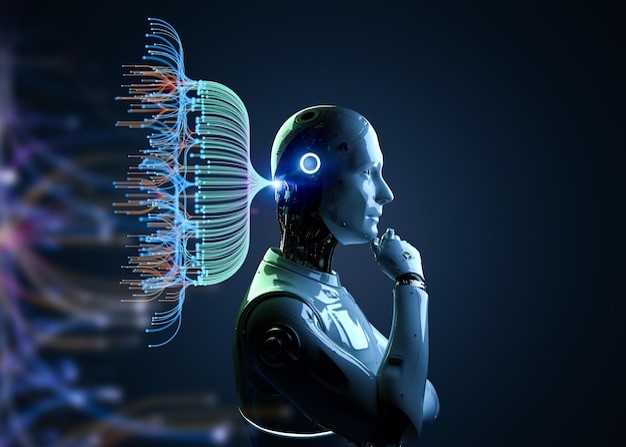
Can AI Unlock the Door to Digital Immortality? Probing the Promise and Perils of Afterlife Tech
The quest to extend human life beyond its biological limits has captivated scientists, philosophers, and dreamers for millennia. But in recent years, this age-old pursuit has taken on a distinctly digital flavor.
Armed with exponentially advancing AI and a deepening understanding of the brain‘s workings, a growing chorus of researchers and tech leaders now believe that the key to cheating death lies not in the realm of flesh and blood, but in circuits and code. Their audacious goal: to upload human consciousness to machines, allowing our minds to live on long after our bodies have returned to dust.
Mapping the Mind: The State of Brain Emulation Science
The vision of liberating the mind from its mortal coil has long been a staple of science fiction. But according to some experts, recent breakthroughs in neuroscience and computing have brought it closer to reality than ever before.
"I absolutely believe mind uploading will be possible, and my guess is that it will happen within the next half century," says Dr. Randal Koene, neuroscientist and founder of the brain emulation research nonprofit Carboncopies. "Every year we‘re mapping the brain in greater detail and building AIs that can mimic its functions more precisely."
Indeed, initiatives like the Human Brain Project and BRAIN Initiative are producing stunningly detailed models of brain tissue and neural activity, while AI systems are becoming increasingly adept at complex cognitive tasks. In one recent study, published in the journal Nature in April 2023, scientists were able to create a digital twin of the 100,000-neuron brain of a fruit fly, successfully simulating its feeding behaviors.
Still, most researchers caution that these advances, while significant, are a far cry from uploading human-level intelligence. Our brains are staggeringly complex information processors, containing around 86 billion neurons and 100 trillion synapses. Mapping this vast biological network and replicating it digitally is a monumental undertaking.
"Emulating even a single neuron in a computer requires immense computational resources," says Dr. Anil Seth, professor of cognitive and computational neuroscience at the University of Sussex. "To do that for an entire human brain, you‘re looking at a machine that‘s thousands or millions of times more powerful than anything that exists today."
By some estimates, digitally simulating the human brain‘s raw processing power could require anywhere from 1018 to 1025 FLOPS – or up to a billion times more than the world‘s current fastest supercomputer. And that‘s not accounting for the brain‘s complex web of biochemical processes, which many believe are integral to cognition.
"There are major unsolved problems in duplicating human intelligence," says Dr. Kenneth Miller, professor of neuroscience at Columbia University. "It‘s not just about mapping the connectome – there‘s the molecular level, the level of synaptic transmission, neuromodulators, plasticity, and more. The idea that we can abstract the mind from the nitty-gritty of biology is highly questionable."
Second Life: Visions of a Mind-Uploaded Future
Supposing these Herculean technical challenges can be overcome, what might a world of uploadable consciousness look like? Proponents paint a rapturous picture of life unshackled from the limits of biology – a realm where minds can flit between robotic bodies or virtual realities at the speed of thought, where death is a relic of a meatbound past.
"In an uploaded world, you could make a backup of your mind and store it in the cloud," says Koene. "If something happened to your physical instantiation, you could simply load into a new substrate. Humans could live for hundreds or thousands of years."
This digital afterlife could take many forms, from immersive VR environments to disembodied ‘infomorphs‘ exploring the depths of cyberspace. Relationships too might undergo a radical shift, as people could merge minds, fork copies of themselves, or even have their consciousness fragmented across multiple platforms.
"Uploading would represent a fundamental change in the human condition," says Dr. Anders Sandberg, philosopher and senior research fellow at Oxford‘s Future of Humanity Institute. "Our current notions of identity, individuality, life and death – all of these could be upended."
But not everyone is convinced that this mind-uploading future would be a utopia. Critics raise concerns about the psychological toll of existing as disembodied code, the potential for mind hacking or deletion, and the specter of radical inequality between uploaded and ‘legacy‘ humans.
"If uploading becomes a reality, it‘s likely that only the wealthy and privileged will have access to it, at least initially," says Dr. Michael Cerullo, psychiatrist and lecturer on neurotechnology at Harvard Medical School. "The divide between biological and digital humans could be one of the defining inequities of the 21st century."
There are also deeper philosophical questions about whether an uploaded copy of a mind would truly be continuous with the original person, or just a very sophisticated imitation. Some thinkers, like philosopher John Searle, have argued that computationally simulating a brain would not necessarily reproduce subjective conscious experience.
"Imagine a computer running a perfect simulation of the neural activity in my brain," Searle writes in his famous ‘Chinese Room‘ thought experiment. "That simulation might be able to engage in intelligent conversation, but there‘s no more reason to think it‘s consciously experiencing anything than to think a complex AI language model is."
The Allure and the Angst: Public Opinion on Digital Resurrection
As the science of brain emulation advances and the debate over mind uploading heats up, what does the public make of these heady visions? Surveys suggest that while many find the idea intriguing, just as many have deep reservations.
In a 2022 Pew Research poll, 46% of US adults said they would be interested in using AI technology to interact with a digital recreation of a deceased loved one. But an equal percentage said they would not, with many expressing unease about the emotional and ethical implications.
"I don‘t think I could handle talking to an AI version of my mother," said one respondent. "It would just be too painful, knowing it‘s not really her. I think it‘s healthier to let the dead stay dead."
Others worry that the technology could be used to exploit vulnerable people or manipulate the bereaved for profit. "I can see this being used by scammers to extract money or information from grieving families," said another survey taker. "It just seems like it could so easily cross a line."
Ethicists tend to share many of these concerns, even as they recognize the powerful allure of communing with lost loved ones. "There‘s a profound human desire to maintain connection with the deceased," says Dr. Caitlin Doughty, mortician and author of Will My Cat Eat My Eyeballs? "But attempting to recreate them digitally raises all kinds of thorny questions about privacy, consent, and the rights of the dead."
Seeking Solace in Silicon: AI Companions for the Grieving
For some, though, the promise of AI-enabled afterlives is simply too compelling to resist. In Japan, where an aging population and plummeting birth rates have left many older people living and dying alone, some are turning to digital companions to fill the void.
Kanae Date, an 84-year-old resident of Tokyo, interacts daily with an AI hologram of her late husband, created by startup Gatebox. "It‘s not the same as having him here physically," she tells me over Zoom. "But just being able to hear his voice, to see his face, it‘s a tremendous comfort in my old age."
As AI grows more sophisticated, these digital ghosts are likely to become increasingly lifelike. Generative AI tools like Anthropic‘s Claude and Google‘s PaLM 2 language model are already demonstrating remarkable proficiency at mimicking human writing styles and knowledge domains. It‘s not hard to imagine similar systems being trained on a deceased person‘s data trail to create uncanny simulacra.
"With enough information about an individual – their writings, their photos, their online interactions – you could potentially create an AI model that replicates key aspects of their personality, their unique mannerisms and thought patterns," says Dr. Bruce Duncan, Managing Director of the Terasem Movement Foundation, which researches mind uploading and AI immortality.
"It would be like a very advanced Replika or Dadbot," he says, referring to popular AI companion apps. "An eternally patient confidant who shares your memories and can offer you words of comfort and wisdom, even after you‘re gone."
The Undiscovered Country: Seeking Immortality in the Present
In the end, while the dream of digital resurrection may be alluring, the reality is still a long way off. Even if we manage to artificially replicate human intelligence, many experts doubt that a computer could ever truly capture the ineffable essence of a human mind.
"Saying you can upload a person‘s consciousness to a machine is a bit like saying you can capture the beauty of a sunset in a spreadsheet," says Dr. Susan Schneider, NASA chair of astrobiology and director of the AI, Mind and Society Group at the University of Connecticut. "You might be able to record the raw sensory data, but the felt experience, the qualia, would be lost."
Perhaps, then, the healthiest approach is to engage with the idea of digital immortality as a thought-provoking "what if" – one that invites us to reflect more deeply on the preciousness and fragility of our current existence.
After all, the average human lifespan is a mere 4,000 weeks – a blip against the unfathomable expanse of cosmic time. Faced with that humbling fact, perhaps the wisest path is not to rage against the dying of the light, but to embrace the shadow that gives the light its meaning.
"We‘re all going to die, but that‘s what makes life beautiful – its very impermanence," says Schneider. "The knowledge that our time is fleeting is what spurs us to cherish each moment, to live with purpose and urgency and love."
So while it‘s natural to yearn for more time, to dream of a world where we can hold onto our loved ones forever, perhaps true immortality is found not in silicon and code, but in the trace we leave on the world in the brief, incandescent miracle of the lives we lead.
In the words of poet Mary Oliver: "To live in this world, you must be able to do three things: to love what is mortal; to hold it against your bones knowing your own life depends on it; and, when the time comes to let it go, to let it go."