
Can You Change Tire Size? A Safe Comparison Guide
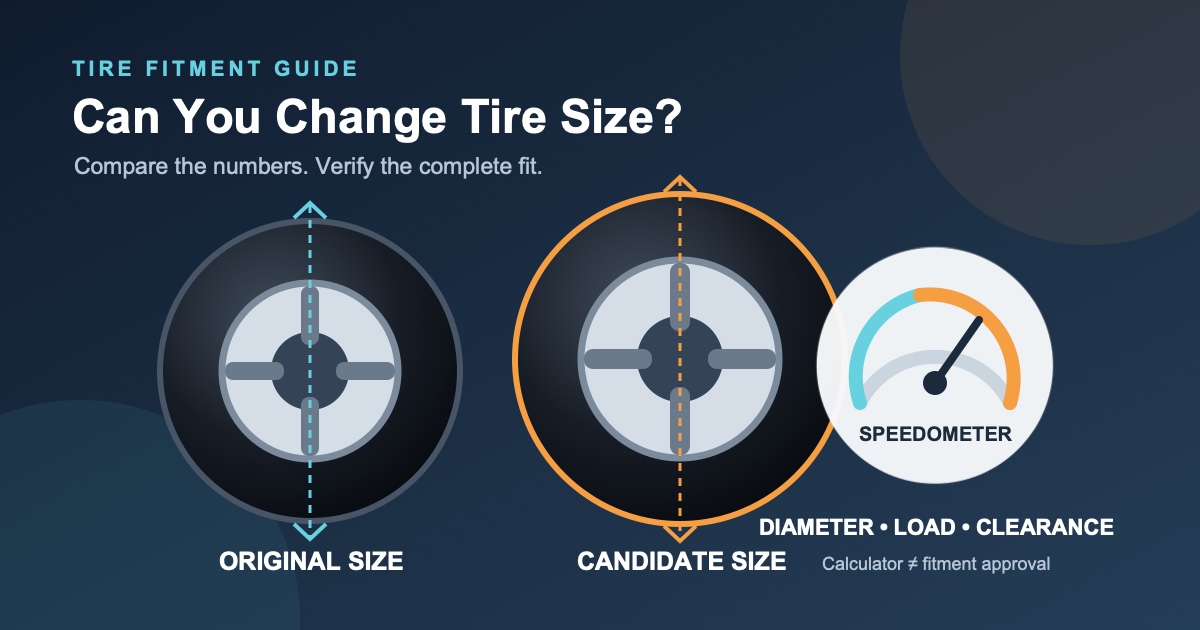
You can sometimes change tire size, but a size that looks close on paper is not automatically safe for your vehicle. The new tire must fit the wheel, clear the suspension and body through the vehicle's full range of movement, carry the required load, meet the appropriate speed capability, and work correctly with the vehicle's braking and stability systems.
The safest starting point is always the size printed on the Tire and Loading Information label in the driver's door area or listed in the owner's manual. The National Highway Traffic Safety Administration recommends replacing tires with the same size as the originals or another size recommended by the vehicle manufacturer. A comparison calculator can help you understand the geometry of a proposed change, but it cannot certify fitment.
This guide explains how tire-size codes work, what changes when overall diameter changes, how to compare two sizes, and which checks must happen before you buy.
Can You Put a Different Tire Size on Your Car?
Possibly. Manufacturers sometimes approve more than one wheel-and-tire package for the same model, trim, or market. A vehicle offered with 16-inch and 17-inch factory wheels, for example, may use different tire codes that produce similar overall diameters. This is often called plus sizing: the wheel diameter increases while the sidewall becomes shorter enough to keep the complete tire close to the original rolling diameter.
That does not mean any tire that fits a 17-inch wheel is a suitable replacement for another 17-inch tire. Tire codes combine several measurements, and changing one number can alter overall diameter, section width, sidewall height, revolutions per mile, and clearance. Load index, speed rating, tire construction, and wheel-width requirements add further constraints that a simple diameter comparison does not resolve.
For a standard replacement, follow the vehicle manufacturer's approved sizes. If you are considering a non-listed size, have a qualified tire professional verify the complete wheel-and-tire combination for your exact vehicle, trim, axle configuration, load, and use.
Start With the Vehicle Placard, Not the Old Tire
The old tire mounted on a used vehicle is not always proof of the correct specification. A previous owner may already have changed wheels or tires. Instead, look for the Tire and Loading Information label on the driver's door edge, doorjamb, or B-pillar, and check the owner's manual.
NHTSA's TireWise guidance says these sources identify the correct tire size and the vehicle manufacturer's recommended cold inflation pressure. NHTSA also warns that the pressure molded into a tire sidewall is not the vehicle's recommended operating pressure. The sidewall figure is a tire limit; the placard pressure is the vehicle manufacturer's specification for the approved fitment.
Some vehicles use different front and rear sizes or pressures. Others have packages that vary by trim, engine, brake size, or suspension. Record the complete front and rear specifications before comparing alternatives.
How to Read a Tire Size
Consider the common code 225/60R16 98H. Each section tells you something different:
- 225 is the nominal section width in millimeters.
- 60 is the aspect ratio. The sidewall height is nominally 60% of the section width.
- R indicates radial construction.
- 16 is the wheel or rim diameter in inches.
- 98 is the load index, which corresponds to a standardized load capacity.
- H is the speed rating symbol.
The first three numbers are enough to estimate unloaded tire geometry, but they are not the whole replacement specification. A candidate with a similar calculated diameter can still have an inadequate load index, an unsuitable speed rating, or a section width that does not match the wheel or available clearance.
What a Tire Size Comparison Calculates
For a metric tire code, estimated sidewall height is:
Section width in millimeters × aspect ratio ÷ 100
Estimated overall diameter is:
Wheel diameter in millimeters + two sidewall heights
Because wheels are specified in inches, multiply the wheel diameter by 25.4 to convert it to millimeters. Circumference is approximately overall diameter multiplied by pi. Those measurements allow you to compare revolutions per mile and estimate the direction and size of speedometer error.
You can enter the original and candidate codes into this tire size comparison calculator to see their dimensions side by side. Use the original placard size as the baseline. The result is a screening tool: it can show that two options are far apart, but it cannot prove that a candidate clears your vehicle or meets its engineering requirements.
A Worked Tire Size Comparison
Suppose the original tire is 225/60R16 and you are considering 235/55R17.
For the 225/60R16:
- Sidewall height: 225 × 0.60 = 135 mm
- Wheel diameter: 16 × 25.4 = 406.4 mm
- Estimated overall diameter: 406.4 + 135 + 135 = 676.4 mm
For the 235/55R17:
- Sidewall height: 235 × 0.55 = 129.25 mm
- Wheel diameter: 17 × 25.4 = 431.8 mm
- Estimated overall diameter: 431.8 + 129.25 + 129.25 = 690.3 mm
The candidate is about 13.9 mm larger in diameter, or approximately 2.05%. Its radius is about 6.95 mm greater, so static ground clearance would rise by roughly that amount before accounting for real tire construction, tread, load, and pressure.
If the vehicle's speed calculation remained calibrated to the original tire, the larger circumference would make the vehicle travel slightly farther per wheel revolution. An indicated 60 mph would be approximately 61.2 mph in this simplified calculation. Actual dashboard behavior can differ because vehicles use different sensors, calibration strategies, and tolerances.
This example only compares nominal geometry. It does not tell you whether the 235 tire fits the wheel width, rubs at full steering lock, contacts the body under suspension compression, meets the axle load requirement, or is approved by the vehicle manufacturer.
Why Overall Diameter Matters
Changing rolling diameter changes how far the vehicle travels for each wheel revolution. That can affect speedometer and odometer readings. A larger tire generally makes actual road speed higher than the indicated speed if the system is not recalibrated; a smaller tire generally does the opposite.
Diameter can also affect effective gearing. A larger rolling radius makes the gearing effectively taller, which may reduce engine speed at a given road speed but can also reduce acceleration or make transmission behavior feel different. A smaller diameter produces the opposite tendency.
Modern vehicles may compare wheel-speed signals for anti-lock braking, traction control, stability control, all-wheel-drive operation, and tire-pressure monitoring. The consequences depend on the vehicle and on whether all four tires change together. Mixing substantially different rolling circumferences across axles can be especially problematic on some all-wheel-drive systems. Follow the owner's manual and manufacturer instructions.
Width and Clearance Matter Too
A wider tire can contact suspension components on the inside or the fender liner and body on the outside. Clearance must be checked with the steering turned in both directions and with the suspension moving through its usable travel. A tire that clears while parked on level ground can still rub over a bump, during hard cornering, or with passengers and cargo aboard.
Wheel width and offset influence where the tire sits. Two tires with the same nominal width can also measure differently when mounted because published dimensions vary by model, measuring rim, construction, and inflation. Use the tire manufacturer's specification sheet for the exact model, including its approved rim-width range and measured dimensions.
Do not assume extra space around the current tire is permission to use all of it. Snow chains, mud accumulation, alignment variation, body tolerances, steering movement, and tire growth at speed may require additional clearance.
Load Index and Speed Rating Are Safety Checks
Load index is not optional fine print. It represents the tire's standardized load capacity under specified conditions. NHTSA has stated that replacement tires should have at least the equal maximum load rating of the original tires. A candidate that matches diameter but carries less load is not an equivalent replacement.
Speed rating also describes a tested capability under defined conditions. It is not a recommendation to drive at that speed, and it does not override speed limits or safe conditions. When selecting a replacement, follow the vehicle manufacturer's requirements for speed rating as well as size and load capacity.
Service descriptions must be evaluated with the exact tire type. Passenger-metric, Euro-metric, and light-truck tires can use different load and inflation conventions. Moving between these systems may require professional load-equivalency calculations and different pressures; matching only the numbers printed before the load index is not enough.
Do Not Use the Tire Sidewall's Maximum PSI as Your Target
A tire-size change often leads drivers to ask whether they should simply use the maximum pressure shown on the new tire. They should not. NHTSA directs drivers to the vehicle placard or owner's manual for the recommended cold pressure, not the maximum pressure on the tire sidewall.
If a vehicle manufacturer approves an alternate size, use its specified pressure for that fitment. If you are engineering a non-listed combination, pressure depends on load capacity, tire construction, axle loads, and the approved load-and-inflation data. That is a job for the vehicle or tire manufacturer and a qualified professional, not a guess based on appearance.
Can You Change Only Two Tires?
Replacing two tires does not create permission to change size on one axle. Many vehicles require matching sizes on all four positions unless they were designed with a staggered setup. Differences in rolling circumference can affect wheel-speed comparisons and driveline operation.
If only two tires are being replaced, follow the owner's manual and the tire manufacturer's installation guidance. The new pair should match the required size and service description, and the remaining tires must still be safe. On four-wheel-drive and all-wheel-drive vehicles, allowable tread-depth or circumference differences may be tightly limited.
A Pre-Purchase Tire Size Checklist
- Record the placard specification. Note front and rear sizes, recommended cold pressures, and vehicle load information.
- Check the owner's manual. Look for approved alternate sizes, staggered fitments, chain restrictions, and AWD tire-matching rules.
- Compare nominal geometry. Review width, sidewall, diameter, circumference, and estimated speed difference.
- Verify the exact tire. Check its load index, speed rating, approved rim-width range, measured dimensions, and intended service.
- Verify the wheel. Rim diameter must match exactly; width, offset, bolt pattern, center bore, load rating, and brake clearance also matter when wheels change.
- Check physical clearance. Account for steering, suspension compression, cargo, passengers, chains, and real-world tolerances.
- Check vehicle systems. Confirm effects on TPMS, ABS, stability control, AWD, gearing, speedometer, and odometer.
- Get professional confirmation. Ask a qualified tire dealer or the vehicle manufacturer to approve the complete setup before purchase.
Common Tire Size Comparison Mistakes
One mistake is treating a percentage guideline as a universal approval rule. You may see informal recommendations to stay within a certain diameter percentage, but a small diameter difference does not guarantee clearance, load capacity, or manufacturer approval.
Another is comparing only wheel diameter. A 17-inch tire does not fit a 16-inch wheel, regardless of how similar their outer diameters appear. The number after R must match the wheel diameter exactly.
A third mistake is ignoring the service description. Two sizes can produce nearly identical diameters while having different load indexes or speed ratings. The replacement still has to support the vehicle safely.
Finally, do not rely on a generic photograph or another driver's report as proof. Trim level, wheel offset, alignment, suspension modifications, tire model, and actual use can change fitment.
Frequently Asked Questions
Will a different tire size affect the speedometer?
It can. A different circumference changes distance traveled per wheel revolution. Larger tires generally make actual speed higher than indicated if the vehicle is not recalibrated, while smaller tires generally make it lower. Vehicle-specific behavior varies.
Can I put a wider tire on the same rim?
Only if the exact tire's approved rim-width range includes that wheel and the mounted tire has adequate clearance and load capacity. Confirm with the tire manufacturer and a qualified installer.
Is the same overall diameter enough?
No. Diameter is only one screen. Width, wheel compatibility, load index, speed rating, pressure requirements, clearance, and vehicle-system compatibility still need verification.
Where do I find my car's correct tire size?
Check the Tire and Loading Information label on the driver's door area and the owner's manual. NHTSA recommends the original size or another size recommended by the vehicle manufacturer.
Should I inflate replacement tires to the PSI on the sidewall?
No. Use the vehicle manufacturer's recommended cold pressure from the placard or owner's manual for an approved fitment. The tire sidewall displays a maximum value, not the vehicle's routine target pressure.
The Bottom Line
A tire-size calculator is excellent for translating codes into useful dimensions and exposing potential speedometer differences. It is not a substitute for the vehicle placard, owner's manual, manufacturer specifications, or a professional fitment check.
Start with an approved size. If you are considering an alternative, compare the geometry, then verify load capacity, speed rating, wheel compatibility, clearance, inflation requirements, and vehicle-system effects. The right replacement is not merely the tire whose numbers are closest; it is the complete setup that remains safe and appropriate for your vehicle.


