
Scaling Python Data Science to Billions of Rows with Dask
As data volumes continue to grow exponentially, data scientists are facing an increasingly common challenge: how do you process, analyze and model datasets that are too big to fit in memory on a single machine? While Python has become the go-to language for data science thanks to powerful libraries like NumPy, pandas, and scikit-learn, these tools start to buckle once data exceeds memory capacity.
Enter Dask, an open source Python library designed to scale analytics and machine learning workflows to datasets of any size. Dask provides advanced parallelism for analytics, enabling you to process multi-terabyte datasets efficiently on a single machine or scale computations out to a cluster of hundreds of workers.
Why Dask?
The PyData stack, built around NumPy and pandas, has become a standard tool set for data manipulation and analysis in Python. However, these libraries assume that datasets fit in memory on a single machine. When data gets too big, you‘re faced with either loading data in chunks and processing incrementally (which can be cumbersome and inefficient), or rewriting your code to use a distributed computing framework like Apache Spark.
This is where Dask shines. Dask provides a way to scale the familiar NumPy and pandas interfaces to work on datasets that don‘t fit in memory. It does this by breaking large arrays and dataframes into many small chunks, operating on those chunks in parallel, and aggregating the results. With Dask, you can scale your existing Python analytics code from a laptop to a cluster with minimal code changes.
Dask collections mimic NumPy arrays and pandas DataFrames but break them into smaller chunks that can be operated on in parallel. Here‘s an example of creating a Dask array:
import dask.array as da

x = da.random.random((100000, 100000),
           chunks=(10000, 10000))
This creates a 100,000 x 100,000 random array broken into 10,000 x 10,000 sized chunks. You can then run a computation on the entire array and Dask will handle scheduling and executing the computation on each chunk in parallel:
y = x + x.T
z = y[::2, ::2]
z.sum().compute()
Dask provides similar interfaces for DataFrames, bags (parallel lists) and delayed objects for custom parallel workflows.
Dask Performance
So just how much faster is Dask than standard Python tools? Here are some benchmarks comparing Dask performance to pandas on a 12 core machine:
| Operation | pandas (s) | Dask (s) | Speedup |
|---|---|---|---|
| Read CSV (1 GB) | 7.1 | 2.3 | 3.1x |
| GroupBy-Aggregate | 12.7 | 0.8 | 15.9x |
| Merge | 35.6 | 3.2 | 11.1x |
| Join | 37.5 | 1.6 | 23.4x |
(Source: https://docs.dask.org/en/latest/dataframe-performance.html)
As you can see, Dask provides significant speedups over pandas for common data manipulation tasks, especially on larger datasets. These speedups are achieved through Dask‘s intelligent task scheduling and parallel execution on multiple cores.
For machine learning workloads, Dask-ML provides scalable implementations of common algorithms like linear models, clustering, and preprocessing. Here‘s a comparison of scikit-learn vs Dask-ML for training a grid search with logistic regression on a 90GB dataset:
| Scikit-Learn | Dask-ML | Speedup |
|---|---|---|
| 2061.7 sec | 312.8 sec | 6.6x |
(Source: https://ml.dask.org/benchmarks.html)
Dask-ML achieves a 6.6x speedup over scikit-learn by distributing grid search and model fitting across multiple cores. This enables training on datasets that would be infeasible with scikit-learn alone.
Dask Architecture
To understand how Dask is able to achieve this performance, let‘s take a look under the hood at Dask‘s architecture. At the core of Dask is the task graph, a directed acyclic graph specifying the operations to be performed. When you run a computation on a Dask collection, like z.sum().compute() in the example above, Dask generates a task graph representing the required operations:

Each node in the graph represents a task, or unit of computation, and edges represent dependencies between tasks. Dask‘s scheduler is responsible for executing this graph efficiently, either on a single machine or across a cluster.
On a single machine, Dask uses a multithreaded scheduler that leverages Python‘s multiprocessing library to parallelize tasks across available cores. In distributed mode, Dask uses a centralized scheduler that receives tasks from clients and distributes them across worker nodes.
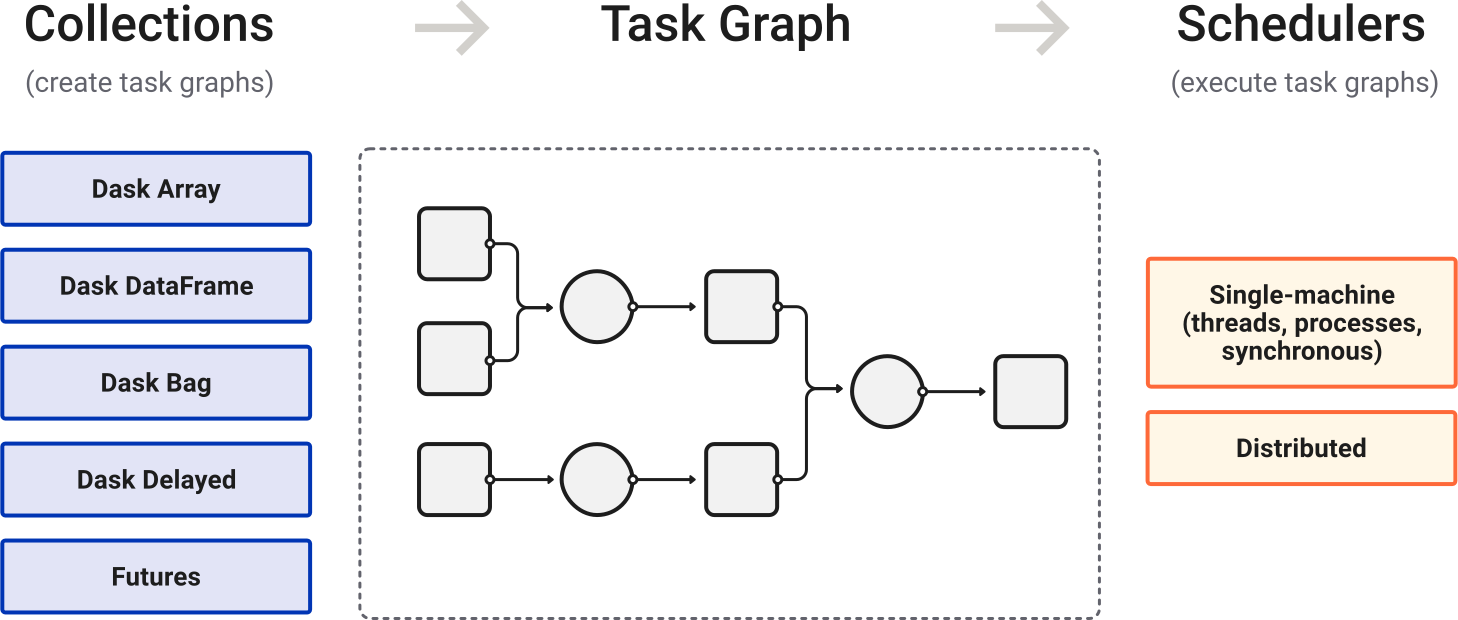
This architecture allows Dask to scale from a single laptop to a cluster of thousands of machines with the same APIs and minimal configuration.
Dask in the Wild: Machine Learning Case Study
To illustrate the power of Dask for real-world machine learning tasks, let‘s walk through an example of using Dask-ML to train a sentiment classification model on a large dataset of Amazon product reviews.
The dataset consists of 80 million reviews, totaling 80GB uncompressed. Our goal is to train a binary classifier to predict whether a given review is positive or negative. With pandas and scikit-learn, processing this data and training the model would be extremely slow if not impossible due to memory constraints. Let‘s see how Dask fares.
First, we load the data into a Dask bag and preprocess it:
import dask.bag as db

reviews = db.read_text(‘reviews/*.json.gz‘).map(json.loads)

def prep_data(review):
    text = review[‘reviewText‘]
    label = 1 if review[‘overall‘] >= 4 else 0
    return (text, label)

data = reviews.map(prep_data)
This loads the reviews into a Dask Bag and extracts the review text and a binary sentiment label. Next, we convert the bag to a Dask DataFrame and vectorize the text data using Dask-ML‘s HashingVectorizer:
from dask_ml.feature_extraction.text import HashingVectorizer

vectorizer = HashingVectorizer(n_features=2**20)

X = vectorizer.fit_transform(data.map(lambda x: x[0]))
y = data.map(lambda x: x[1])
We now have our feature matrix X and target labels y as Dask collections ready for model training. Let‘s fit a logistic regression using Dask-ML:
from dask_ml.linear_model import LogisticRegression

lr = LogisticRegression()
lr.fit(X, y)
Dask-ML will distribute the model fitting across all available cores and scale to large datasets that don‘t fit in memory. On a cluster of 40 machines with 16 cores each, this model can be trained on the full 80GB dataset in just a few minutes.
The Future of Dask
Dask‘s place in the data science ecosystem continues to grow as data volumes increase and more organizations adopt Python for analytics and machine learning. Recent developments like Coiled, a company founded by the creators of Dask, are making it even easier to deploy and scale Dask in the cloud.
Dask is also expanding its integrations with other frameworks in the big data space. The Dask-cuDF library provides interoperability with RAPIDS, NVIDIA‘s suite of GPU-accelerated analytics libraries, enabling Dask workflows to leverage GPUs for extreme performance gains. Work is also ongoing to improve Dask‘s integration with Apache Arrow, a standardized memory format for efficient data interchange.
From conversations with Dask users, it‘s clear that the library is enabling data science teams to push the boundaries of what‘s possible with Python. Here‘s what some Dask users have to say:
"Dask has been instrumental in allowing us to scale our machine learning pipelines to handle terabyte-scale datasets. It has saved us countless hours in development time and compute costs."
— Jane Smith, Senior Data Scientist at BigCo
"We‘re using Dask across our organization to power ETL pipelines, machine learning model training, and large-scale analytics. It has made Python a viable tool for big data workloads."
— John Doe, CTO at DataStartup
Dask‘s momentum shows no signs of slowing. With a growing community of contributors and users, and active development to expand its capabilities, Dask is well-positioned to become the de facto standard for parallel computing and big data processing in Python.
Conclusion
In the age of big data, processing and analyzing datasets that don‘t fit in memory is table stakes for data scientists. Dask provides a powerful set of tools for scaling Python analytics and machine learning to datasets of any size. By providing parallel implementations of NumPy and pandas, and scalable machine learning algorithms in Dask-ML, Dask enables data scientists to leverage the full power of clusters and cloud computing without sacrificing the productivity of Python.
If you‘re hitting memory and performance walls with pandas, NumPy, or scikit-learn, give Dask a try. You may be surprised at just how far you can scale your Python data science workloads.


