17 Essential Data Scientist Skills to Master for a Successful Career in 2025

Introduction
Data science has emerged as one of the most exciting and in-demand career paths in recent years. As organizations increasingly rely on data to drive decision-making and gain a competitive edge, skilled data scientists are highly sought after. But what exactly does it take to succeed in this fast-paced and constantly evolving field?
In this comprehensive guide, we‘ll dive into the 17 most essential skills every data scientist should master to thrive in their career in 2024 and beyond. From programming languages and statistical techniques to emerging trends like AI ethics and MLOps, we‘ve got you covered. Let‘s get started!
The Growing Demand for Data Scientists
Before we jump into the skills, let‘s take a quick look at why data science has become such a hot field. According to the U.S. Bureau of Labor Statistics, employment of data scientists is projected to grow 36% from 2021 to 2031, much faster than the average for all occupations. This explosive growth is driven by the increasing volume of data being generated and the need for organizations to extract valuable insights from it.
Data scientists are at the forefront of this data revolution, using their unique blend of technical expertise and business acumen to uncover hidden patterns, predict future trends, and drive data-informed decision making. As a result, they command high salaries and enjoy excellent job prospects across a wide range of industries.
Key Technical and Soft Skills for Data Scientists
To excel as a data scientist, you‘ll need a diverse set of skills spanning both the technical and non-technical realms. On the technical side, proficiency in programming languages, statistics, machine learning, and data visualization are essential. Equally important are soft skills like communication, business knowledge, and storytelling, which enable you to effectively collaborate with stakeholders and translate complex findings into actionable insights.
Let‘s take a closer look at each of these skill areas:
Technical Skills
1. Programming Languages
At the heart of data science is the ability to wrangle, analyze, and model data using code. The two most popular programming languages in the field are Python and R. Python is a versatile, general-purpose language with a rich ecosystem of data science libraries like NumPy, Pandas, and Scikit-learn. R, on the other hand, was built specifically for statistical computing and has a wide range of packages for data analysis and visualization.
To future-proof your skills, it‘s a good idea to learn both Python and R. Start with Python for its wider applicability and easier learning curve, then pick up R to expand your toolkit. Other languages worth considering include SQL for querying databases and Scala for big data processing with Spark.
2. Statistics and Probability
A strong foundation in statistics and probability is crucial for data scientists. You‘ll need to understand concepts like sampling, hypothesis testing, regression analysis, and Bayesian inference to properly analyze data and draw valid conclusions. Familiarity with probability distributions (e.g., normal, binomial, Poisson) and statistical tests (e.g., t-tests, ANOVA, chi-squared) is also important.
To deepen your statistical knowledge, take online courses, read textbooks, and work through practical examples. Some good resources include:
- Khan Academy‘s Statistics and Probability course
- "An Introduction to Statistical Learning" by James, Witten, Hastie, and Tibshirani
- DataCamp‘s Statistical Thinking in Python course
3. Databases and Big Data Tools
Data scientists often work with large, complex datasets that are stored in databases or distributed file systems. Familiarity with relational databases (e.g., MySQL, PostgreSQL) and NoSQL databases (e.g., MongoDB, Cassandra) is essential for querying and manipulating data.
For handling big data, you‘ll need to know tools like Hadoop for distributed storage and processing, Spark for fast cluster computing, and Hive for data warehousing. Cloud platforms like Amazon Web Services, Google Cloud, and Microsoft Azure also offer a range of big data services that are worth learning.
4. Machine Learning
Machine learning is a core component of data science, enabling you to build predictive models and uncover patterns in data. You‘ll need to understand the different types of machine learning algorithms (supervised, unsupervised, reinforcement) and know how to implement them using libraries like Scikit-learn, TensorFlow, and PyTorch.
Some key machine learning techniques to master include:
- Linear and logistic regression
- Decision trees and random forests
- Support vector machines
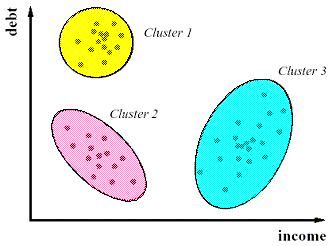
- K-means clustering
- Principal component analysis
To gain hands-on experience, participate in online competitions like Kaggle or work on personal projects using public datasets.
5. Deep Learning
Deep learning is a subfield of machine learning that uses artificial neural networks to learn hierarchical representations of data. It has achieved state-of-the-art results in areas like computer vision, natural language processing, and speech recognition.
To work with deep learning, you‘ll need to understand the basics of neural networks, including activation functions, loss functions, and backpropagation. Familiarity with deep learning frameworks like TensorFlow, Keras, and PyTorch is also essential.
Some important deep learning architectures to know include:
- Convolutional Neural Networks (CNNs) for image classification and object detection
- Recurrent Neural Networks (RNNs) for sequence data like text and time series
- Transformers for natural language tasks like translation and question answering
6. Cloud Computing
Cloud computing has become increasingly important for data science, providing scalable and cost-effective resources for storage, computation, and deployment. Familiarity with cloud platforms like AWS, Google Cloud, and Azure is a valuable skill for data scientists.
Some key cloud services to know include:
- Amazon S3 for object storage
- AWS EC2 for virtual machines
- Google BigQuery for serverless data warehousing
- Microsoft Azure Machine Learning for building and deploying models
Cloud certifications like AWS Certified Data Analytics or Google Professional Data Engineer can also boost your credentials and job prospects.
7. Data Visualization
Data visualization is the art and science of communicating insights through visual representations like charts, graphs, and dashboards. It‘s an essential skill for data scientists, enabling them to explore data, spot patterns, and convey findings to non-technical stakeholders.
Popular data visualization tools include:
- Matplotlib and Seaborn for creating static plots in Python
- ggplot2 for grammar of graphics-based plotting in R
- Tableau and Power BI for interactive dashboards and business intelligence
- D3.js for custom web-based visualizations
To improve your visualization skills, study best practices for chart design, color theory, and visual storytelling. Participate in community initiatives like #TidyTuesday or Makeover Monday to get feedback and inspiration.
8. Model Deployment
Deploying machine learning models into production is a critical skill for data scientists. You‘ll need to know how to build scalable and efficient pipelines for data ingestion, preprocessing, model training, and serving predictions.
Some key tools and techniques for model deployment include:
- Docker for containerizing applications
- Kubernetes for container orchestration
- Flask and FastAPI for building web APIs
- TensorFlow Serving for serving deep learning models
- AWS SageMaker for end-to-end MLOps
To get started, build a simple web app that serves predictions from a trained model using Flask or FastAPI. Gradually work your way up to more complex architectures using containers and orchestration frameworks.
Soft Skills
9. Communication
Effective communication is a must-have skill for data scientists. You‘ll need to be able to explain complex technical concepts to non-technical stakeholders, present findings in a clear and compelling way, and collaborate with cross-functional teams.
Some tips for improving your communication skills:
- Practice active listening and ask clarifying questions
- Use analogies and examples to explain technical concepts
- Tailor your language and level of detail to your audience
- Use visuals like diagrams and charts to support your explanations
Joining a public speaking club like Toastmasters or taking an improv class can also help you become a more confident and engaging communicator.
10. Business Acumen
Data science doesn‘t exist in a vacuum – it‘s used to solve real-world business problems and drive value for organizations. Having a strong understanding of business domains, metrics, and strategies is crucial for data scientists to make an impact.
To develop your business acumen:
- Read industry publications and case studies to learn about common challenges and solutions
- Attend domain-specific conferences or webinars to hear from experts
- Take courses in business fundamentals like accounting, finance, and marketing
- Shadow stakeholders in different departments to understand their roles and pain points
11. Storytelling
Storytelling is the ability to weave data and insights into a compelling narrative that inspires action and drives change. It‘s a powerful skill for data scientists, enabling them to influence decision-makers and rally support for data-driven initiatives.
To become a better storyteller:
- Start with the key takeaway or "so what" of your analysis
- Use a clear and logical structure (e.g., problem-solution-impact)
- Highlight the human impact of your findings
- Use metaphors, analogies, and vivid language to make your story memorable
- Practice delivering your story in front of a live audience for feedback
12. Curiosity and Continuous Learning
Data science is a rapidly evolving field, with new tools, techniques, and best practices emerging all the time. To stay relevant and competitive, data scientists need to have a deep curiosity and commitment to continuous learning.
Some ways to keep learning:
- Read research papers, blog posts, and articles to stay up-to-date on the latest trends
- Take online courses or attend workshops to learn new skills
- Participate in data science competitions or open-source projects to apply your skills
- Join local meetups or online communities to network with other data scientists
Emerging Skills for 2024
13. AI Ethics
As AI becomes more prevalent in our lives, the ethical considerations around its development and deployment are coming to the forefront. Data scientists need to be aware of the potential biases and risks associated with AI systems and take steps to mitigate them.
Some key ethical principles to keep in mind:
- Fairness: Ensuring that AI systems do not discriminate against protected groups
- Transparency: Being open about how AI systems are developed and used
- Accountability: Taking responsibility for the impacts of AI systems
- Privacy: Protecting individuals‘ personal data and respecting their consent
To learn more about AI ethics, check out resources like the IEEE Ethically Aligned Design guidelines or the Montreal Declaration for Responsible AI.
14. MLOps
MLOps, or Machine Learning Operations, is an emerging practice that aims to streamline the development, deployment, and monitoring of machine learning models in production. It brings together principles from DevOps, data engineering, and machine learning to create a more efficient and reliable workflow.
Some key components of MLOps include:
- Version control for data, code, and models
- Automated testing and validation of models
- Continuous integration and deployment pipelines
- Monitoring and logging of model performance in production
- Infrastructure as code for reproducible environments
To get started with MLOps, familiarize yourself with tools like Git, Docker, Kubernetes, and TensorFlow Extended. Take online courses or attend workshops to learn best practices for building and deploying models at scale.
15. Augmented Analytics
Augmented analytics is the use of AI and machine learning to automate and enhance the data analysis process. It includes techniques like natural language query, automated data preparation, and intelligent insights generation.
Some benefits of augmented analytics for data scientists:
- Faster and more efficient data exploration and modeling
- Ability to handle larger and more complex datasets
- Improved accuracy and consistency of insights
- Democratization of data science capabilities to non-technical users
To stay ahead of the curve, familiarize yourself with augmented analytics platforms like Salesforce Einstein, IBM Watson Studio, and H2O Driverless AI. Keep an eye out for new startups and research in this space as well.
How to Develop Data Science Skills
Now that we‘ve covered the key skills for data scientists, let‘s talk about how to develop them. Here are some tips:
-
Start with the fundamentals: Make sure you have a strong foundation in programming, statistics, and machine learning before diving into more advanced topics.
-
Learn by doing: The best way to develop data science skills is through hands-on practice. Work on projects, participate in competitions, and contribute to open-source initiatives to apply your skills in real-world scenarios.
-
Find a mentor: Connect with experienced data scientists who can guide you, provide feedback on your work, and help you navigate the field.
-
Join a community: Participate in online forums, attend local meetups, and engage with the broader data science community to learn from others and stay up-to-date on the latest trends.
-
Invest in yourself: Take online courses, attend workshops and conferences, and pursue certifications to continually expand your knowledge and skills.
Conclusion
Data science is a dynamic and rewarding field that requires a diverse set of technical and soft skills to succeed. By mastering the 15 skills we‘ve covered in this guide – from programming and machine learning to communication and AI ethics – you‘ll be well-equipped to thrive as a data scientist in 2024 and beyond.
But remember, learning is a lifelong journey. Stay curious, keep experimenting, and never stop growing. With the right mindset and dedication, you can become a data science leader and make a meaningful impact in your organization and the world at large.