7 Essential NoSQL Databases Every Data Scientist Must Know in 2025
Introduction
As a data scientist, having a solid understanding of databases is crucial. While traditional SQL relational databases still dominate, the rise of big data has led to the widespread adoption of NoSQL databases in recent years. NoSQL databases offer greater flexibility, scalability, and performance compared to their SQL counterparts, making them well-suited for handling the massive volumes of structured and unstructured data being generated today.
By 2024, it‘s estimated that the world will generate 149 zettabytes of data annually. To put that in perspective, if each gigabyte of data were a brick, we could build 258 Great Walls of China with the data produced in just one year! NoSQL databases have emerged as the go-to solution for storing and managing this data deluge.
As a data scientist, being familiar with the leading NoSQL databases is not optional—it‘s a necessity. These databases are ubiquitous in industry and you‘ll be working extensively with them for data collection, storage, and analysis. NoSQL will also be a hot topic in data science job interviews.
In this article, we‘ll take a deep dive into the world of NoSQL. First, we‘ll clarify what NoSQL databases are and highlight their key advantages. Next, we‘ll explore the four main types of NoSQL databases. Finally, we‘ll survey seven of the most popular NoSQL databases today, examining their key features, main use cases, and notable companies using them in production. By the end, you‘ll have a solid primer on the NoSQL landscape and be ready to confidently work with these powerful databases.
What are NoSQL Databases?
NoSQL stands for "not only SQL". Contrary to popular belief, NoSQL is not synonymous with non-relational. While most NoSQL databases are non-relational, the term NoSQL actually refers to databases that use a different data model than the traditional tabular schema of SQL relational databases.
Some key characteristics of NoSQL databases include:
- Schema-less: Most are schema-less, allowing you to store data without first defining a rigid structure
- Non-relational: Most do not use the tabular schema of rows and columns used by SQL databases
- Distributed: Designed to scale horizontally across clusters of machines
- Open-source: Most popular NoSQL databases are open-source
- Flexible: Easily accommodate unstructured, semi-structured, and structured data
NoSQL databases have several advantages over SQL databases:
- Greater scalability
- Improved flexibility
- Better performance
- Built for big data
- Less complex and easier to set up
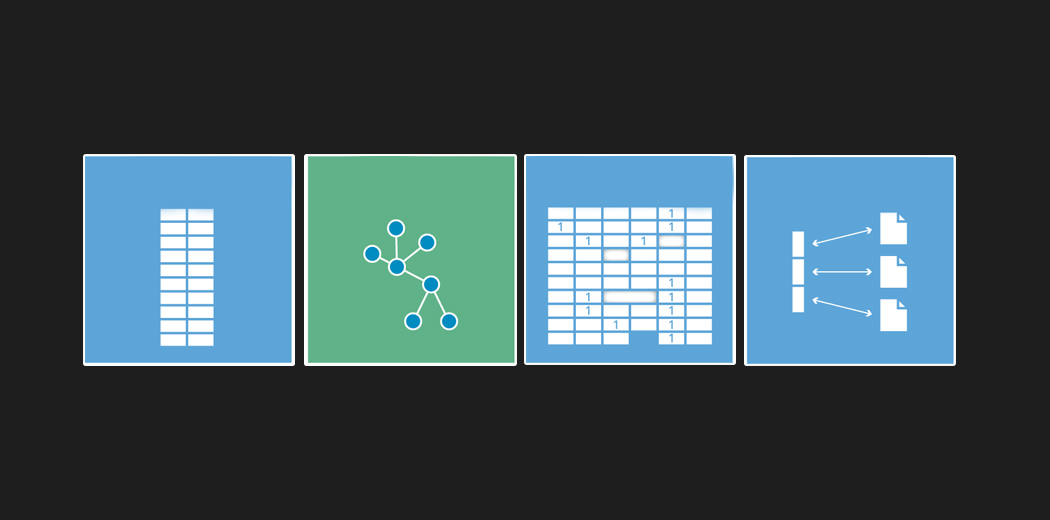
There are four main types of NoSQL databases:
- Document-based
- Key-value
- Wide column
- Graph-based
Let‘s examine each type in turn.
1. Document-Based Databases
Document-based databases store data in documents, typically in a semi-structured JSON or XML format. Each document contains key-value pairs—the key is the name of a field, while the value is the data stored in that field. Documents can have different structures, allowing for flexible schemas.
Some popular document-based databases include:
- MongoDB
- Couchbase
- Apache CouchDB
Document databases work well for content management systems, real-time web apps, and other use cases dealing with semi-structured data. They make it easy to map application objects to database objects.
2. Key-Value Databases
Key-value databases are a simple type of NoSQL database that store data as a collection of key-value pairs. The key serves as a unique identifier and the value can be anything from a string to a complex object. Key-value databases are known for their blazing-fast performance.
Some popular key-value databases are:
- Redis
- Amazon DynamoDB
- Riak
Key-value databases are often used for caching, session management, real-time analytics, and message queues. Their simple model makes them easy to scale.
3. Wide Column Databases
Also known as column family databases, wide column stores organize data into columns instead of rows. Related columns are grouped into column families. Each row can have a different number of columns, allowing for flexible schemas and efficient storage of sparse data.
Leading wide column databases include:
- Cassandra
- HBase
- Google Bigtable
Wide column databases work well for time series data, historical records, high-write workloads, and other applications requiring fast writes and efficient storage.
4. Graph Databases
Graph databases use graph structures to store data as nodes, edges, and properties. Nodes represent entities, edges represent relationships between entities, and properties are attributes of nodes and edges. Graph databases excel at managing heavily interconnected data.
Popular graph databases include:
- Neo4j
- Amazon Neptune
- OrientDB
Graph databases are ideal for social networks, recommendation engines, fraud detection, and network analysis. They allow you to efficiently traverse relationships and uncover patterns.
7 Essential NoSQL Databases
Now that we‘ve covered the four main types of NoSQL databases, let‘s take a closer look at seven of the most widely used NoSQL databases today.
1. MongoDB

MongoDB is the most popular document-based database. It stores data in flexible, JSON-like documents, making it easy to evolve schemas and accommodate varying data structures. MongoDB provides extensive querying, indexing, and aggregation capabilities along with built-in replication and sharding for high availability and horizontal scalability.
Key features:
- Flexible document model
- Powerful query language
- Secondary indexes
- Aggregation framework
- Automatic sharding
Main use cases:
- Real-time applications
- Content management
- Geospatial data
- Hybrid cloud apps
- Agile development
Notable users: Uber, eBay, Adobe, Coinbase, Sega
2. Redis

Redis is the most popular key-value database and is often used as a high-performance in-memory cache. All Redis data resides in-memory, enabling sub-millisecond response times. Redis supports a wide range of data structures including strings, hashes, lists, sets, and more. It also offers pub/sub messaging, Lua scripting, and automatic partitioning.
Key features:
- In-memory dataset
- Blazingly fast performance
- Rich data structures
- Pub/Sub messaging
- Lua scripting
Main use cases:
- Caching
- Real-time analytics
- Message queues
- Leaderboards
- Session storage
Notable users: Twitter, GitHub, Pinterest, Snapchat, Craigslist
3. Cassandra

Cassandra is the most widely used wide column database. Originally developed at Facebook, it‘s designed to handle massive amounts of structured data across commodity servers. Cassandra offers continuous availability, linear scalability, and operational simplicity. Its masterless "ring" architecture allows it to scale to thousands of nodes with no single point of failure.
Key features:
- Masterless architecture
- Linear scalability
- Tunable consistency
- Flexible data model
- Fast writes
Main use cases:
- Time series data
- Sensor data
- Messaging
- High-volume web apps
- Real-time personalization
Notable users: Apple, Netflix, Instagram, Spotify, Uber
4. DynamoDB

DynamoDB is a fully managed NoSQL database offered by Amazon Web Services. It‘s a multi-region, multi-master database that provides consistent single-digit millisecond latency at any scale. DynamoDB supports both key-value and document data models. It offers enterprise-grade security, automatic scaling, and ACID transactions.
Key features:
- Multi-region replication
- Serverless
- ACID transactions
- Automatic scaling
- Encryption at rest
Main use cases:
- Ad tech
- Gaming
- Retail
- Banking and finance
- Media and entertainment
Notable users: Lyft, Airbnb, Nike, Capital One, Netflix
5. Elasticsearch

Elasticsearch is a distributed search and analytics engine built on top of Apache Lucene. It allows you to store, search, and analyze massive volumes of data quickly and in near real-time. Elasticsearch is document-oriented and stores data in JSON format. It provides a full-text search engine with an HTTP web interface and schema-free JSON documents.
Key features:
- Full-text search
- Aggregations
- Near real-time operations
- High availability
- Multi-tenancy
Main use cases:
- Log analytics
- Full-text search
- Anomaly detection
- Clickstream analysis
- Metrics analysis
Notable users: Wikipedia, The Guardian, Stack Overflow, GitHub, Salesforce
6. Neo4j

Neo4j is the most popular graph database. It allows you to model, store, and query your data as a graph. With Neo4j, everything is stored as an edge, node, or attribute. Its Cypher query language allows you to traverse graphs with ease. Neo4j offers high performance, ACID compliance, and a flexible schema.
Key features:
- Native graph store
- Cypher query language
- Massive scalability
- High availability
- ACID compliance
Main use cases:
- Fraud detection
- Knowledge graphs
- Social networks
- Recommendation engines
- Identity and access management
Notable users: Walmart, Comcast, eBay, UBS, Caterpillar
7. HBase

HBase is a column-oriented NoSQL database that runs on top of Hadoop. It provides real-time read/write access to large datasets. HBase scales linearly to handle massive datasets with billions of rows and millions of columns. It integrates seamlessly with Hadoop and allows low-latency lookups in a high-throughput environment.
Key features:
- Runs on Hadoop
- Linear scalability
- Automatic sharding
- Consistent reads/writes
- Tight integration with Hadoop
Main use cases:
- Clickstream analysis
- Monitoring and alerting
- Ad tech
- Financial data
- IoT sensor data
Notable users: Airbnb, Bloomberg, Amadeus, Yahoo!, Pinterest
Conclusion
As data continues to grow at an explosive rate, the importance of NoSQL databases will only increase. For data scientists, having NoSQL chops is quickly becoming table stakes. A strong grasp of the NoSQL landscape and hands-on experience with popular NoSQL databases will help you stay competitive in the job market and excel in your data science career.
MongoDB, Redis, Cassandra, DynamoDB, Elasticsearch, Neo4j, and HBase are seven of the most essential NoSQL databases to know. However, this is by no means an exhaustive list—honourable mentions go to databases like Couchbase, CouchDB, and InfluxDB.
Different NoSQL databases are optimized for different use cases, so the right choice depends on the type of data you‘re working with and your specific requirements. Document databases like MongoDB work well for content management, while wide column stores like Cassandra are built for time series data. Key-value stores like Redis are ideal for caching, while graph databases like Neo4j are designed for interconnected data. Search engines like Elasticsearch enable blazing-fast full-text search.
Ultimately, as a data scientist, the key is to build familiarity with the NoSQL ecosystem, understand the tradeoffs between different types of NoSQL databases, and get hands-on experience with a few of the leading options. Dive deep into one or two NoSQL databases to start and branch out from there. Before long, you‘ll be wielding NoSQL like a pro. Here‘s to the future of data—it‘s flexible, scalable, and lightning-fast!