Gartner‘s 2024 Magic Quadrant Reveals the Leading Platforms Shaping the Future of Data Science and Machine Learning
As artificial intelligence (AI) and machine learning (ML) become critical drivers of business transformation, organizations are looking for the best platforms to build, deploy, and scale AI solutions. However, with a crowded field of vendors offering a dizzying array of capabilities, it can be challenging to identify the right platform for your needs.
Fortunately, Gartner‘s Magic Quadrant for Data Science and Machine Learning Platforms provides an independent and authoritative assessment of the key vendors in this dynamic market. Now in its eighth year, the 2024 edition evaluated 20 platforms on 15 critical capabilities and ranked them based on their Completeness of Vision and Ability to Execute.
Key Insights from the 2024 Magic Quadrant
The 2024 Magic Quadrant reveals a market in transition, with a mix of established leaders and disruptive innovators reshaping the landscape. Here are some of the key takeaways:
-
Convergence of data science, ML, and AI platforms: Leading vendors are consolidating disparate tools into end-to-end platforms that support the entire AI lifecycle, from data preparation and modeling to deployment and monitoring.
-
Democratization through AutoML: Automated machine learning (AutoML) has become a key differentiator, enabling non-experts to build high-quality models and expand AI use cases. Gartner predicts that by 2025, 70% of new ML projects will use AutoML.
-
Collaboration and governance take center stage: As AI scales across the enterprise, platforms must enable cross-functional collaboration between data scientists, engineers, and business users while providing robust governance, explainability, and fairness.
-
Cloud-native and hybrid architectures dominate: Most leading platforms are now cloud-native and support multi-cloud and hybrid deployments, allowing organizations to leverage the scalability and flexibility of cloud infrastructure.
-
Open source integration is table stakes: Commercial platforms are embracing open source libraries and frameworks like TensorFlow, PyTorch, and scikit-learn, allowing data scientists to tap into the latest innovations.
Inside the Magic Quadrant
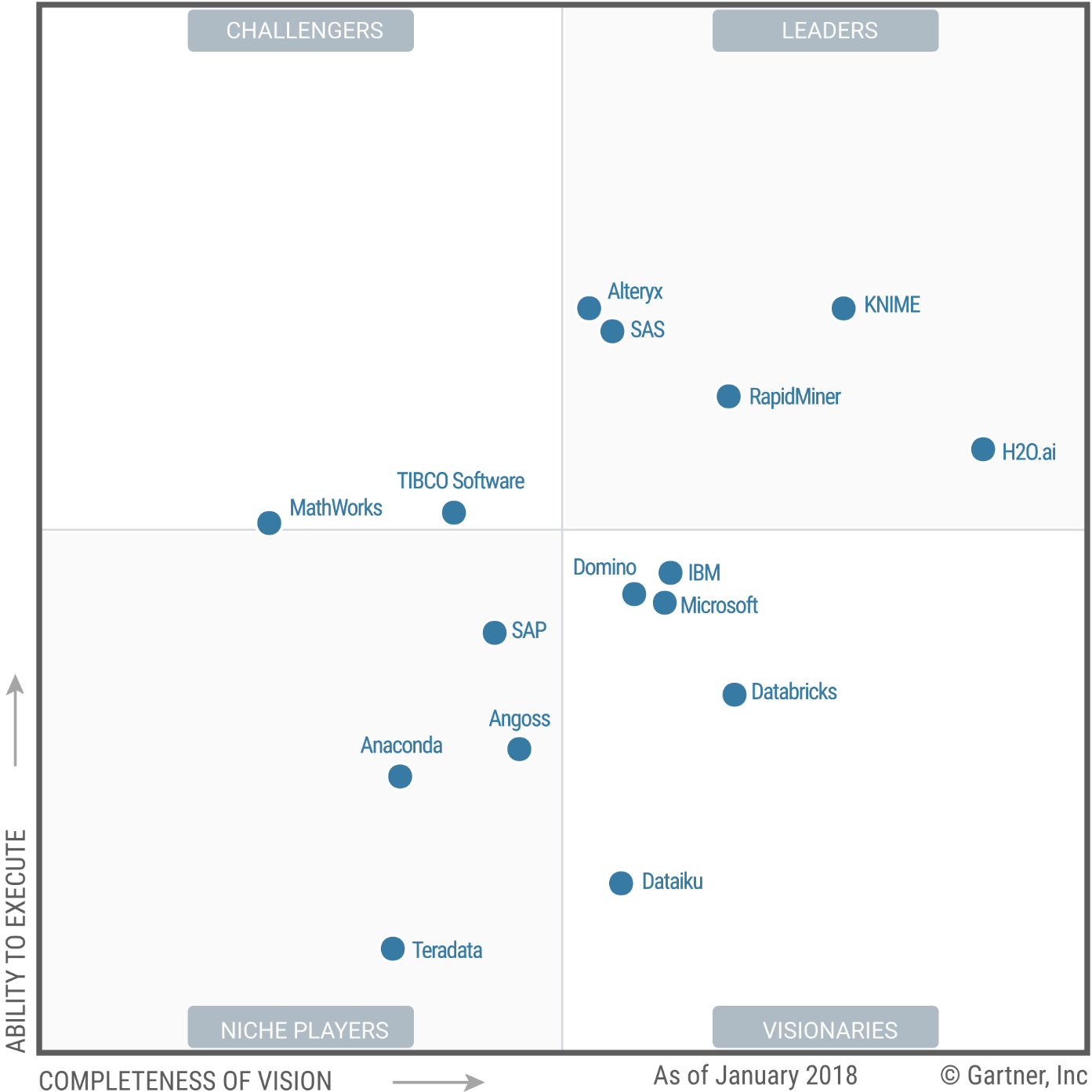
The 20 vendors in the 2024 Magic Quadrant are divided into four categories based on their Completeness of Vision and Ability to Execute:
- Leaders execute well against their current vision and are well positioned for tomorrow.
- Challengers execute well today but may lack the vision to maintain their lead.
- Visionaries understand where the market is going but have not yet fully executed on that vision.
- Niche Players focus successfully on a small segment or are unfocused and do not innovate or outperform others.
Here is the 2024 Magic Quadrant with the vendors plotted:

Source: Gartner (March 2024)
The Leaders
The Leaders quadrant is populated by vendors that offer comprehensive and cohesive platforms with broad appeal across industries and use cases. These vendors have a strong track record of successful deployments, significant market share, and a clear vision for the future of AI.
H2O.ai has solidified its position as a Leader with its flagship Driverless AI platform, which provides advanced AutoML capabilities for building and deploying models. H2O.ai‘s open source roots and commitment to interpretability and fairness have made it a popular choice for enterprises.
DataRobot continues to innovate with an end-to-end platform that democratizes AI for users of all skill levels. With a library of hundreds of pre-built models and integrations, DataRobot enables organizations to rapidly prototype and deploy AI solutions at scale.
IBM remains a Leader with its Cloud Pak for Data platform, which unifies data science, engineering, and business workflows. IBM has strengthened its position with the integration of AutoAI and the launch of the IBM Watson Orchestrate tool for building AI-powered automation.
SAS retains its long-standing leadership position with the SAS Viya platform, which provides a complete set of tools for data preparation, visualization, modeling, and deployment. SAS has invested heavily in augmented analytics and IoT edge computing.
Microsoft offers a comprehensive cloud-native platform in Azure Machine Learning that integrates with the broader Azure ecosystem. Microsoft has enhanced its AutoML and MLOps capabilities and launched the Azure OpenAI Service for building AI-powered applications.
Google has reimagined its AI platform with the launch of Vertex AI, which provides a unified UI and API for the entire ML workflow. Vertex AI offers novel features like Vizier for black-box optimization and Matching Engine for product recommendations.
Other Leaders include KNIME, Dataiku, Alteryx, and RapidMiner, each offering robust and user-friendly platforms that cater to different personas and use cases.
The Challengers
The Challengers quadrant includes tech giants like Amazon Web Services, Oracle, SAP, Huawei, and Alibaba Cloud that have significant resources and customer bases but are still ramping up their AI/ML capabilities. These vendors offer solid platforms that appeal to their existing install base but may lack the depth and breadth of the Leaders.
The Visionaries
The Visionaries quadrant showcases innovative vendors that are pushing the boundaries of what‘s possible with AI and ML.
Snowflake has gained traction with its Data Cloud platform that enables data scientists to build and deploy models where their data resides. Snowflake‘s partnership with Databricks has created a compelling offering for data-intensive workloads.
Datawatch (acquired by Altair) offers an automated analytics platform that empowers business users to derive insights from structured and unstructured data. Datawatch‘s NLP and computer vision capabilities have garnered attention from marketing and CX teams.
Other Visionaries include Aible, Tellius, and Comet, who are driving innovations in decision intelligence, augmented analytics, and MLOps, respectively.
The Niche Players
The Niche Players quadrant features vendors that specialize in specific verticals, use cases, or capabilities.
Anaconda provides a popular distribution of Python and R data science packages and tools. While Anaconda lacks an end-to-end platform, it remains a critical component of the data science stack.
Domino Data Lab has carved out a niche in MLOps with its platform for collaborative model development and deployment. Domino‘s enterprise-grade security and governance have made it a favorite among highly regulated industries.
Choosing the Right Platform for Your Needs
With this overview of the Magic Quadrant in mind, how should you go about evaluating data science and machine learning platforms? Here are some key considerations:
-
Alignment with your AI maturity and use cases: Are you building a centralized data science team, democratizing AI for business users, or deploying AI to edge devices? Different platforms cater to different levels of AI readiness and complexity.
-
Support for your data infrastructure and tools: Can the platform integrate with your existing data sources, pipelines, and BI tools, or does it require a wholesale migration? Look for platforms that can work with your data and tools, not against them.
-
Openness and interoperability: Does the platform lock you into a proprietary stack, or does it allow you to leverage open source libraries and frameworks? The best platforms provide a productive environment while giving you the flexibility to innovate.
-
Automation and augmentation: How well does the platform automate tedious and time-consuming tasks like feature engineering, model selection, and hyperparameter tuning? Platforms with strong AutoML capabilities can dramatically accelerate your AI projects.
-
Collaboration and governance: Does the platform enable seamless collaboration between data scientists, engineers, and business stakeholders? Look for platforms with strong security, version control, and audit trails to ensure responsible AI development.
The Road Ahead
As the 2024 Magic Quadrant demonstrates, the data science and machine learning platform market is evolving rapidly. We can expect to see continued consolidation as leading vendors build out end-to-end AI platforms, as well as the emergence of new entrants that challenge the status quo.
Some of the key trends that will shape the market in the coming years include:
-
Democratization of AI: Platforms will continue to lower the barriers to entry for AI with more user-friendly interfaces, pre-built models, and AutoML capabilities.
-
Operationalization of AI: MLOps will become a critical capability as organizations seek to deploy and manage AI models in production with greater reliability, scalability, and governance.
-
Convergence of AI and analytics: Platforms will blur the lines between AI and traditional business intelligence by infusing ML into every stage of the data pipeline, from data preparation to insight generation.
-
Emergence of AI-powered applications: We will see a new generation of intelligent applications that embed AI to deliver personalized and adaptive experiences, such as dynamic pricing, predictive maintenance, and autonomous systems.
As a data and analytics leader, your challenge is to navigate this complex landscape and align your platform investments with your organization‘s AI strategy and maturity. By leveraging the insights from Gartner‘s Magic Quadrant and staying abreast of the latest market developments, you can make informed decisions that will set your organization up for success in the age of AI.