Getting Clustering Right: A Deep Dive into Variable Clustering
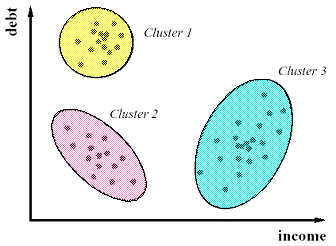
Clustering is an essential unsupervised machine learning technique for exploring and understanding the hidden structure in datasets. By partitioning data points into distinct groups based on their similarity, clustering enables us to discover meaningful patterns, identify anomalies, and generate valuable insights from raw, unlabeled data.
Clustering has diverse applications across domains – customer segmentation in marketing, image compression in computer vision, document categorization in NLP, and much more. Whether you‘re a data scientist trying to make sense of a complex dataset or a business analyst segmenting customers for targeted campaigns, getting your clustering right is crucial.
However, clustering is far from a straightforward task. Several challenges can trip up even experienced practitioners – determining the optimal number of clusters, dealing with clusters of varying shapes and sizes, scaling to high-dimensional data, and more. In this post, we‘ll dive deep into one technique that can help us get clustering right – variable clustering.
The Curse of Dimensionality in Clustering
Before we get into variable clustering, let‘s understand the core challenge it addresses – the curse of dimensionality. Modern datasets often contain a large number of features or variables. While more data can be beneficial, it also introduces problems like increased computational costs, diluted distance metrics, and difficulties in visualization.
As the number of dimensions increases, data points tend to become equidistant from each other, making it hard to distinguish between clusters. This is especially problematic for distance-based algorithms like K-means. High dimensionality can also lead to overfitting, where clusters capture noise rather than true patterns.
Dimensionality reduction techniques like PCA can help, but they have limitations. PCA projects the data into a lower-dimensional subspace while preserving global variance, but it may not retain the original cluster structure. This is where variable clustering comes in.
Introducing Variable Clustering
Variable clustering is a dimensionality reduction technique that aims to find groups of related variables and replace each group with a single representative feature. The goal is to reduce the number of dimensions while maintaining the original cluster structure in the data.
The intuition behind variable clustering is simple – if two variables are strongly correlated or capture similar information, we can cluster them together and use a single feature to represent the group. By clustering variables rather than data points, we can significantly reduce dimensionality without losing too much information.
Variable clustering is especially useful when dealing with high-dimensional datasets where the number of features far exceeds the number of samples. By reducing the feature space, variable clustering can improve the performance and interpretability of downstream clustering tasks on the data points.
Popular Variable Clustering Algorithms
There are several algorithms for variable clustering, each with its own strengths and weaknesses. Here are two of the most popular techniques:
Varmeans (Variable Reduction K-means)
Varmeans is a simple and intuitive variable clustering algorithm that extends the classic K-means to cluster variables rather than data points. The steps are:
- Initialize k variable clusters randomly
- Assign each variable to the cluster with the closest centroid (mean)
- Recompute the centroid of each cluster based on the assigned variables
- Repeat steps 2-3 until convergence
Once the variable clusters are found, we can replace each cluster with a single representative variable, such as the centroid or medoid. Varmeans is easy to implement and scales well to large datasets, but it inherits some of the limitations of K-means like sensitivity to initialization and assumption of spherical clusters.
CLV (Clustering of Variables Around Latent Variables)
CLV is a more sophisticated variable clustering method that aims to find clusters of variables that are strongly related to an underlying latent variable or factor. The idea is to partition the variables into clusters such that the variables within each cluster are maximally correlated with a latent variable specific to that cluster.
CLV operates by iteratively optimizing two steps:
- Estimating the latent variables for each cluster given the current partition
- Updating the partition by assigning each variable to the cluster whose latent variable explains it best
The latent variables are typically estimated using techniques like PCA or factor analysis. CLV can discover clusters of variables with complex, non-linear relationships and handle overlapping clusters. However, it is more computationally intensive than Varmeans and may be sensitive to the choice of the number of clusters and initialization.
Validating Variable Clusters
As with any unsupervised learning task, evaluating the quality of variable clusters is challenging due to the lack of ground truth labels. However, there are some strategies we can use:
- Visualize the variable clusters using techniques like heatmaps or dendrograms to assess their cohesion and separation
- Measure the within-cluster and between-cluster correlation of the variables to ensure that variables within a cluster are more similar to each other than to those in different clusters
- Evaluate the impact of variable clustering on the downstream task, such as clustering the data points. If variable clustering improves the quality of the final clusters, it‘s a good sign.
- Use domain expertise to interpret the meaning and relevance of the variable clusters. Do they align with your understanding of the data generating process?
It‘s also important to experiment with different variable clustering algorithms, distance metrics, and numbers of clusters to find the configuration that best suits your data and goals. Variable clustering is an exploratory technique, and it‘s okay to iterate and refine your approach based on the results.
Limitations of Variable Clustering
While variable clustering is a powerful tool for dimensionality reduction and feature selection, it‘s not a silver bullet. Here are some limitations to keep in mind:
- Variable clustering can miss important non-linear or higher-order interactions between variables that may be relevant for the downstream task
- The quality of the variable clusters depends on the choice of the algorithm, distance metric, and number of clusters, which can be difficult to tune
- Variable clustering may not be appropriate for datasets with a small number of variables or where all variables are believed to be equally important
- Interpreting and naming the variable clusters can be challenging, especially if they capture abstract or complex relationships between variables
Despite these limitations, variable clustering remains a valuable technique in the data scientist‘s toolkit for exploratory analysis, feature selection, and preprocessing high-dimensional data for clustering tasks.
Conclusion
Clustering is a powerful unsupervised learning technique, but getting it right requires careful consideration of the challenges posed by high-dimensional data. Variable clustering is a promising approach for dimensionality reduction that aims to preserve the original cluster structure while reducing the number of features.
By finding groups of related variables and replacing them with single representative features, variable clustering can improve the performance, scalability, and interpretability of clustering tasks. Popular algorithms like Varmeans and CLV offer different trade-offs in terms of simplicity, flexibility, and computational efficiency.
However, variable clustering is not a panacea and should be used judiciously based on the characteristics of the data and the goals of the analysis. It‘s important to validate the quality of the variable clusters using a combination of quantitative and qualitative techniques and to iterate and refine the approach as needed.
When applied thoughtfully and in combination with other techniques like data preprocessing, feature scaling, and careful algorithm selection, variable clustering can be a valuable tool for getting clustering right and extracting meaningful insights from complex, high-dimensional datasets.