GPUs: The Engine Powering the Deep Learning Revolution
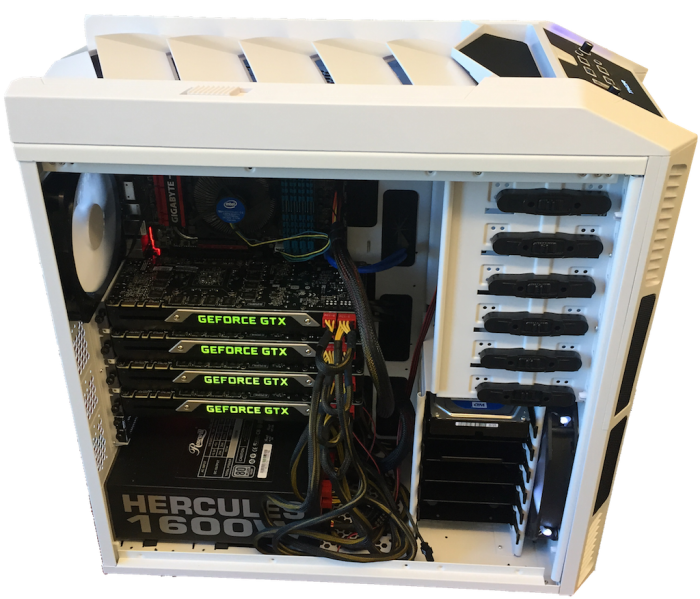
Deep learning has transformed the field of artificial intelligence, enabling remarkable breakthroughs in domains ranging from computer vision and natural language processing to drug discovery and autonomous vehicles. Training the massively parameterized neural networks that power these applications requires an enormous amount of computation – on the order of 1018 floating point operations for the largest models. This computational demand has grown exponentially, doubling roughly every 3.4 months for the last decade. [1]
Conventional CPUs, while versatile, are ill-suited to the types of massively parallel matrix math that neural networks rely on. Fortunately, another class of hardware, the graphics processing unit (GPU), has proven to be a perfect fit. With their thousands of cores and high memory bandwidth, GPUs can perform the key computations required for deep learning orders of magnitude faster than CPUs.
In this article, we‘ll take a deep dive into the critical role GPUs play in deep learning, the evolution of GPU architectures, current state of the art, and future directions. Whether you‘re an ML engineer, researcher, or just curious about the hardware that makes modern AI possible, read on to learn why GPUs are essential infrastructure for deep learning.
Parallel Performance: How GPUs Accelerate Deep Learning
To understand why GPUs are so effective for deep learning, let‘s examine the core computations involved and how well they map to GPU architectures.
The fundamental building block of deep neural networks is the perceptron or artificial neuron, which takes a weighted sum of its inputs, applies an activation function, and passes the result to the next layer. Training a neural network with gradient descent involves two alternating phases:
-
Forward pass: input data is passed through the network, computing the activations of each neuron layer by layer to produce the output.
-
Backward pass: the error between the output and the labeled data is used to compute gradients of the loss with respect to each weight, which are then used to update the weights.
Both passes involve a large number of matrix multiplications, since the weights and activations of each layer can be represented as matrices. For a fully-connected layer with $N$ inputs and $M$ outputs, the forward pass computes the matrix product $\mathbf{y} = \mathbf{W} \mathbf{x} + \mathbf{b}$, where $\mathbf{W}$ is an $M \times N$ weight matrix, $\mathbf{x}$ is the $N$-dimensional input vector, $\mathbf{y}$ is the $M$-dimensional output vector, and $\mathbf{b}$ is a bias vector.
Matrix multiplication is inherently parallel – each element of the output matrix can be computed independently and simultaneously. This property makes matrix multiplication a great fit for GPUs, which consist of thousands of relatively simple cores that can execute in parallel.
On modern hardware, matrix multiplication is highly optimized using specialized instructions like FMA (fused multiply-add) that can perform a combined multiplication and addition in a single clock cycle. On NVIDIA‘s Tensor Core GPUs, a single FMA instruction can operate on 4×4 matrices, performing 64 floating point operations.
The A100 GPU, one of the most powerful available as of 2023, has 6912 FP32 cores and 432 Tensor Cores, enabling it to perform over 150 TFLOPs (1012 floating point operations per second) of matrix math in mixed FP16/FP32 precision. [2] In comparison, a top-of-the-line AMD Ryzen 9 7950X3D CPU has 16 cores and maxes out around 2 TFLOPs, nearly two orders of magnitude slower.
To illustrate the speedup of GPUs over CPUs for deep learning, let‘s look at some benchmarks. Training the ResNet-50 image classification model on the ImageNet dataset is a common reference task. Using TensorFlow, a single A100 GPU can train ResNet-50 to 75.9% accuracy in 8 minutes. The same task takes 7 hours on a 16-core/32-thread Ryzen 9 7950X3D, a more than 50x speedup for the GPU. [3]
This performance gap is even more pronounced for larger models. The GPT-3 language model, one of the largest as of 2023 with 175B parameters, would take over 1 year to train on 1024 CPUs, but can be trained in just over 1 month on 1024 A100 GPUs. [4]
Clearly, GPUs offer an enormous advantage over CPUs when it comes to training deep neural networks – an advantage that has proven crucial to the rapid advancement of deep learning in the last decade.
How GPU Architectures Have Evolved for Deep Learning
When GPUs were first developed in the 1990s, their intended purpose was to accelerate 3D graphics rendering, primarily for the burgeoning gaming market. However, researchers soon recognized their potential for accelerating other parallel workloads.
In the early 2000s, several research groups demonstrated that certain scientific computing problems could be accelerated using GPUs. However, taking advantage of GPUs required using graphics APIs like OpenGL, a cumbersome process.
The advent of NVIDIA‘s CUDA platform in 2007 made GPU programming far more accessible, providing a general purpose C-like programming model. This sparked a wave of interest in general purpose GPU (GPGPU) programming.
The first successful application of GPUs to deep learning came in 2012 when Alex Krizhevsky, Ilya Sutskever, and Geoffrey Hinton trained the AlexNet convolutional neural network on NVIDIA GPUs, resulting in a landmark victory in the ImageNet challenge. [5] AlexNet demonstrated the power of deep learning for computer vision and kickstarted the deep learning revolution.
In the years since, NVIDIA has released several GPU architectures tailored for deep learning, introducing features like:
-
Tensor Cores: specialized matrix multiply-accumulate units that can perform mixed-precision matrix math with up to 16 32-bit effective precision. First introduced in the Volta architecture (2017).
-
NVLink: a high-bandwidth interconnect that enables fast communication between GPUs, with up to 12x the bandwidth of PCIe. Critical for multi-GPU training. Introduced in Pascal (2016).
-
HBM2 Memory: high bandwidth memory that offers up to 1.2TB/s of memory bandwidth vs 616 GB/s for GDDR6. Used in datacenter GPUs starting with Volta.
-
Multi-Instance GPU (MIG): enables GPUs to be securely partitioned into smaller logical instances, useful for multi-tenant environments. Introduced in Ampere (2020).
The latest NVIDIA architecture as of 2023 is Hopper, which incorporates several new features aimed at accelerating giant deep learning models. These include a Transformer Engine for attention-based models, a new NVLink Switch system to connect multiple nodes, and DOE (data orchestration engine) cores to handle data exchange between GPUs and NICs. [6]
Other vendors have also developed GPUs suitable for deep learning. AMD offers the Instinct MI250 accelerator, which delivers up to 383 TFLOPs of FP16 compute. Intel‘s Data Center GPU Max Series includes the Flex 170 GPU for AI training and Flex 140 for inference.
Current State of the Art and Future Directions
As of 2023, the highest performing GPUs for deep learning training workloads are:
-
NVIDIA H100: 4th Gen Tensor Cores, 16896 FP32 CUDA cores, 3TB/s HBM3 memory bandwidth, 350W TDP. Up to 1.3 exaFLOPs of FP16/FP32 matrix compute.
-
NVIDIA A100: 3rd Gen Tensor Cores, 6912 FP32 CUDA cores, 1.6TB/s HBM2e, 400W TDP. Up to 312 TFLOPs of FP16/FP32 compute.
-
AMD MI250X: 14080 Stream processors, 3.2TB/s HBM2e, 560W TDP. Up to 383.7 TFLOPs peak FP16.
For extremely large language models like GPT-3 and PaLM, these high-end datacenter GPUs are coupled together in massive pod configurations. For example, the Megatron-Turing NLG model with 530B parameters was trained on 4480 A100 GPUs, using tensor slicing to shard the model across GPUs. [7]
Several open challenges remain in productionizing large models on GPUs:
- Inter-GPU communication bandwidth often limits scaling
- Sparsity and quantization can reduce compute/memory requirements but often degrade quality
- Distributed training can be unreliable and difficult to coordinate
- Moving models in and out of GPU memory is still a bottleneck
Active areas of research in GPU-accelerated deep learning include:
- Scaling to even larger models via GPU parallelization techniques like pipeline parallelism, tensor slicing, and ZeRO [8]
- Optimizing sparse computation on GPUs via new hardware support and software libraries
- Improving reliability and usability of distributed training, e.g. via better checkpointing and fault tolerance
- Co-designing GPU hardware and software, e.g. working with framework developers to bake in optimized primitives
Over the next decade, GPU architectures will likely evolve in several key ways:
-
Increasingly heterogenous designs incorporating specialized units for deep learning workloads like transformers and unstructured sparsity
-
Scaling to multi-GPU systems with high-bandwidth interconnects and unified memory
-
Optimizations for energy efficiency to enable greener AI
-
Tighter integration with other deep learning hardware like NVMe storage and fast networking
-
Enhancements aimed at emerging use cases like reinforcement learning and federated learning
At the same time, alternative deep learning architectures like ASICs, FPGAs, and even analog hardware will likely grow in importance, with GPUs remaining a key part of an increasingly diverse ecosystem. Neuromorphic architectures like IBM‘s TrueNorth and Intel‘s Loihi may offer compelling advantages in energy-efficiency and enable new approaches like spiking neural networks.
Longer-term, technologies like photonic computing and quantum computing, while still largely speculative, could potentially further revolutionize the hardware landscape for AI. However, in the near to medium term, GPUs will likely continue to serve as the essential computational foundation that powers the ongoing deep learning revolution.
Practical Tips for Using GPUs in Deep Learning
If you‘re ready to harness the power of GPUs for your own deep learning projects, here are a few key tips:
-
Choose the right GPU for your use case. For local experimentation, an NVIDIA GeForce RTX 2080 Ti, RTX 3080 Ti, or AMD Radeon RX 6000 series GPU can be great options. For training larger models, you‘ll likely want a datacenter GPU like an A100.
-
Familiarize yourself with GPU programming paradigms. The most important is CUDA for NVIDIA GPUs. Many deep learning frameworks like PyTorch and TensorFlow provide high-level APIs that abstract away the details of GPU programming, but understanding the basics can help you optimize performance.
-
Use a cloud GPU provider for easy scaling. Services like AWS, GCP, Azure, and Lambda Labs offer on-demand GPU instances with popular deep learning environments and frameworks pre-installed. This can be far more convenient than managing your own physical GPU servers.
-
Exploit parallelism at multiple levels. This includes vectorized operations, threading, and distributing across multiple GPUs/machines. Most deep learning frameworks will handle much of this for you, but be aware of the different paradigms for multGPU training like data parallelism and model parallelism.
-
Monitor GPU utilization and performance. Tools like NVIDIA‘s nvtop and Pytorch‘s torchstat can help you identify bottlenecks and optimize efficiency. Aim to maximize utilization and minimize data transfer between CPU and GPU memory.
-
Use mixed precision. FP16/FP32 mixed precision training exploits Tensor Cores and can provide significant speedups and memory savings with minimal impact on model accuracy. Autocast in PyTorch and Keras make this easy to implement.
-
Be mindful of memory usage. GPU memory is often a scarce resource. Techniques like gradient accumulation, activation checkpointing, and model parallelism can reduce memory requirements.
-
Stay up to date on the latest techniques. The field of GPU-accelerated deep learning moves incredibly quickly. Follow academic venues like NeurIPS, ICML, ICLR, and MLSys to stay abreast of the latest techniques for training large models on GPUs.
Conclusion
GPUs have been a key driver of progress in deep learning over the last decade, providing the compute needed to train the increasingly large and sophisticated neural networks that power modern AI applications. Today, GPUs are an essential tool for anyone working in deep learning, from students and researchers to engineers deploying models in production.
As we‘ve seen, GPU architectures have evolved rapidly to meet the demands of deep learning, with key innovations like Tensor Cores, high-bandwidth memory, and fast interconnects. At the same time, challenges remain in scaling to even larger models and deploying them efficiently.
The coming years will likely see further specialization of GPUs for AI workloads, as well as a growing diversity of AI chips and architectures. However, one thing is clear: the incredible progress in deep learning would not have been possible without GPUs, and they will continue to play a crucial role as we push towards more capable, efficient, and deployable AI systems.