Mastering the Bias-Variance Tradeoff: An Expert‘s Guide

As a machine learning practitioner, you‘ve likely encountered the age-old dilemma: you want your model to perform well not only on your training data but also on new, unseen data. You want low bias to avoid underfitting, but also low variance to prevent overfitting. This delicate balance, known as the bias-variance tradeoff, is a fundamental concept that every data scientist must grapple with. In this comprehensive guide, we‘ll dive deep into the theory and practice of navigating this tradeoff to achieve optimal model performance.
Understanding Bias, Variance, and the Tradeoff
At its core, the bias-variance tradeoff is about the generalization ability of a model—how well it can learn the underlying patterns in the data while ignoring noise. To fully appreciate this, let‘s unpack the mathematical definitions of bias and variance.
Given a training set $S = {(x_1, y_1), \ldots, (x_n, y_n)}$ and a model $\hat{f}$ trained on $S$, the bias of $\hat{f}$ at a point $x$ is defined as:
$$ \text{Bias}(\hat{f}(x)) = \mathbb{E}_S[\hat{f}(x)] – f(x) $$
where $\mathbb{E}_S$ denotes the expectation over all possible training sets, and $f(x)$ is the true underlying function we‘re trying to learn.
The variance of $\hat{f}$ at $x$ is defined as:
$$ \text{Var}(\hat{f}(x)) = \mathbb{E}_S[(\hat{f}(x) – \mathbb{E}_S[\hat{f}(x)])^2] $$
Intuitively, bias measures how far off our model‘s average prediction is from the truth, while variance captures how much the predictions fluctuate across different training sets.
The expected test error of a model can be decomposed into three terms:
$$ \mathbb{E}_S[(y – \hat{f}(x))^2] = \text{Bias}(\hat{f}(x))^2 + \text{Var}(\hat{f}(x)) + \sigma^2 $$
where $\sigma^2$ is the irreducible error due to noise in the data. This decomposition, known as the bias-variance decomposition, clearly shows the tradeoff: as we decrease bias, variance tends to increase, and vice versa.
Visualizing the Tradeoff
A powerful way to build intuition around the bias-variance tradeoff is through visualization. One common approach is to plot model complexity against prediction error, decomposed into bias and variance terms.
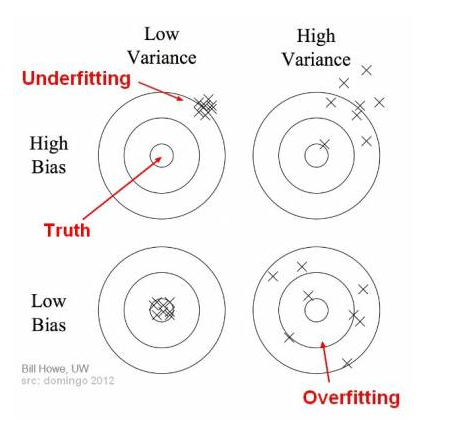
As we move from simpler to more complex models (e.g., increasing polynomial degree), bias decreases while variance increases. The optimal model complexity is at the minimum of the total error curve, balancing underfitting and overfitting.
We can also visualize the tradeoff in 3D, with model complexity on one axis, training set size on another, and error on the vertical axis. This perspective reveals how the optimal complexity varies with data availability.

With small datasets, simpler models are preferred to avoid overfitting. As the training size grows, the optimal complexity shifts higher, enabling richer models to capture more intricate patterns.
Strategies for Reducing Bias and Variance
Armed with a solid understanding of the tradeoff, let‘s explore practical strategies for achieving the right balance. The key is to diagnose whether your model is suffering from high bias (underfitting) or high variance (overfitting), and apply targeted remedies.
Tackling High Bias
If your model is underfitting, consider the following:
-
Increase model complexity: Use a more expressive model class that can learn richer relationships. For instance, you might move from linear to polynomial regression, or from a shallow to a deep neural network. Beware of going overboard, though, as excessive complexity can lead to overfitting.
-
Enrich your feature space: Incorporate additional informative features that can help explain the target variable. Apply domain knowledge to engineer relevant features, or use automated feature selection techniques to identify the most predictive subset.
-
Tune hyperparameters: Hyperparameters control model flexibility. For regularized models, decreasing the regularization strength (e.g., lowering $\lambda$ for L2 regularization) can reduce bias by allowing more complex fits. Use cross-validation to find the optimal hyperparameter values.
Combating High Variance
When overfitting is the issue, try these approaches:
-
Gather more training data: A larger dataset can help the model learn more robust, generalizable patterns. If collecting new data is infeasible, consider data augmentation techniques like adding noise, applying transformations, or generating synthetic examples.
-
Simplify your model: Decreasing model complexity can rein in overfitting. Techniques like dimensionality reduction (e.g., PCA) or feature selection can help focus on the most informative aspects of the data. Regularization methods like L1/L2 regularization or dropout can constrain model flexibility.
-
Use ensemble methods: Combining predictions from multiple models can reduce variance by averaging out their individual fluctuations. Bagging, boosting, and stacking are powerful ensemble techniques that can improve generalization.
-
Validate and tune hyperparameters: Use cross-validation to assess model performance on unseen data and optimize hyperparameters. This helps ensure that your model is not overly tuned to the peculiarities of a single training set.
Impact of Data Quality and Preprocessing
The quality and preprocessing of your training data can significantly impact the bias-variance tradeoff. Poor quality data with noise, outliers, or missing values can mislead the model, inducing both bias and variance. Careful data cleaning, normalization, and imputation can mitigate these issues.
Feature selection and engineering play a crucial role. Including irrelevant or redundant features can increase variance by introducing unnecessary complexity. Conversely, omitting informative features can increase bias by limiting the model‘s expressiveness. Striking the right balance through judicious feature engineering is key.
The Tradeoff in Different Model Classes
The manifestation of the bias-variance tradeoff varies across model classes. Let‘s consider a few common examples:
-
Decision Trees: For decision trees, depth is a key determinant of complexity. Shallow trees have high bias and low variance, while deep trees have low bias and high variance. Pruning methods can help find the optimal tree size.
-
Neural Networks: In neural nets, the number and size of hidden layers control complexity. Wider and deeper networks can learn more intricate patterns but are prone to overfitting. Regularization techniques like L2 regularization and dropout are crucial for managing variance.
-
Support Vector Machines: For SVMs, the choice of kernel and its parameters impact the bias-variance balance. A linear kernel has high bias and low variance, while complex kernels like RBF have low bias and high variance. The C parameter trades off margin size and misclassification, influencing the tradeoff.
Automating Bias-Variance Optimization
Recent advancements in automated machine learning (AutoML) offer exciting possibilities for optimizing the bias-variance tradeoff. AutoML techniques can automatically search the space of model architectures and hyperparameters to find the best configuration for a given dataset.
One promising approach is Neural Architecture Search (NAS), which uses reinforcement learning or evolutionary algorithms to discover optimal neural network designs. By exploring a vast space of architectures, NAS can uncover models that strike a good balance between bias and variance.
Meta-learning techniques like few-shot learning and transfer learning can also help optimize the tradeoff. By leveraging knowledge learned from related tasks, these methods can improve generalization performance, especially in low-data regimes.
Conclusion
Navigating the bias-variance tradeoff is a central challenge in machine learning. By understanding the theoretical underpinnings, employing practical optimization strategies, and staying abreast of emerging techniques, you can find the sweet spot between underfitting and overfitting. Remember, the optimal balance is problem-dependent, so it‘s crucial to iterate, experiment, and let the data guide you.
As you tackle your next machine learning project, keep these principles in mind. Diagnose bias and variance issues, apply targeted remedies, and continuously monitor performance. And don‘t forget the fundamentals: gather high-quality data, engineer informative features, and validate your models rigorously. With practice and perseverance, you‘ll master the art and science of the bias-variance tradeoff—and unlock the full potential of your models.