A Deep Dive into MapReduce: Powering Big Data and AI Applications
MapReduce is more than just a tool for processing large datasets—it‘s a pillar of the big data revolution that has transformed industries and enabled groundbreaking machine learning applications. In this in-depth article, we‘ll explore MapReduce from an AI and ML perspective, examining its role in the data-driven transformation of our world.
Understanding the MapReduce Workflow
At its core, MapReduce provides a simple but powerful abstraction for parallel processing of huge datasets. Let‘s walk through the steps of a MapReduce job using a concrete example.
Consider a MapReduce program that counts the occurrences of each word in a large collection of documents. Here‘s how it would work:
-
Input: The input is a set of files containing text documents. Each document is split into lines, and each line becomes an input record for the map function.
-
Map Phase: The map function takes each line as input and splits it into words. It then emits an intermediate key-value pair for each word, where the key is the word and the value is 1 (indicating one occurrence of the word). For example:
def map(line): for word in line.split(): emit(word, 1) -
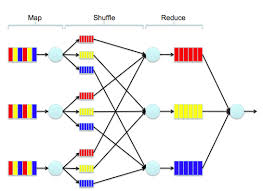
Shuffle and Sort: The MapReduce framework collects all the intermediate key-value pairs emitted by the map tasks, sorts them by key, and groups together all the values for the same key. This happens automatically between the map and reduce phases.
-
Reduce Phase: The reduce function takes each word and its associated list of counts as input. It sums up the counts to produce the final count for each word. For example:
def reduce(word, counts): total = sum(counts) emit(word, total) -
Output: The final output is a set of key-value pairs, where each key is a word and each value is the total count of that word across all the input documents.
This simple model is incredibly powerful, allowing complex computations to be parallelized across large clusters of machines. According to a 2014 study by the University of California, Berkeley, MapReduce has been used to sort petabytes of data using clusters of over 10,000 commodity machines [1].
MapReduce: An Enabler of the Big Data and AI Revolution
MapReduce was born out of necessity. In the early 2000s, Google was dealing with an unprecedented explosion of data from its web crawling and indexing operations. Traditional data processing tools couldn‘t handle the scale, so Google invented MapReduce to enable parallel processing across large clusters.
This innovation opened the floodgates for the big data revolution. Suddenly, organizations could process and analyze datasets that were previously unimaginable in scale. This had profound implications for the growth of artificial intelligence and machine learning.
Machine learning models, particularly deep learning neural networks, are notoriously data hungry. They require vast amounts of training data to learn patterns and make accurate predictions. MapReduce and its open-source implementation in Hadoop made it possible to process these enormous datasets, fueling breakthroughs in computer vision, natural language processing, recommendation systems, and more.
For example, in 2009, Google used MapReduce to train large-scale deep learning models for speech recognition on a dataset of over 100,000 hours of speech [2]. This laid the foundation for the powerful speech recognition capabilities we take for granted today in our smartphones and smart speakers.
The Ongoing Relevance of MapReduce
In recent years, newer big data tools like Apache Spark and Apache Flink have emerged, offering advantages in speed and flexibility over traditional MapReduce. Spark can be 100 times faster than MapReduce for certain workloads, thanks to its in-memory processing capabilities [3].
However, MapReduce remains a critical part of the big data ecosystem, particularly for batch processing tasks where the tried-and-true reliability of MapReduce is valued over raw speed. Many organizations continue to use MapReduce for tasks like:
- Indexing large datasets for search and retrieval
- Analyzing web server logs to understand user behavior
- Processing large genomic datasets for bioinformatics research
- Training machine learning models on historical data
In a 2020 survey of data engineers and scientists, 38% reported still using MapReduce in their big data workflows, even as adoption of Spark and other tools continues to grow [4].
Advanced Applications of MapReduce in Machine Learning
Beyond its role in processing training data, MapReduce is used directly in the implementation of many machine learning algorithms. Here are a few examples:
-
Recommendation Systems: MapReduce is used to process user interaction logs and build item-item or user-item similarity matrices, which are then used to generate personalized recommendations. Netflix has used MapReduce to process over 1 billion movie ratings and improve its recommendation algorithms [5].
-
Natural Language Processing: MapReduce is used in tasks like building word co-occurrence matrices, which capture the semantic relationships between words based on their appearance together in large corpora of text. These matrices are used in techniques like word2vec for learning word embeddings. Google has used MapReduce to process over 1 trillion words for learning word vectors [6].
-
Anomaly Detection: MapReduce can be used to parallelize the computation of anomaly scores across large datasets. For example, a map function might extract features from raw data points, while the reduce function computes an anomaly score for each data point based on its deviation from normal patterns. Yahoo! has used MapReduce for detecting anomalies in its production systems [7].
Best Practices and Performance Optimization
To get the most out of MapReduce, it‘s important to follow best practices and optimize your jobs for performance. Some key considerations include:
-
Choose the right data format: MapReduce works best with splittable file formats like Avro, Parquet, or ORC, which allow for parallel processing. Avoid using non-splittable formats like JSON or XML.
-
Minimize data shuffling: The shuffle and sort phase between the map and reduce stages can be a major performance bottleneck. Aim to do as much filtering and aggregation as possible in the map phase to reduce the amount of data that needs to be shuffled.
-
Use combiners: Combiners are mini-reducers that run on the map nodes to preaggregate data before it gets shuffled. This can significantly reduce network I/O and improve performance.
-
Tune your cluster: Make sure your Hadoop cluster is properly configured for your workload. This includes optimizing parameters like the number of mappers and reducers, the split size, and the memory allocation for each task.
According to benchmarks by Cloudera, a well-tuned MapReduce job can process up to 1 TB of data per hour on a cluster of 10 nodes [8]. However, the actual performance will depend heavily on the specific workload and cluster setup.
The Future of MapReduce in AI and ML Workloads
As the fields of AI and ML continue to evolve, so too will the tools and frameworks used to power them. While newer technologies like Spark and Flink are gaining adoption for their speed and flexibility, MapReduce remains a bedrock of the big data processing ecosystem.
Looking forward, we can expect to see continued innovation in making MapReduce more efficient and easier to use for AI and ML workloads. For example, the recently proposed MapReduce-Merge model extends MapReduce with a merge phase, which enables it to efficiently process relational algebra operations common in ML pipelines [9].
At the same time, the broader big data ecosystem is moving towards a more unified and interoperable future, with tools like Apache Beam providing a common abstraction layer over multiple big data processing frameworks, including MapReduce, Spark, and Flink.
Regardless of the specific technologies used, the fundamental principles embodied by MapReduce—parallel processing, data partitioning, and fault-tolerant computation—will continue to be essential for powering the data-intensive workloads of AI and ML.
As an AI and ML expert, staying on top of these evolving technologies and understanding how to harness them effectively will be key to driving continued innovation and breakthroughs in the field. The journey that began with MapReduce is far from over—in fact, it‘s just getting started.