The Monty Hall Problem: Conditional Probability and Lessons for AI
Introduction
The Monty Hall problem is a classic probability puzzle that has stumped countless people and ignited fierce debates, even among mathematicians and statisticians. This seemingly simple problem challenges our intuitions about probability and reveals crucial insights about conditional probability, Bayesian reasoning, and decision-making under uncertainty.
At its core, the Monty Hall problem is about updating beliefs based on new information – a central theme in artificial intelligence and machine learning. By unpacking this brain teaser, we‘ll explore key concepts that underpin probabilistic machine learning, highlight common pitfalls in human reasoning, and draw valuable lessons for building robust AI systems.
The Problem Setup
The Monty Hall problem is named after the host of the game show "Let‘s Make a Deal." Here‘s the scenario:
-
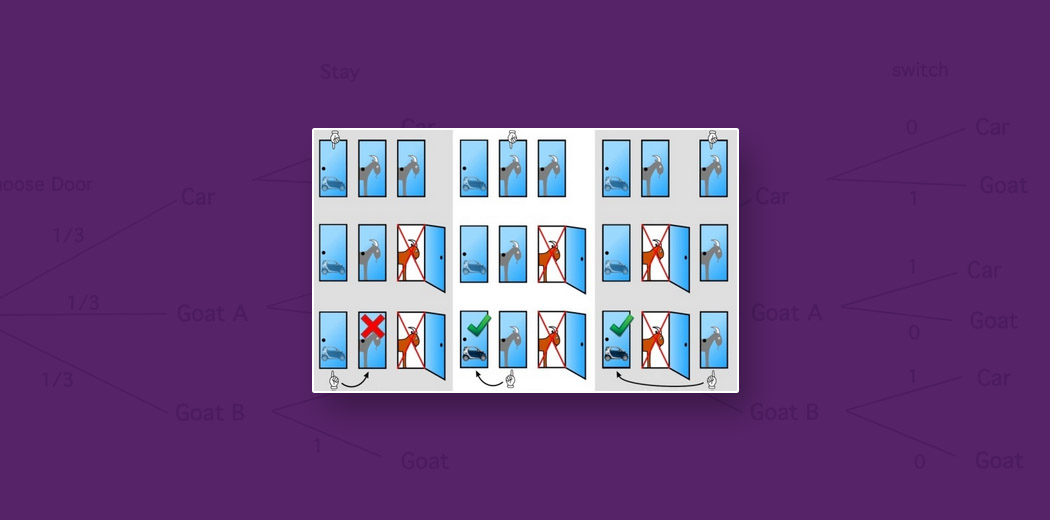
You‘re presented with three closed doors. Behind one door is a car (the prize), and behind the other two are goats (the duds).
-
You pick one door, say door 1.
-
The host, Monty Hall, who knows what‘s behind each door, opens one of the other doors, say door 3, to reveal a goat.
-
Monty then asks you if you want to stick with your initial choice (door 1) or switch to the remaining unopened door (door 2).
The million dollar question is: Should you switch doors?
The Solution
Surprisingly, switching doors doubles your chances of winning the car from 1/3 to 2/3! Here‘s the logic:
-
Initially, the probability the car is behind any given door is 1/3.
-
When you make your initial pick, there‘s a 1/3 chance you chose the car and a 2/3 chance you chose a goat.
-
After Monty reveals a goat behind one of the doors you didn‘t pick, he‘s essentially telling you that the door you didn‘t pick is more likely to have the car.
-
If you initially picked a goat (2/3 chance), then the car must be behind the other unopened door. Switching wins the car!
-
The only way you lose by switching is if you initially picked the car (1/3 chance).
We can formalize this reasoning using conditional probability and Bayes‘ theorem.
Conditional Probability and Bayes‘ Theorem
Conditional probability measures the probability of an event A occurring given that another event B has occurred, denoted P(A|B). It‘s calculated as:
$$P(A|B) = \frac{P(A \cap B)}{P(B)}$$
where $P(A \cap B)$ is the joint probability of A and B (the probability that both events occur) and $P(B)$ is the probability of B.
Bayes‘ theorem is a powerful tool for updating beliefs based on new evidence. It states:
$$P(A|B) = \frac{P(B|A)P(A)}{P(B)}$$
where $P(A)$ is the prior probability of A, $P(B|A)$ is the likelihood of observing B given A, and $P(B)$ is the marginal probability of B (the probability of observing B under any circumstance).
Let‘s apply Bayes‘ theorem to the Monty Hall problem. We want to compare the probability of winning with your initial pick to the probability of winning by switching, given that Monty revealed a goat.
- Let $A$ = "Car is behind door 1" (your initial pick)
- Let $B$ = "Monty reveals a goat behind door 3"
We‘re interested in $P(A|B)$, the probability the car is behind door 1 given that Monty revealed a goat behind door 3.
The prior probability $P(A) = 1/3$ since the car is equally likely to be behind each door initially.
To find the likelihood $P(B|A)$, we need to consider two scenarios:
-
If the car is behind door 1 (A is true), then Monty can open either door 2 or door 3 with equal probability to reveal a goat. So $P(B|A) = 1/2$.
-
If the car is not behind door 1 (A is false), then Monty must open the other door hiding a goat. If the car is behind door 2, Monty must open door 3. So $P(B|not A) = 1$.
The marginal probability $P(B)$ can be calculated using the law of total probability:
$$P(B) = P(B|A)P(A) + P(B|not A)P(not A)$$
$$ = (1/2)(1/3) + (1)(2/3) = 5/6$$
Plugging into Bayes‘ theorem:
$$P(A|B) = \frac{P(B|A)P(A)}{P(B)} = \frac{(1/2)(1/3)}{5/6} = 1/3$$
So even after Monty reveals a goat, the probability the car is behind your initial pick is still 1/3.
Since winning by switching is the complement of winning with your initial pick:
$$P(switch | B) = 1 – P(A|B) = 1 – 1/3 = 2/3$$
Therefore, switching doors gives you a 2/3 chance of winning the car!
Probability Tables
We can also represent the Monty Hall problem using probability tables. Initially, the probability distribution for the car‘s location is:
| Door | Probability |
|---|---|
| 1 | 1/3 |
| 2 | 1/3 |
| 3 | 1/3 |
After you pick door 1 and Monty reveals a goat behind door 3, the updated conditional probabilities are:
| Door | Probability of car | Probability of goat |
|---|---|---|
| 1 | 1/3 | 2/3 |
| 2 | 2/3 | 1/3 |
| 3 | 0 | 1 |
The probability the car is behind door 2 (the door you didn‘t pick and Monty didn‘t reveal) has increased to 2/3, while the probability it‘s behind door 1 remains 1/3.
Cognitive Biases and Suboptimal Reasoning
The Monty Hall problem is notoriously counterintuitive because it exploits cognitive biases in human reasoning about probability. The most common mistake is assuming that after Monty reveals a goat, the two remaining doors have equal probabilities of hiding the car. This faulty reasoning stems from two biases:
-
Base rate neglect: People tend to ignore prior probabilities and focus only on new information. In this case, the prior probability the car is behind the initially chosen door is 1/3, but people neglect this base rate after Monty‘s reveal.
-
Assuming independence: People often treat events as independent when they‘re actually dependent. Monty‘s reveal is not independent of the contestant‘s initial pick – he can never reveal the contestant‘s chosen door or the car. Treating the final two doors as equally likely implicitly assumes Monty‘s reveal is independent of the initial choice.
These biases lead to suboptimal decision-making in many real-world scenarios involving conditional probability, such as medical diagnosis, legal reasoning, and machine learning.
The Monty Hall Problem and Machine Learning
The key ideas behind the Monty Hall problem – conditioning, belief updating, and probabilistic reasoning under uncertainty – are central to many machine learning algorithms, especially those based on Bayesian inference.
In machine learning, we often start with prior beliefs about the parameters of a model, then update these beliefs based on observed data to get a posterior distribution. This process of iteratively updating beliefs as new evidence comes in is exactly what Bayes‘ theorem captures.
For example, Naive Bayes classifiers use Bayes‘ theorem to predict the most likely class label for a new data point based on its features. The model starts with prior probabilities for each class, then updates these probabilities based on the observed feature values to make a prediction.
Similarly, Bayesian networks represent the conditional dependencies among variables in a probabilistic graphical model. They use Bayes‘ theorem to perform inference, answering questions like "What‘s the probability of variable X given the observed values of variables Y and Z?"
More recently, researchers have applied Bayesian principles to deep learning, creating Bayesian neural networks that can quantify uncertainty in their predictions. Instead of just outputting point estimates, these models can express their confidence through probability distributions over the outputs.
In all these cases, the core principles are the same: start with prior beliefs, observe new data, and update your beliefs accordingly. The Monty Hall problem provides a concrete example of this process in action.
Simulations and Empirical Verification
Despite the clear mathematical reasoning behind the Monty Hall problem, many people remain skeptical of the counterintuitive solution. To convince doubters, numerous simulations and empirical experiments have been conducted.
For example, you can easily simulate the Monty Hall problem in Python:
import random

def monty_hall(switch_door):
    doors = [0, 0, 1]  # 0 represents a goat, 1 represents the car
    random.shuffle(doors)

    # Contestant picks a door at random
    choice = random.randint(0, 2)

    # Host reveals a goat behind one of the other doors
    revealed = next(i for i in range(3) if i != choice and doors[i] == 0)

    # Contestant decides whether to switch
    if switch_door:
        final_choice = next(i for i in range(3) if i != choice and i != revealed)
    else:
        final_choice = choice

    return doors[final_choice]

# Simulate 10,000 games with each strategy
switch_wins = sum(monty_hall(True) for _ in range(10000))
stick_wins = sum(monty_hall(False) for _ in range(10000))

print(f"Switching wins {switch_wins/10000:.2f} of the time")
print(f"Sticking wins {stick_wins/10000:.2f} of the time")
Output:
Switching wins 0.67 of the time
Sticking wins 0.33 of the time
As expected, switching doors wins about 2/3 of the time, while sticking with the initial pick wins only 1/3 of the time.
Empirical experiments with real people have also confirmed the optimal strategy is to switch doors. In a famous study, cognitive psychologist Massimo Piattelli-Palmarini hosted a Monty Hall game with MIT students and faculty as contestants. When the participants played the game themselves, the vast majority stuck with their initial choice and won only 1/3 of the time. But when they watched someone else play the game, they quickly realized the advantage of switching doors.
These simulations and experiments demonstrate the power of empirical testing to refine our intuitions and correct misconceptions. They also highlight the value of formal mathematical analysis for understanding tricky probability problems like the Monty Hall scenario.
Variations and Extensions
The classic Monty Hall problem has inspired numerous variations and extensions that probe deeper into the principles of conditional probability and optimal decision-making. A few notable examples:
-
The "Monty Fall" problem: In this variant, Monty randomly opens one of the two unchosen doors, which may or may not reveal a goat. If he happens to reveal the car, the game ends. If he reveals a goat, the contestant can choose whether to switch. Surprisingly, switching doors in this scenario doesn‘t affect the contestant‘s chances of winning – they‘re 1/3 either way.
-
The Three Prisoners problem: Three prisoners, A, B, and C, are in jail. The warden decides to release one of them at random. Prisoner A asks the guard to tell him the identity of one of the other two prisoners who will remain in jail. The guard tells A that C will stay in jail. Given this information, what‘s the probability that A will be released? (Hint: It‘s not 1/2!)
-
The Boy or Girl paradox: Mr. Smith has two children. At least one of them is a boy born on a Tuesday. What‘s the probability that both children are boys? (Hint: It‘s not 1/2!)
These problems further challenge our intuitions about probability and highlight the importance of careful reasoning about conditional information.
Conclusion
The Monty Hall problem is a fascinating case study in conditional probability, Bayesian reasoning, and the cognitive biases that can lead us astray. By carefully analyzing the problem, we‘ve seen how new information can dramatically shift probabilities and why our intuitions often fail us in these scenarios.
The key takeaways are:
-
Always consider prior probabilities and update beliefs based on new evidence, as captured by Bayes‘ theorem.
-
Be mindful of subtle dependencies between events that can alter probabilities in unexpected ways.
-
Verify counterintuitive results through mathematical analysis, simulations, and empirical experiments.
-
Apply these principles to make better decisions under uncertainty, whether in game shows, medical diagnoses, legal cases, or machine learning models.
As we‘ve seen, the Monty Hall problem is not just a trivial game show puzzle, but a profound illustration of core concepts in probability theory and rational decision-making. By wrestling with this problem and its variations, we can sharpen our probabilistic reasoning skills and gain valuable insights for building smarter, more reliable AI systems.
At the end of the day, the Monty Hall problem reminds us that in a world full of uncertainty, the best strategies often go against our gut feelings. By embracing the counterintuitive and following the math, we can navigate even the most perplexing problems with confidence and clarity.