
Extracting Insights from Unstructured Text Data: A Step-by-Step Guide
In today‘s data-driven world, organizations are collecting vast amounts of textual data from various sources such as social media, customer reviews, emails, and documents. According to IBM, it is estimated that 80% of all data is unstructured, primarily in the form of text. This presents a significant challenge for businesses looking to derive meaningful insights, as traditional data analysis techniques are designed for structured data in tabular formats.
Text mining and natural language processing (NLP) techniques enable us to unlock the value hidden in unstructured text by converting it into a structured format suitable for analysis. By extracting entities, relationships, sentiment, and key phrases, we can transform free-form text into actionable intelligence to drive business decisions.
In this guide, we will walk through a step-by-step process for extracting information from unstructured text data, along with practical examples and best practices. Whether you are a data scientist, analyst, or business user, this guide will equip you with the knowledge and tools to tackle text mining projects with confidence.
Step 1: Data Collection and Sampling
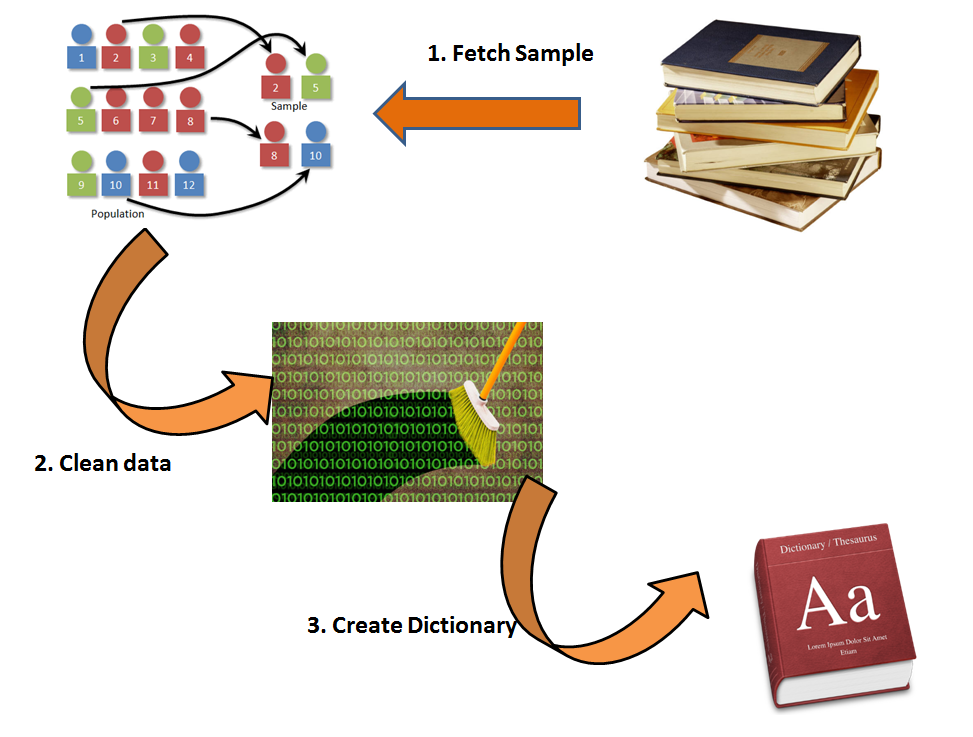
The first step in any text mining project is to identify and collect the relevant data sources. This could include internal data like customer support tickets, product reviews, and employee feedback, as well as external sources like social media posts, news articles, and competitor websites.
Given the high volume and velocity of textual data, it is often impractical and unnecessary to analyze the entire corpus. Instead, we can use sampling techniques to select a representative subset of the data for analysis. Some common sampling methods include:
- Simple random sampling: Each data point has an equal probability of being selected
- Stratified sampling: The data is divided into homogeneous subgroups (strata) and samples are selected from each stratum
- Cluster sampling: The data is divided into clusters, and a subset of clusters is randomly selected for analysis
The choice of sampling technique depends on the characteristics of the data and the objectives of the analysis. For example, if we want to compare sentiment across different product categories, we may use stratified sampling to ensure sufficient representation from each category.
Step 2: Data Cleaning and Pre-processing
Raw text data often contains noise, inconsistencies, and irrelevant information that can hinder the effectiveness of text mining algorithms. Therefore, an essential step is to clean and preprocess the text to improve its quality and reliability. Some common text preprocessing techniques include:
- Tokenization: Splitting the text into individual words or tokens
- Lowercasing: Converting all characters to lowercase to treat words consistently
- Removing punctuation and special characters
- Removing stop words: Filtering out common words like "a", "an", "the" that carry little meaning
- Stemming: Reducing words to their base or root form (e.g. "running" to "run")
- Lemmatization: Converting words to their dictionary form (e.g. "better" to "good")
- Spelling correction: Identifying and correcting misspelled words
Here‘s an example of preprocessing a text document using Python and the NLTK library:
import nltk
from nltk.corpus import stopwords
from nltk.stem import WordNetLemmatizer

text = "This is an example document. It contains some misspelled wrods and punctuation!!!"

# Tokenize and lowercase
tokens = [word.lower() for word in nltk.word_tokenize(text)]

# Remove punctuation and non-alphabetic tokens
words = [word for word in tokens if word.isalpha()]

# Remove stop words
stop_words = set(stopwords.words(‘english‘))
words = [word for word in words if not word in stop_words]

# Lemmatize
lemmatizer = WordNetLemmatizer()
words = [lemmatizer.lemmatize(word) for word in words]

print(words)
Output:
[‘example‘, ‘document‘, ‘contains‘, ‘misspelled‘, ‘wrods‘, ‘punctuation‘]By cleaning and standardizing the text, we can improve the accuracy and efficiency of downstream analysis tasks.
Step 3: Feature Extraction and Representation
The next step is to convert the preprocessed text into a structured format that can be used as input to machine learning algorithms. This involves extracting relevant features or attributes from the text and representing them numerically. Some common feature extraction techniques for text include:
- Bag-of-Words: Representing a document as a vector of word counts, disregarding grammar and word order
- TF-IDF: A weighted Bag-of-Words representation that reflects how important a word is to a document in a collection
- N-grams: Extracting contiguous sequences of n items (words or characters) from the text
- Word Embeddings: Mapping words to dense vector representations that capture semantic relationships, such as Word2Vec or GloVe
For example, let‘s represent a set of documents using the Bag-of-Words model in Python:
from sklearn.feature_extraction.text import CountVectorizer

docs = [
    "This is the first document.",
    "This document is the second document.",
    "And this is the third one.",
    "Is this the first document?",
]

vectorizer = CountVectorizer()
X = vectorizer.fit_transform(docs)

print(vectorizer.get_feature_names())
print(X.toarray())
Output:
[‘and‘, ‘document‘, ‘first‘, ‘is‘, ‘one‘, ‘second‘, ‘the‘, ‘third‘, ‘this‘]
[[0 1 1 1 0 0 1 0 1]
 [0 2 0 1 0 1 1 0 1]
 [1 0 0 1 1 0 1 1 1]
 [0 1 1 1 0 0 1 0 1]]
Here, each document is represented as a vector of word counts, where each element corresponds to the frequency of a particular word in the document.
Step 4: Building a Custom Dictionary
For many text mining tasks, off-the-shelf dictionaries and knowledge bases may not be sufficient to capture the specific terminology and domain knowledge relevant to the problem at hand. In such cases, we need to build a custom dictionary tailored to our data and use case.
A dictionary is essentially a collection of terms or concepts that we want to extract from the text. Building a custom dictionary typically involves the following steps:
- Identify a representative sample of documents from the corpus
- Manually review and annotate the documents to identify the key terms and concepts
- Compile the annotated terms into a dictionary format (e.g. CSV, JSON)
- Validate and refine the dictionary through iteration and feedback
For example, let‘s say we want to build a dictionary of product features mentioned in customer reviews. We would start by selecting a diverse sample of reviews, and then manually highlighting the feature-related terms like "battery life", "screen resolution", "camera quality", etc. We can then organize these terms into a structured format like:
Feature,Synonyms
battery life,battery,power,charge
screen resolution,resolution,display,screen
camera quality,camera,photo,picture
...
Having a high-quality, domain-specific dictionary is crucial for accurate information extraction and entity recognition.
Step 5: Information Extraction
With the text data preprocessed and represented as features, and a custom dictionary in place, we can now perform the actual information extraction to identify entities, relationships, and attributes of interest. Some common information extraction techniques include:
- Named Entity Recognition (NER): Identifying and classifying named entities such as persons, organizations, locations, etc. in the text
- Relation Extraction: Identifying semantic relationships between entities, such as "works for", "lives in", "purchased", etc.
- Event Extraction: Identifying occurrences of specific events or actions in the text, along with their participants and attributes
- Keyword Extraction: Identifying the most salient and informative keywords or phrases in a document
There are various open-source libraries and tools available for information extraction, such as spaCy, NLTK, Stanford CoreNLP, and OpenNLP. Here‘s an example of performing NER using the spaCy library in Python:
import spacy

nlp = spacy.load("en_core_web_sm")

text = "Apple Inc. is an American multinational technology company headquartered in Cupertino, California."

doc = nlp(text)

for ent in doc.ents:
    print(ent.text, ent.label_)
Output:
Apple Inc. ORG
American NORP
Cupertino GPE
California GPE
Here, spaCy identifies "Apple Inc." as an organization, "American" as a nationalities or religious or political group, and "Cupertino" and "California" as geopolitical entities.
Step 6: Scoring and Tagging
Once we have extracted the relevant entities and relationships from a sample of documents, the next step is to apply this knowledge to the entire corpus to tag and categorize each document. This involves:
- Using the custom dictionary and extraction rules to identify entities and relationships in each document
- Assigning scores or confidence levels to each extracted entity based on factors like frequency, context, and dictionary match
- Tagging each document with the extracted entities and their scores
- Storing the tagged documents in a structured format (e.g. database, JSON) for further analysis
For example, let‘s say we have extracted product features and sentiment from a set of customer reviews. We can represent each review as a JSON object with the extracted information:
{
  "review_id": "123",
  "text": "The battery life on this phone is amazing! The screen is also very clear and bright.",
  "features": [
    {
      "feature": "battery life",
      "sentiment": "positive",
      "score": 0.9
    },
    {
      "feature": "screen",
      "sentiment": "positive",
      "score": 0.8
    }
  ]
}
By tagging the entire corpus in this manner, we can enable structured querying and aggregation of the extracted information.
Step 7: Summarization and Insight Generation
The final step in the text mining process is to summarize the extracted information and derive actionable insights that can inform decision making. This involves:
- Aggregating the tagged documents by various dimensions such as entity type, sentiment, time period, etc.
- Computing summary statistics and metrics to quantify the patterns and trends in the data
- Visualizing the insights through charts, dashboards, and reports
- Communicating the findings to stakeholders and recommending actions based on the insights
For example, continuing with the customer review example, we can generate insights like:
- What are the most frequently mentioned product features?
- What is the overall sentiment towards each feature?
- How does the sentiment towards a feature vary over time?
- Which features have the highest correlation with overall product rating?
- What are the most common issues or complaints mentioned in negative reviews?
By answering these types of questions, we can uncover valuable insights that can help improve product design, customer satisfaction, and marketing strategies.
Conclusion
Extracting insights from unstructured text data is a complex and iterative process that requires a combination of domain knowledge, natural language processing techniques, and data analysis skills. By following the steps outlined in this guide, you can convert raw text into structured, actionable intelligence that drives business value.
As the volume and variety of unstructured data continues to grow, the ability to effectively mine and analyze text data will become increasingly critical for organizations across industries. By staying up-to-date with the latest techniques and best practices in NLP and text analytics, data professionals can position themselves to tackle the challenges and opportunities posed by unstructured data.
Some emerging trends and research directions in this field include:
- Transfer Learning: Leveraging pre-trained language models like BERT and GPT to improve the accuracy and efficiency of text mining tasks
- Unsupervised Learning: Developing algorithms that can learn patterns and relationships from unlabeled text data
- Multimodal Learning: Combining text with other data modalities like images, speech, and video to enable richer insights
- Explainable AI: Designing text mining models that are transparent, interpretable, and accountable
- Domain Adaptation: Adapting general-purpose NLP models to specific domains and use cases
As you embark on your own text mining projects, remember to start with a clear problem statement, gather high-quality data, experiment with different techniques, and iterate based on feedback and results. With the right approach and tools, the insights hidden in your unstructured text data are waiting to be discovered.


