Understanding Supervised and Unsupervised Machine Learning
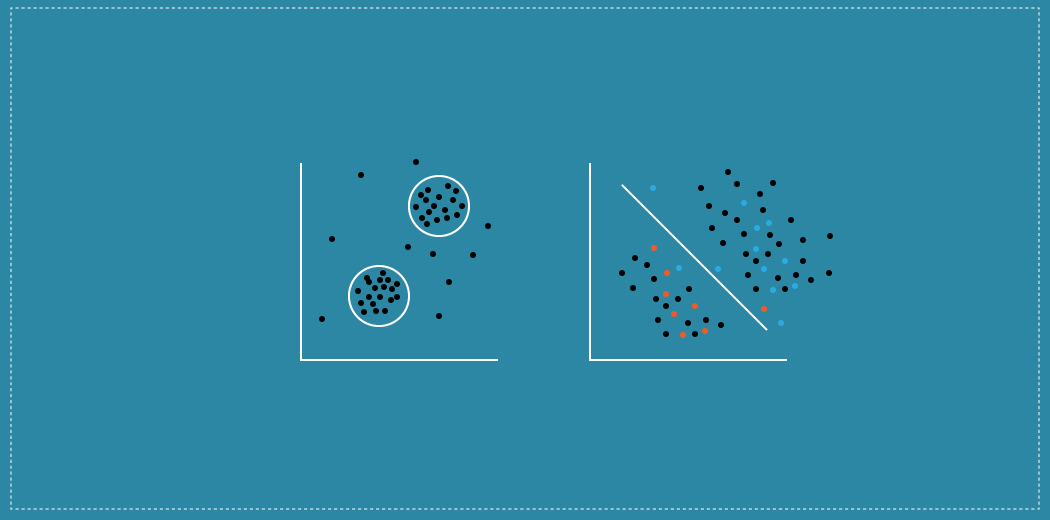
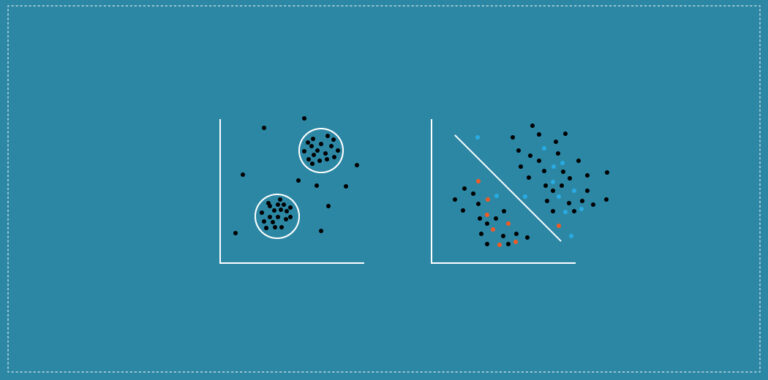
Machine learning has revolutionized the way we interact with data and make predictions. At a high level, machine learning algorithms can be categorized into two main types: supervised learning and unsupervised learning. Understanding the key differences between these two approaches is crucial for any data scientist or machine learning practitioner.
In this article, we‘ll dive deep into supervised and unsupervised learning. We‘ll explain the core concepts behind each approach, explore commonly used algorithms, and discuss practical applications and use cases. By the end, you‘ll have a solid grasp of when to use supervised learning versus unsupervised learning and how to get started applying these powerful techniques to real-world problems.
What is Supervised Learning?
Supervised learning is a type of machine learning in which an algorithm learns from labeled training data. The key characteristic of supervised learning is that the training data consists of input-output pairs. Each example in the training set contains one or more input features (the independent variables) and a corresponding output label (the dependent variable that we want to predict).
The goal of supervised learning is to train a model that can take in new, unseen inputs and accurately predict the corresponding outputs. You can think of supervised learning as learning with a "teacher." The labeled training data provides direct feedback to the algorithm, allowing it to learn the mapping from inputs to outputs. Common supervised learning tasks include:
- Regression: Predicting a continuous numerical value
- Classification: Predicting a discrete category or class
Some well-known applications of supervised learning include:
- Spam email filtering (classification)
- Medical diagnosis (classification)
- Stock price prediction (regression)
- Sales forecasting (regression)
The general process of supervised learning looks like:
- Collect a dataset containing input features and corresponding output labels
- Split the data into a training set and a test set
- Feed the training data to a supervised learning algorithm
- The algorithm learns a model that maps inputs to outputs
- Evaluate the trained model‘s performance on the unseen test set
- If performance is good, deploy the model to make predictions on new data
Supervised learning algorithms vary in terms of their underlying mathematical formulations and assumptions, but they all share this basic training paradigm of learning from labeled examples.
Popular Supervised Learning Algorithms
There are many supervised learning algorithms, each with its own strengths and weaknesses. Some of the most widely used include:
Linear Regression
Linear regression is used to predict a continuous output variable based on one or more input features. It assumes a linear relationship between the inputs and the output. The model representation is a linear equation like:
y = β0 + β1×1 + β2×2 + … + βnxn
where y is the predicted output, the x‘s are the input features, and the β‘s are the learned weights. Linear regression is simple and interpretable but can struggle with highly nonlinear relationships.
Logistic Regression
Despite its name, logistic regression is actually a classification algorithm. It predicts the probability that an input belongs to the positive class (labeled 1). The model representation is the logistic function:
p(y=1|x) = 1 / (1 + e^(-βTx))
where p(y=1|x) is the predicted probability, x is the input vector, and β is the learned weight vector. Logistic regression is often used for binary classification problems.
Decision Trees and Random Forests
Decision trees learn a tree-like model of decisions and their possible consequences. They make predictions by recursively splitting the input space into smaller subregions based on the most informative features. Random forests are an ensemble method that trains multiple decision trees and combines their predictions. These methods can learn complex, nonlinear relationships and handle both regression and classification.
Support Vector Machines
Support Vector Machines (SVMs) are a discriminative classification method that tries to find the hyperplane that maximally separates the classes in a high-dimensional space. SVMs employ a technique called the kernel trick to implicitly transform the inputs into a high-dimensional space. This allows them to learn nonlinear decision boundaries while still optimizing a convex objective.
Neural Networks
Neural networks, also known as deep learning, have achieved state-of-the-art performance on many supervised learning benchmarks, especially for perceptual tasks like computer vision and speech recognition. Neural nets are composed of layers of interconnected nodes that transform the inputs into increasingly abstract representations. They can learn highly complex functions but require a large amount of training data.
What is Unsupervised Learning?
In contrast to supervised learning, unsupervised learning algorithms are trained on unlabeled data. The dataset contains only input features and no corresponding output labels. The goal of unsupervised learning is to discover the underlying structure or distribution of the data.
Since unsupervised algorithms don‘t have a "teacher" providing the correct answers, they must learn from the data itself. They do this by identifying similarities between examples and grouping them together or by learning a compressed representation of the data that captures its salient features.
Common unsupervised learning tasks include:
- Clustering: Grouping similar examples together
- Dimensionality reduction: Reducing the number of features while retaining the most important information
- Anomaly detection: Identifying rare or unusual examples that differ from the norm
- Association rule mining: Discovering rules that describe large portions of the data
Some typical applications of unsupervised learning are:
- Customer segmentation (clustering)
- Genome sequencing (clustering)
- Recommender systems (dimensionality reduction + clustering)
- Fraud detection (anomaly detection)
The general process of unsupervised learning looks like:
- Collect an unlabeled dataset containing only input features
- Feed the data to an unsupervised learning algorithm
- The algorithm discovers patterns or structure in the data
- Extract knowledge or insights from the learned patterns
- If needed, assign semantic labels to the discovered groups or dimensions
Unsupervised learning is a powerful tool for exploratory data analysis and discovering novel insights from data. However, without ground truth labels, evaluating the quality of the results can be more challenging than in supervised learning.
Popular Unsupervised Learning Algorithms
Some of the most commonly used unsupervised learning algorithms include:
K-Means Clustering
K-means is a centroid-based clustering algorithm that partitions n examples into k clusters. It does this by iteratively assigning each example to its closest centroid and then updating the centroids to be the mean of their assigned points. K-means is simple and efficient but requires specifying the number of clusters in advance.
Hierarchical Clustering
Hierarchical clustering algorithms build a tree of nested clusters, known as a dendrogram. They can be agglomerative (starting with each example in its own cluster and merging the most similar clusters) or divisive (starting with all examples in one cluster and recursively splitting the least coherent clusters). Hierarchical clustering allows for more flexible cluster shapes than K-means.
Gaussian Mixture Models
Gaussian Mixture Models (GMMs) are a probabilistic clustering approach. They model the data distribution as a mixture of Gaussian distributions and use expectation-maximization to learn the parameters. GMMs are more flexible than K-means and can handle clusters with different sizes and correlation structures.
Dimensionality Reduction
High-dimensional data can be difficult to visualize and computationally expensive to process. Dimensionality reduction techniques aim to find a lower-dimensional representation of the data that preserves its most important structure.
Principal Component Analysis (PCA) is a popular linear method that finds the directions of maximal variance in the data. Singular Value Decomposition (SVD) is closely related and used in recommender systems.
For nonlinear dimensionality reduction, techniques like t-SNE and UMAP aim to preserve local neighborhoods of points while embedding them in a lower-dimensional space.
Choosing Between Supervised and Unsupervised Learning
So when should you use supervised learning versus unsupervised learning? The primary factor is whether you have access to labeled training data.
If you have a dataset with input-output pairs and your goal is to predict the outputs for new inputs, supervised learning is the way to go. With enough labeled examples, supervised learning algorithms can learn highly complex mappings from inputs to outputs.
On the other hand, if you only have unlabeled data and your goal is to discover its underlying structure, unsupervised learning is the appropriate choice. Unsupervised learning can reveal novel patterns that can lead to new hypotheses and insights.
There are also some situations where you can use both together:
-
Semi-supervised learning: When you have a small amount of labeled data and a large amount of unlabeled data, you can use the labeled examples to guide the unsupervised learning process.
-
Unsupervised pretraining: Some neural network architectures use unsupervised pretraining to initialize the weights before fine-tuning with labeled data, resulting in better generalization.
-
Dimensionality reduction before supervised learning: Using unsupervised methods like PCA to reduce the dimensionality can sometimes improve the performance of supervised learning algorithms.
Conclusions
We‘ve covered a lot of ground in this deep dive into supervised and unsupervised machine learning. To recap:
-
Supervised learning uses labeled data to learn a mapping from inputs to outputs. It‘s well-suited for prediction tasks like classification and regression.
-
Unsupervised learning discovers patterns in unlabeled data. It‘s often used for exploratory analysis and tasks like clustering and dimensionality reduction.
-
The choice between supervised and unsupervised learning depends on the availability of labeled data and the goals of the analysis.
Both supervised and unsupervised learning encompass a wide variety of algorithms, each with their own assumptions and use cases. Gaining hands-on experience with these algorithms is the best way to develop your intuition for when and how to apply them.
As machine learning continues to advance, we can expect to see new algorithms that blur the lines between supervised and unsupervised learning. For example, self-supervised learning uses clever techniques to extract "labels" from unlabeled data, enabling the use of supervised methods without manual annotation.
I hope this article has given you a solid foundation for understanding the core concepts of supervised and unsupervised machine learning. Armed with this knowledge, you‘re well on your way to leveraging these powerful techniques to uncover insights and make data-driven decisions. Happy learning!