20 Questions to Master the DBSCAN Clustering Algorithm
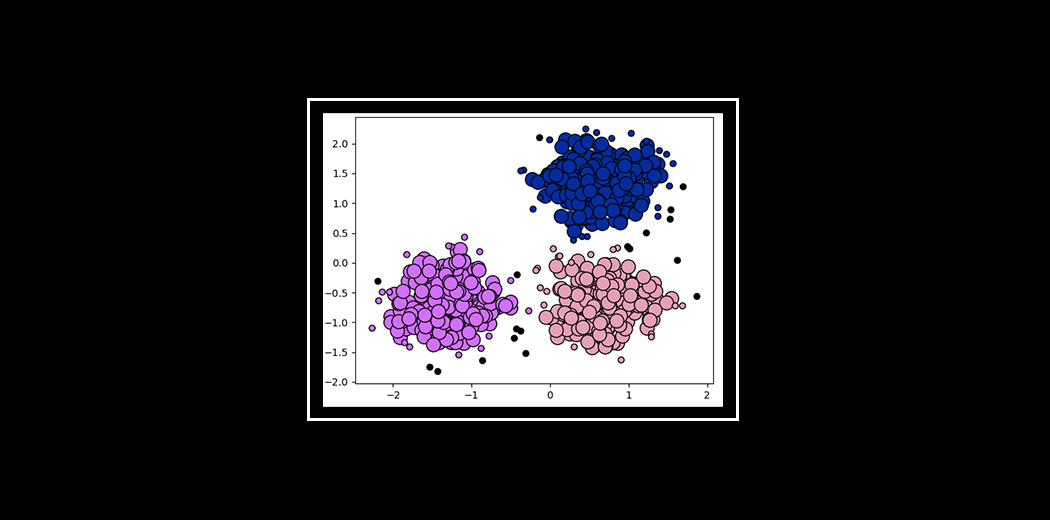
The DBSCAN (Density-Based Spatial Clustering of Applications with Noise) algorithm is an essential unsupervised machine learning technique for clustering that every aspiring data scientist should have in their toolkit. DBSCAN excels at identifying clusters of arbitrary shape and size in datasets that contain noise and outliers.
In this comprehensive guide, we‘ll dive deep into the inner workings of DBSCAN through 20 key questions. By the end, you‘ll have a solid grasp of the core concepts, key parameters, and practical considerations for applying DBSCAN effectively. Let‘s jump right in!
1. What is DBSCAN and how does it work?
DBSCAN is a density-based clustering algorithm that groups together data points that are closely packed in space, marking points in low-density regions as outliers. The algorithm works by:
-
Specifying two parameters: epsilon (the radius around a point to search for neighbors) and min_pts (the minimum number of points required to form a dense region).
-
Categorizing points as core points (at least min_pts within epsilon), border points (fewer than min_pts but within epsilon of a core point), and noise points (neither core nor border).
-
Assigning core points to the same cluster if they are within epsilon of each other. Border points are assigned to the cluster of their nearest core point. Noise points are not assigned to any cluster.
By connecting core points that are density reachable from each other, DBSCAN can find clusters of any shape and size, even in datasets with significant noise.
2. What are the steps of the DBSCAN algorithm?
The DBSCAN algorithm proceeds as follows:
-
Specify values for epsilon and min_pts.
-
For each unvisited point in the dataset:
- If it has at least min_pts neighbors within epsilon, mark it as a core point and assign it a new cluster label.
- Recursively do the same for all neighboring core points, assigning them to the same cluster.
-
For each non-core point:
- If it‘s within epsilon of a core point, mark it as a border point and assign it to that cluster.
- Else, mark it as a noise point.
-
Repeat steps 2-3 until all points have been processed.
The result is a partitioning of the data into clusters, with some points potentially marked as noise.
3. What are density-based models and how does DBSCAN relate to them?
Density-based models aim to find regions of high density in a dataset that are separated by regions of low density. They define clusters as contiguous regions of high density.
DBSCAN is the most widely used density-based clustering algorithm. It uses the concept of density-reachability (a point is reachable from another if there is a chain of points between them whose distance is less than epsilon) and density-connectivity (points are connected if they are both reachable from a common core point).
By defining clusters based on density rather than distance to a centroid (like k-means does), DBSCAN can find clusters of arbitrary shape and is robust to outliers and noise.
4. How do you choose values for the epsilon and min_pts parameters?
Choosing appropriate values for epsilon and min_pts is crucial, as they determine what DBSCAN considers a "dense" region. Here are some guidelines:
For epsilon:
- Plot the distance to the k-th nearest neighbor (where k=min_pts) for each point, sorted in descending order.
- Look for a knee or elbow in the plot – this is a good value for epsilon.
- Smaller epsilon will tend to find more, smaller clusters. Larger epsilon will tend to find fewer, larger clusters.
For min_pts:
- A good rule of thumb is min_pts >= dimensions of the data + 1.
- Larger min_pts are better for noisy data, but may miss smaller clusters.
- 2*dimensions is a reasonable default, but it depends on your data.
In general, it‘s good to try a few different parameter settings to get a feel for what works best for your particular dataset. Visualizing the resulting clusters can help guide your choice.
5. What are core, border, and noise points in DBSCAN?
DBSCAN categorizes data points into three types:
-
Core points have at least min_pts other points within a radius of epsilon. They are the seeds fromwhich clusters are grown.
-
Border points are within epsilon of a core point, but have fewer than min_pts neighbors. They are on the edge of a cluster but don‘t expand it.
-
Noise points are not within epsilon of any core points. They are considered outliers and are not assigned to any cluster.
For example, in a 2D dataset with epsilon=2 and min_pts=3:
- A core point would have at least 3 points within a radius of 2 (including itself).
- A border point would be within 2 units of a core point, but have only 1 or 2 neighbors total.
- A noise point would be more than 2 units away from any core points.
Understanding these point types is key to interpreting DBSCAN results and tuning the parameters effectively.
6. How does DBSCAN compare to k-means clustering?
While both are unsupervised clustering algorithms, DBSCAN and k-means have some key differences:
-
k-means requires specifying the number of clusters upfront, while DBSCAN determines this automatically based on density.
-
k-means assumes spherical clusters of similar size, while DBSCAN can find clusters of arbitrary shape and size.
-
k-means is sensitive to outliers, while DBSCAN is robust to outliers (marking them as noise).
-
k-means always assigns every point to a cluster, while DBSCAN may mark some as noise.
In general, DBSCAN outperforms k-means when the data has clusters of varying density and shape, and contains noise. However, k-means is often more computationally efficient, especially for high-dimensional data.
7. What are the advantages and disadvantages of DBSCAN?
Advantages of DBSCAN include:
- Doesn‘t require specifying number of clusters upfront
- Can find clusters of arbitrary shape and size
- Robust to outliers and noise
- Requires only two parameters (epsilon and min_pts)
Disadvantages of DBSCAN include:
- Sensitive to parameter choice, especially epsilon
- Struggles with clusters of varying density
- Computationally expensive, especially for high-dimensional data
- Can‘t handle datasets where distance between points doesn‘t capture density well
Whether DBSCAN is right for your problem depends on the characteristics of your data and your goals for clustering. It‘s a great choice for 2D/3D data with clear density differences, but may not be optimal for very high-dimensional data or clusters of similar density.
8. What is the time complexity of DBSCAN and how can it be optimized?
The time complexity of DBSCAN depends on how efficiently the neighborhood of each point can be found:
- Best case: If a spatial index like a k-d tree or R-tree is used to find neighbors, complexity is O(n log n).
- Worst case: If neighborhoods are found by brute force, complexity is O(n^2), where n is the number of points.
To optimize DBSCAN, using a spatial index is highly recommended, especially for larger datasets. Spatial indexes allow neighborhood queries to be performed in logarithmic time instead of linear time.
Additionally, DBSCAN can be parallelized by partitioning the data across machines and merging the results. There are also variants like HDBSCAN that aim to improve efficiency.
9. Discussion Question
Consider the following scenario: You are given a dataset of customer locations (latitude and longitude) for a delivery service. Your task is to group the customers into clusters for efficiently planning delivery routes.
- Would you use DBSCAN for this task? Why or why not?
- If using DBSCAN, how would you choose epsilon and min_pts?
- What other clustering algorithms might you consider?
- How would you validate whether the clustering results are useful for route planning?
Share your thoughts in the comments! There‘s no single right answer, but considering the pros and cons of different approaches is great practice.
Conclusion
We‘ve covered a lot of ground in this deep dive into DBSCAN – from the basic algorithm and key parameters, to practical tips for using it effectively. Density-based clustering is a powerful tool to have in your machine learning toolbox.
To recap, the key things to remember about DBSCAN are:
- It groups points based on density rather than distance to a centroid.
- It automatically determines the number of clusters based on epsilon and min_pts.
- It can find clusters of arbitrary shape and is robust to noise and outliers.
- Careful parameter tuning and spatial indexing are important for getting good results efficiently.
I hope these 20 questions have given you a solid foundation for applying DBSCAN to your own data. Try it out on a few datasets and see how it compares to other clustering methods. And don‘t forget to experiment with different parameters!
If you have any other questions or insights to share, please leave a comment below. Happy clustering!

![Claude AI Login Free: Sign Up, Login, Features, Security & FAQs [2025]](https://33rdsquare.com/wp-content/uploads/2024/03/20240312072802-65f00402611e7.png.webp)