AWS Glue: The Ultimate Guide to Serverless ETL for AI/ML Workloads

In today‘s data-driven world, organizations need to collect, process, and analyze massive amounts of data from diverse sources to power machine learning models and data-driven applications. However, the process of extracting data from source systems, transforming it into a usable format, and loading it into target destinations for analysis – known as ETL (extract, transform, load) – can be complex and time-consuming, especially as data volumes and varieties continue to grow.
This is where a tool like AWS Glue comes in. As a fully managed, serverless data integration service, Glue makes it easy to discover, prepare, and combine data for analytics, machine learning, and application development. By abstracting away infrastructure complexity and providing advanced capabilities like auto-scaling, job bookmarks, and built-in transforms, Glue enables data engineers and data scientists to build end-to-end ETL pipelines faster than ever before.
How AWS Glue Works: Architecture and Components
At its core, AWS Glue consists of three main components that work together to enable serverless ETL:
-
Glue Data Catalog: This is a fully managed metadata repository that stores information about your data assets, including table definitions, schema, partitions, and more. The Data Catalog acts as a central registry for your ETL jobs, allowing them to discover and access data without hardcoding paths or credentials. It also integrates with other AWS services like Athena, Redshift, and EMR for seamless querying and analysis.
-
Glue Crawlers: These are automated programs that scan your data stores (S3, RDS, Redshift, etc.), extract schema information, and populate the Glue Data Catalog with table definitions. Crawlers can be scheduled to run periodically and can automatically detect schema changes and new partitions. This eliminates the need for manual schema management and keeps your metadata in sync with your data.
-
Glue ETL Engine: This is the serverless Apache Spark environment that executes your ETL jobs. You can write your jobs using Python or Scala, or use the visual editor in Glue Studio to create no-code ETL workflows. The ETL engine dynamically provisions and scales up the necessary compute resources (e.g. memory, vCPUs) based on the volume and complexity of data processed. You only pay for the resources consumed during job execution.
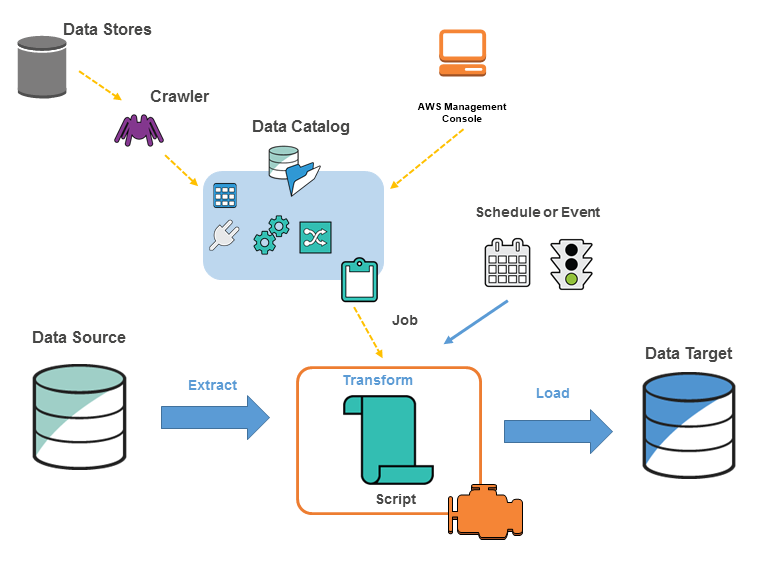
Image Source: AWS Glue Developer Guide
Here‘s how these components typically work together in an ETL workflow:
- A Glue crawler scans your data store (e.g. an S3 bucket) and populates the Glue Data Catalog with table definitions and schema.
- A Glue ETL job reads the source data from the Data Catalog, performs the necessary transformations (e.g. filtering, joining, aggregating), and writes the results to a target data store (e.g. Redshift).
- The transformed data can then be queried using SQL with tools like Amazon Athena or Redshift Spectrum, or fed into machine learning models using tools like SageMaker.
By orchestrating these components with Glue Workflows and Triggers, you can build complex, event-driven ETL pipelines that process data seamlessly from raw ingestion to processed consumption.
AWS Glue: Advanced ETL Features for AI/ML
Beyond the core functionality we just covered, AWS Glue provides a rich set of advanced features tailored for AI/ML workflows:
Glue Databrew
AWS Glue DataBrew is a visual data preparation tool that enables data analysts and data scientists to clean and normalize data without writing code. With DataBrew, you can easily discover data quality issues, apply standard transformations (e.g. filtering, splitting, joining), and enrich your data with pre-built functions for common tasks like sentiment analysis and entity extraction.
DataBrew profiles your data and provides intelligent suggestions to help you quickly identify and fix quality issues like missing values, outliers, and inconsistent formats. You can interactively explore and refine your datasets before publishing them to the Glue Data Catalog for downstream usage. This allows data scientists to spend less time wrangling data and more time building models.
Glue Elastic Views
Glue Elastic Views enable you to combine and replicate data across multiple data stores without the need for complex ETL jobs. With Elastic Views, you can create a virtual table that automatically combines data from different sources, including relational databases (Amazon Aurora, RDS), data warehouses (Amazon Redshift), and data lakes (Amazon S3).
Elastic Views keeps the combined view in sync with the source data, propagating any changes in real-time. This allows you to maintain a unified, consistent view of your data for analysis and model building, even as the underlying data changes. It also reduces data duplication and saves on storage costs.
SageMaker Notebooks Integration
AWS Glue integrates directly with Amazon SageMaker, allowing data scientists to use familiar Jupyter notebooks to prepare data and build machine learning models. With Glue‘s SageMaker Notebooks integration, you can:
- Access data in the Glue Data Catalog directly from SageMaker notebooks
- Run Glue ETL jobs from within a notebook to transform data on the fly
- Write and execute Spark code interactively to process large datasets
- Visualize and explore data using popular libraries like Pandas and Matplotlib
- Train and deploy machine learning models using SageMaker‘s built-in algorithms or your own custom code
This integration creates a seamless development experience, enabling data scientists to easily move between data engineering and model development tasks.
Glue Streaming ETL
In addition to batch ETL, AWS Glue supports streaming ETL to process and transform data in near-real-time. With Glue Streaming ETL, you can:
- Continuously ingest data from streaming sources like Amazon Kinesis or Apache Kafka
- Use Glue‘s familiar Spark-based programming model to transform data on the fly
- Write the transformed data to Amazon S3 data lakes and Amazon Redshift or Elasticsearch
Glue automatically scales the underlying Apache Spark Streaming clusters based on the volume of data being processed, so you don‘t have to worry about provisioning or scaling infrastructure. You can build end-to-end streaming pipelines entirely in AWS Glue, from ingestion to transformation to analysis and model training.
Glue Performance & Cost-Efficiency at Scale
One of the key benefits of using AWS Glue for ETL is its ability to handle large-scale data processing workloads in a cost-efficient manner. Glue‘s serverless, pay-as-you-go model automatically scales the underlying compute resources based on the amount of data being processed and the complexity of the workload.
In a benchmark conducted by AWS, Glue was able to process 1 TB of data stored in Amazon S3 in under 7 minutes, at a cost of just $3.29. The same workload running on a self-managed Spark cluster took over an hour and cost $28.13 – nearly 9x more expensive.

Image Source: AWS Big Data Blog
Glue achieves this performance through several optimizations:
- Dynamic Resource Allocation: Glue automatically scales up the number of workers (Apache Spark executors) based on the size of the dataset being processed. It also dynamically adjusts the worker type (Standard vs G.1X vs G.2X) based on the memory and CPU requirements of the ETL job. This ensures optimal utilization of compute resources without over-provisioning.
- Intelligent Partitioning: Glue analyzes the structure and size of your dataset and automatically determines the optimal number of partitions and partition keys. This allows Spark to process data in parallel across multiple workers, improving performance and avoiding out-of-memory errors.
- Serverless Spark Optimizations: Glue extends and optimizes Apache Spark to run efficiently in a serverless environment. This includes techniques like container reuse, dynamic executor sizing, and aggressive object caching, which minimize task startup costs and data shuffling overhead.
Together, these optimizations allow Glue to achieve near-linear scalability for ETL workloads, while maintaining a very attractive price-performance ratio compared to self-managed Spark.
Customer Case Studies
Many organizations, from startups to enterprises, are using AWS Glue to power their mission-critical ETL and ML workflows. Here are a few notable case studies:
- Netflix uses AWS Glue to process and analyze petabytes of user behavior data to power its famous recommendation engine. Glue crawlers scan the massive amounts of data landing in Amazon S3 from Netflix‘s streaming applications and populate the Glue Data Catalog. Nightly Glue ETL jobs then transform and aggregate this data into features that are used to train Netflix‘s machine learning models. Glue‘s serverless nature allows Netflix to easily scale this pipeline to handle spikes in viewership, without having to manage any infrastructure.
- Yelp uses AWS Glue to streamline its ad-hoc ETL workloads and enable self-service analytics for its business users. Yelp data scientists author ETL jobs using Glue‘s PySpark libraries and orchestrate them using Glue Workflows. The jobs read data from a variety of sources (S3, RDS, Redshift), apply complex business logic and transformations, and write the results into Redshift for analysis. Glue‘s dynamic mapping and schema evolution features allow Yelp to easily handle changing data structures and onboard new datasets with minimal effort.
- Autodesk uses AWS Glue to process IoT data from its manufacturing and construction equipment in real-time. Streaming data from sensors is ingested into Amazon Kinesis and then processed using Glue Streaming ETL jobs. The jobs perform data validation, enrichment, and aggregation, before landing the data into Amazon S3 and Redshift. Autodesk data scientists then use this data to train predictive maintenance models that detect equipment failures before they happen. Glue‘s integration with SageMaker allows them to easily move between data preparation and model training tasks.
These are just a few examples of how AWS Glue is helping organizations simplify and scale their data pipelines for AI/ML use cases. As data volumes continue to grow and data architectures become more complex, Glue provides a powerful, flexible, and cost-effective way to harness that data for insights and innovation.
Comparing AWS Glue to Alternatives
While AWS Glue is a popular choice for ETL, especially among AWS customers, it‘s not the only option available. Here‘s how Glue compares to some common alternatives:
| Feature | AWS Glue | Apache Spark | Azure Data Factory | GCP Dataflow |
|---|---|---|---|---|
| Serverless | Yes | No | No | Yes |
| Pricing Model | Pay-per-second | Pay-per-hour | Pay-per-activity | Pay-per-second |
| Programming Languages | Python, Scala | Python, Scala, Java, R | Python, .NET, PowerShell | Java, Python |
| Visual ETL | Glue Studio | Third-party tools | Azure Data Factory UI | Cloud Data Fusion |
| Data Catalog | AWS Glue Data Catalog | Apache Hive Metastore | Azure Data Catalog | GCP Data Catalog |
| Streaming ETL | Glue Streaming | Spark Streaming | Azure Stream Analytics | GCP Dataflow |
| Machine Learning Integration | SageMaker Notebooks | MLlib, Third-party libraries | Azure ML | GCP AI Platform |
| Automatic Scaling | Yes | Manual | Manual | Yes |
As we can see, Glue differentiates itself through its fully managed, serverless architecture, which eliminates the need for infrastructure management and enables automatic scaling based on workload. It also provides a unique set of value-added features, like the Glue Data Catalog, Glue Studio, and SageMaker integration, that accelerate end-to-end ML workflows.
That said, the other platforms have their strengths as well. Apache Spark provides the most flexibility and control, Azure Data Factory offers tight integration with the Azure ecosystem, and GCP Dataflow leverages Google‘s expertise in stream processing.
Ultimately, the right choice depends on your specific use case, existing skills and investments, and strategic priorities. For organizations standardized on AWS, comfortable with a fully managed approach, and looking to enable self-service, large-scale ETL/ML, AWS Glue is a strong contender.
Conclusion
As we‘ve seen, AWS Glue is a powerful and versatile tool for simplifying and scaling ETL data processing in the cloud. Its serverless, pay-as-you-go model abstracts away infrastructure complexity and enables you to focus on your data and business logic. Through capabilities like the Glue Data Catalog, Glue Studio, and Glue Streaming ETL, it accelerates all stages of the data pipeline, from ingestion to transformation to analysis and AI/ML.
While Glue is not the only option for ETL, it has proven its value in many demanding use cases, from Netflix‘s petabyte-scale recommendation pipelines to Autodesk‘s real-time IoT analytics. By following best practices around security, monitoring, and performance optimization, organizations can use AWS Glue to build production-grade ETL workflows that power the next generation of intelligent applications.
As data continues to grow in volume, velocity, and complexity, AWS Glue provides a scalable and resilient foundation for harnessing that data and driving business value. Whether you‘re a data engineer looking to streamline your pipelines, a data scientist looking to prepare data for modeling, or a business analyst looking to enable self-service insights, AWS Glue is a compelling choice.