Clumber Spaniel: Info, Pictures, Facts & More
Introducing the Clumber Spaniel: A Gentle Giant Among Gundogs
If you‘re looking for a calm, loyal and affectionate companion with a larger-than-life personality, look no further than the Clumber Spaniel. This distinctive white spaniel with its massive head, substantial bone and low-slung build may not be the most well-known of the sporting breeds, but those lucky enough to share their lives with a Clumber quickly become devoted fans of the breed. Let‘s take a closer look at this dignified yet comical gentle giant of the spaniel family.
A Brief History of the Clumber Spaniel
Like many dog breeds, the origins of the Clumber Spaniel are somewhat shrouded in mystery. The most commonly accepted theory is that the breed was developed in 18th century England by the Duke of Newcastle at his estate, Clumber Park in Nottinghamshire. It‘s thought that the breed descended from Alpine Spaniels imported to England from the kennels of Duc de Noailles of France.
An alternate theory is that the Clumber Spaniel resulted from crosses between Basset Hounds and early Alpine Spaniels. This could account for the Clumber‘s low build, substantial bone and scenting prowess. Regardless of the exact details of their heritage, we do know that the Clumber Spaniel type was well-established by the late 1700s, appearing in paintings and prints from that time period.
The Clumber Spaniel gained great popularity among the British aristocracy in the 19th century as a superb gun dog known for tirelessly working in dense underbrush to flush and retrieve game birds. Prince Albert, the husband of Queen Victoria, was a devoted fan of the breed and helped promote their status. The Clumber Spaniel was one of the first 10 breeds recognized by the AKC in 1878 upon the club‘s inception. Today, this regal yet fun-loving spaniel remains a beloved companion, though a fairly rare one, ranking 121st out of 195 AKC recognized breeds.
A Closer Look at the Clumber‘s Distinctive Appearance
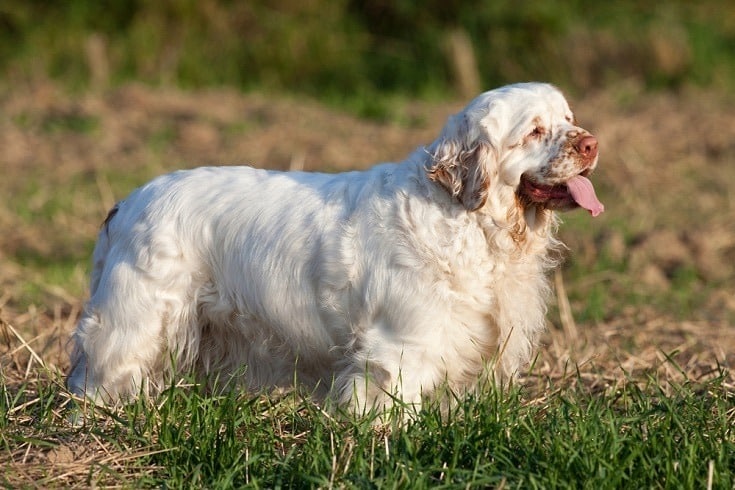
The Clumber Spaniel has a very unique look that sets it apart from other spaniels and sporting breeds. The most immediately noticeable feature is the Clumber‘s large, massive head with a deep, square muzzle and low-set, vine leaf-shaped ears. The eyes are dark amber in color with an intelligent, soulful expression. That broad head is supported by a long, arched neck flowing into a compact, low-slung and powerful body.
The Clumber has a deep chest, straight forelegs, and muscular hindquarters. The breed‘s short, straight coat is always primarily white in color, with possible sparse lemon or orange markings. The thick, soft coat is weather-resistant and provides protection when working in dense cover. The Clumber‘s long feathering on the legs and belly further protect the dog in the field. When viewed from the side, the Clumber has a unique rolling gait thanks to its short legs and elongated body.
The ideal height for a Clumber Spaniel is 17 to 20 inches at the withers for both males and females, with dogs on the smaller end of the range preferred. Males typically weigh 70 to 85 pounds, while females range from 55 to 70 pounds. This substantial size and bone lends the Clumber an aura of strength and dignity.
The Clumber Spaniel Temperament: Mellow, Amusing and Affectionate
When it comes to personality, the Clumber Spaniel is a study in contrasts. At home, this is a calm, laid-back breed content to relax and cuddle with loved ones. Clumbers have a sweet, gentle nature and make devoted companions. They tend to be good with children when raised with them and properly socialized. This mellow demeanor has earned them the nickname "the retired gentleman‘s spaniel."
However, in the field, the Clumber Spaniel transforms into a tireless, determined worker. Clumbers have a keen nose and great stamina, able to push through dense brush and rough terrain in pursuit of game birds. They work at a steady pace and are known for rarely passing birds, making them a practical choice for hunters.
No matter the context, the Clumber Spaniel tends to have an independent streak and a slightly stubborn nature. They are intelligent dogs who learn quickly but can sometimes choose to do things their own way. Maintaining a sense of humor is key when training a Clumber; with positive reinforcement and a patient, consistent approach Clumbers excel as calm, well-mannered companions.
Exercise and Training: Keeping Your Clumber Active and Engaged
Despite their somewhat subdued demeanor at home, Clumber Spaniels need daily exercise to stay physically and mentally healthy. A good long walk or play session each day is a must, though a Clumber will happily hike or jog alongside you for longer periods too. Access to a safely fenced yard is ideal, as Clumbers love having space to ramble and sniff.
Speaking of sniffing, scent games are an excellent way to put your Clumber‘s keen nose to work. Nose work classes, barn hunt events or even just hiding treats around the house or yard will delight your Clumber and provide valuable mental stimulation. Like most spaniels, Clumbers tend to keep a puppy-like love of play well into adulthood and will never turn down a game of fetch or tug.
As mentioned above, Clumber Spaniels are intelligent dogs but they can have a stubborn, independent side. They respond best to positive reinforcement training using treats, toys or enthusiastic praise to reward desired behaviors. Harsh corrections will only damage your relationship and shut your sensitive Clumber down. Keep training sessions short and fun, ending on a positive note while your Clumber is still engaged.
One area where training is particularly important for Clumber Spaniels is recall. These dogs have a high prey drive and will follow their noses if given the opportunity. Teaching a reliable recall from a young age is a must if you want to give your Clumber off-leash freedoms. Enrolling in a positive reinforcement-based obedience class can be a great way to build your training skills while socializing your Clumber.
Grooming and Care: Maintaining Your Clumber‘s Coat and Skin
Clumber Spaniels have a dense double coat that requires regular maintenance to keep it healthy and free of mats. Plan to brush your Clumber at least a couple times a week, more often if they‘ve been out rolling in the mud or swimming. Pay special attention to the longer feathering on the legs and belly, as this is where tangles are most likely to develop. A quick daily brushing is ideal.
Clumbers are moderate shedders but regular brushing will help keep loose hair under control. They typically "blow coat" or shed more heavily once or twice a year; daily brushing during these times will be necessary. Clumbers only need occasional baths, unless of course they‘ve found something delightfully stinky to roll in. When you do bathe your Clumber, be sure to use a mild dog shampoo and rinse thoroughly to prevent skin irritation.
Like all floppy-eared dogs, Clumbers can be prone to ear infections. Check and clean your Clumber‘s ears weekly using a veterinarian-approved ear cleaner. Gently wipe out the exterior of the ear canal, being careful not to insert anything into the ear itself. If you notice redness, a foul odor, or your Clumber frequently scratching at their ears, it‘s time for a vet visit.
Clumbers should have their nails trimmed every few weeks to keep them short and prevent discomfort when walking. Introduce nail trims gradually and pair them with lots of yummy treats so your Clumber learns to enjoy the process. You‘ll also want to brush your Clumber‘s teeth daily or at least a few times a week to prevent dental disease and keep breath fresh.
Potential Health Issues to Be Aware Of
As a large, deep-chested breed, Clumber Spaniels are unfortunately prone to a few health issues that potential owners should be aware of. Responsible Clumber breeders screen for these conditions to help produce the healthiest pups possible. Some issues Clumbers may face include:
-
Hip and elbow dysplasia: These orthopedic conditions occur when the hip or elbow joint fails to develop properly, leading to arthritis and lameness. Responsible breeders screen breeding stock with x-rays to help prevent passing on dysplasia to pups.
-
Eye issues: Clumbers can be prone to eye conditions like entropion (where the eyelid rolls inward, irritating the eye), ectropion (where the eyelid droops outward), and progressive retinal atrophy (PRA). Annual eye exams and screening breeding dogs can help catch and control these issues.
-
Intervertebral disc disease (IVDD): This back condition occurs when the jelly-like discs between the vertebrae bulge or burst, causing pain and sometimes paralysis. Supporting your Clumber to maintain a healthy weight and avoiding high-impact activities can help prevent IVDD.
-
Hypothyroidism: Clumbers may be prone to underactive thyroids. Symptoms include weight gain, hair loss, dry skin and low energy. Hypothyroidism is manageable with daily medication.
-
Exercise-induced collapse (EIC): This genetic condition causes muscle weakness and collapse after periods of intense exercise. A DNA test is available to screen for the EIC mutation before breeding.
While this list may seem daunting, many Clumbers live long, healthy lives, especially when purchased from responsible breeders who health test. Providing your Clumber with a nutritious diet, maintaining a healthy weight, and going to regular vet check-ups will all help promote lifelong health and happiness.
The Clumber Spaniel as a Family Pet
For the right family, the Clumber Spaniel makes a wonderful companion. They are known for being calm, loving and gentle with their people, including kids. Clumbers are not an overly rambunctious or hyper breed, so they fit in well with families looking for a laid-back canine companion. They are content to cuddle on the couch or follow you from room to room just to be close by.
That said, Clumbers are a large, heavy breed and could accidentally knock over small children, so supervision is always recommended. Teaching kids how to appropriately interact with dogs is important for any breed, but especially a dog as big as a Clumber. Clumbers may be less tolerant of rough handling or grabby hands than some smaller spaniel breeds.
Clumber Spaniels generally do well with other dogs, especially when socialized from a young age. Slow introductions and supervision will help your Clumber accept a new canine family member. Because of their strong prey drive, Clumbers may not be trustworthy around small furries like cats or rabbits unless raised with them from puppyhood.
One thing to note about Clumbers is that they can be somewhat messy houseguests. Those lovable jowls mean a fair bit of drool, and their fluffy coats track in water, mud, and debris from outside like nobody‘s business. If you‘re a neat freak, a Clumber may not be the breed for you. But if you can handle a little mess in exchange for a lot of love, a Clumber could be your new best friend.
Finding a Clumber Spaniel Puppy
As a fairly rare breed, finding a Clumber Spaniel puppy can take some time and research. The best place to start your search is through the Clumber Spaniel Club of America (CSCA), the AKC parent club for the breed in the United States. The CSCA maintains a breeder directory on their website and can help connect you with responsible breeders.
When looking for a Clumber breeder, be sure to ask lots of questions. Ethical breeders will be happy to answer your queries about health testing, temperament, and the puppy-raising process. They‘ll likely have questions for you as well, as good breeders are committed to placing pups in appropriate homes. Avoid any breeders who always have puppies available, don‘t health test, or won‘t let you visit their facility.
If you‘re open to adopting an adult Clumber, the CSCA also maintains a rescue and re-home program for Clumbers in need. Adopting an older dog can be a great way to skip the challenging puppy stage while still enjoying the delightful Clumber personality. Plus, you‘ll be providing a loving home to a dog in need.
Fun Facts About the Clumber Spaniel
-
The Clumber Spaniel is the largest of the AKC spaniel breeds. Only the Irish Water Spaniel comes close in size.
-
The name "Clumber" likely comes from the Duke of Newcastle‘s Clumber Park estate, where the breed was developed and refined.
-
Clumbers have a unique gait due to their long, low build. Their distinctive rolling gait has been described as "a roll, or your money back."
-
Despite their great size and somewhat clumsy appearance, Clumber Spaniels are graceful, hardy working dogs capable of traversing difficult terrain with ease.
-
Famous Clumber Spaniel owners throughout history include King Edward VII and George V, Sigmund Freud, and Winston Churchill.
-
Clumbers are sometimes called "the retired gentleman‘s spaniel" thanks to their calm demeanor and history as hunting companions for nobility.
In Conclusion
The Clumber Spaniel may not be a household name like the Labrador Retriever or Golden Retriever, but this gentle giant of the spaniel family has so much to offer as a companion. With their sweet, mellow disposition, amusing antics, and unwavering loyalty, Clumbers charm everyone who meets them. For active families looking for a laid-back best friend or outdoorsy types seeking a capable hunting partner, the Clumber Spaniel is a bred apart. These regal yet playful pups may be one of the dog world‘s best kept secrets.