
Data Engineering for Beginners: A Deep Dive into the Apache Spark Architecture
Introduction to Apache Spark
Apache Spark has become the de facto standard for big data processing and analytics in the data engineering world. Spark‘s ability to efficiently process massive datasets across large clusters of machines has made it an indispensable tool as data volumes continue to grow exponentially.
Spark was born out of the AMPLab at UC Berkeley in 2009 and later donated to the Apache Software Foundation, which has maintained it as a top-level open source project ever since. Over the past decade, Spark has seen widespread adoption across industries for its speed, ease of use, and vibrant open source community. Spark is now one of the most active open source big data projects, with over 500 contributors from more than 200 organizations [1].
Surveys have shown explosive growth in Spark adoption. In the 2016 Spark Survey, 54% of respondents reported using Spark in production, up from just 13% two years prior [2]. By the 2020 Spark + AI Summit, that number reached 92% [3]. Spark has found applications across a variety of use cases including ETL, analytics, streaming, machine learning, and graph processing.
So what makes Spark so powerful and widely adopted? The key lies in its distributed architecture that enables data to be efficiently processed in memory across a cluster of machines. By minimizing expensive disk I/O, Spark is able to achieve performance up to 100x faster than traditional MapReduce for certain applications [4]. Additionally, Spark provides expressive and intuitive APIs in multiple languages for performing this distributed data processing.
Spark Architecture Overview
Credit: Apache Spark Documentation
At a high level, a Spark application consists of a driver process that coordinates work across a cluster of executor processes. The driver is responsible for three main duties:
- Maintaining information about the Spark application, such as the tasks‘ execution DAG and metadata about RDDs
- Responding to user program or input
- Analyzing, distributing, and scheduling work across the executors
The executors are responsible for actually carrying out the work assigned to them by the driver. Executors have several key characteristics:
- Launched once at the beginning of a Spark application and typically run for the entire lifetime of an application
- Perform all data processing and computations assigned by the driver
- Store computation results in memory, disk, or off-heap storage
- Read from and write data to external sources
The cluster manager is the component responsible for launching and managing executor processes across the cluster. Spark interfaces with a variety of cluster managers including:
- Spark Standalone – a built-in cluster manager that makes it easy to set up a cluster
- YARN – part of the Hadoop ecosystem and used to manage cluster resources
- Mesos – a general cluster manager that can run Hadoop, Spark, and other applications
- Kubernetes – an increasingly popular choice for containerized applications
One of the key benefits of Spark‘s architecture is that it abstracts away much of the complexity of distributed computing. Spark automatically handles the distribution of data and computation across the cluster, freeing developers to focus on writing business logic rather than low-level optimizations.
Resilient Distributed Datasets (RDDs)
Resilient Distributed Datasets (RDDs) are the core building blocks and low-level abstraction of a Spark application. An RDD is an immutable, partitioned collection of elements that can be operated on in parallel across a cluster. Immutability is key for fault tolerance, as an RDD can always be recreated if a node fails.
Here are some of the key characteristics of RDDs:
- Immutable, read-only partitioned collection of records
- Resilient, so can be recomputed if nodes fail
- Evaluated lazily, so transformations build up DAG of operations
- Automatically partitioned across the cluster
- In-memory, but can spill to disk if needed
- Cacheable for fast reuse
- Created through deterministic operations on data in stable storage or from other RDDs
RDDs support two main types of operations: transformations and actions. Transformations, such as map and filter, define a new RDD from an existing one. Actions, such as count or collect, trigger computation and return a value to the driver.
Here‘s a simple example of using RDDs in Spark with Python to do a word count:
lines = sc.textFile("data.txt")
counts = lines.flatMap(lambda x: x.split(‘ ‘)) \
              .map(lambda x: (x, 1)) \
              .reduceByKey(lambda x, y: x + y)
output = counts.collect()
This code first reads lines from a text file into an RDD. It then splits each line into words, maps each word to a tuple of (word, 1), and then counts the words by summing the 1‘s for each word. Finally, the collect action brings the results from the RDDs on the executors to the driver.
DataFrames and Spark SQL
While RDDs provide a flexible, low-level API, Spark also provides a higher level abstraction called DataFrames. A DataFrame is a distributed collection of data organized into named columns, conceptually similar to a table in a relational database.
DataFrames offer several benefits over RDDs:
- Ability to scale from kilobytes to petabytes
- Support for wide array of data formats and storage systems
- Automatic optimization with an extensible optimizer
- Support ANSI SQL and HiveQL
- Seamless integration with all big data tooling and frameworks via Spark
With DataFrames and Spark SQL, developers can write significantly less code and still gain huge performance speedups. The following is an example of using DataFrames to find the average age of employees in a company:
df = spark.read.json("employees.json")
df.groupBy("company").agg(avg("age")).show()
This code first reads a JSON file into a DataFrame. It then groups by company, calculates the average age using the agg function, and shows the results.
Behind the scenes, when an action is triggered on a DataFrame, Spark‘s Catalyst optimizer generates an optimized query plan. Catalyst uses a tree representation to manipulate the plan using rules and cost-based optimization. The plan is then translated to lower level RDD operations for execution.
Spark Ecosystem
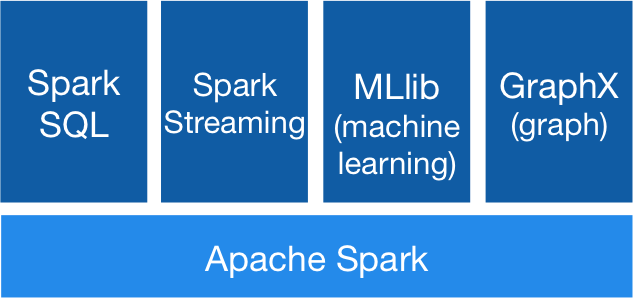
Beyond its core APIs, Spark has grown to encompass an entire ecosystem of libraries covering a variety of data processing tasks. These include:
- Spark SQL – Structured data processing
- Spark Streaming – Real-time stream processing
- MLlib – Machine learning library
- GraphX – Graph computation engine
Additionally, a variety of open source and commercial projects have been built on top of Spark to improve usability, management, monitoring, and data science productivity. Examples include Databricks notebooks, the Koalas project for a pandas API on Spark, and the Delta Lake project for building data lakes.
Conclusion
Apache Spark has revolutionized big data processing with its innovative architecture that combines the scalability of distributed computing with the usability and performance of in-memory processing. As data volumes continue to explode, Spark has become the tool of choice for data engineering across a variety of use cases and industries.
Some key benefits of Spark:
- High performance batch and real-time data processing through in-memory computing
- Support for multiple APIs (RDDs, DataFrames/SQL, Streaming, MLlib, GraphX)
- Unified analytics through support for SQL queries and dataframe operations
- Runs on Hadoop, Kubernetes, standalone or in the cloud
- Active open source community with frequent releases
The upcoming release of Spark 3.0 promises further improvements and new capabilities including:
- ANSI SQL compliance
- 2x performance improvement for Spark SQL
- Adaptive query execution to dynamically optimize partition size
- Structured streaming UI for monitoring and managing production applications
- Up to 40x speedups for certain ML algorithms in MLlib
For data engineers looking to scale data processing to handle massive, real-time datasets, Spark is a critical tool to learn. Its powerful APIs and vibrant ecosystem make it well-suited for everything from ETL to exploratory data analysis to machine learning. With the rapid pace of innovation in the Spark community, the future is bright for this already essential big data framework.


