
The Top 12 Data Science Leaders to Follow in 2026
Introduction
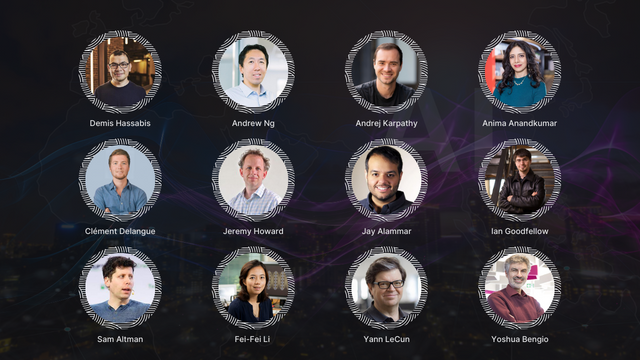
As we enter 2024, data science and artificial intelligence continue to advance at a rapid pace, transforming industries and shaping the future. Staying on the cutting edge requires learning from the brilliant minds at the forefront of the field. In this post, we highlight 12 data science leaders who are driving innovation through their research, entrepreneurship, and thought leadership.
From machine learning pioneers to influential educators, these leaders are not only achieving breakthroughs but also generously sharing their knowledge and vision with the data science community. Following them will give you insight into the latest techniques, tools, and ideas that will power the next wave of AI applications.
1. Andrew Ng
Andrew Ng is one of the most recognized names in artificial intelligence and a pioneer in online education for AI and machine learning. He founded the Google Brain project and previously served as chief scientist at Baidu. Ng now focuses on his company Landing AI, which provides end-to-end AI solutions for enterprises, and his educational initiatives like the Deep Learning Specialization on Coursera which has reached over 250,000 learners.
What impresses me most about Andrew Ng is his rare combination of technical brilliance and ability to make complex concepts accessible to a wide audience. He is not only achieving AI breakthroughs but working hard to dramatically expand access to AI education around the world. His essay "AI For Everyone" lays out an optimistic vision for how artificial intelligence can benefit humanity.
2. Andrej Karpathy
Andrej Karpathy served as Director of AI and Autopilot Vision at Tesla, where he led the computer vision team working on the brand‘s self-driving capabilities. Prior to Tesla, he did fascinating work on image captioning and processing as part of OpenAI and during his PhD at Stanford advised by Fei-Fei Li.
In addition to his technical accomplishments, Karpathy is an influential voice in the AI community due to his widely read blog, which features highly accessible tutorials and musings on deep learning. His motto of "Do Machine Learning Like You‘re Having Fun" embodies his hands-on, experiment-driven approach. I always look forward to his insightful yet irreverent takes on the latest techniques and trends in AI.
3. Anima Anandkumar
Anima Anandkumar is a Bren professor at Caltech and director of machine learning research at NVIDIA. Her research focuses on large-scale machine learning and high-dimensional statistics, with applications in domains like computer vision, natural language processing, and biology. Some of her most notable work involves tensor methods for making ML algorithms more scalable and efficient.
As one of the most followed AI researchers on social media with over 200K twitter followers, Anandkumar has a huge platform for advocating for diversity and inclusion in the field. She frequently highlights rising stars from underrepresented backgrounds and is a co-founder of the organization Women in ML. She sets a powerful example as a leader making machine learning both more advanced and more equitable.
4. Fei-Fei Li
Fei-Fei Li is a professor of computer science at Stanford and one of the world‘s leading experts in computer vision and cognitive neuroscience. She is most well known for her work on ImageNet, a massive visual database that has enabled breakthroughs in areas like object recognition and visual search. The ImageNet Large Scale Visual Recognition Challenge became a benchmark for advancing computer vision.
Beyond her technical feats, Li has also been a prominent advocate for "human-centered AI" that augments rather than replaces people. She co-founded AI4ALL, a nonprofit working to improve diversity and inclusion in the field. Her vision for the future of artificial intelligence is one in which technologists work closely with leaders in other domains to tackle major societal challenges.
5. Yann LeCun
Yann LeCun, along with Geoffrey Hinton and Yoshua Bengio, is considered one of the "godfathers of deep learning". He is best known for developing convolutional neural networks, a foundational deep learning architecture that has powered breakthroughs in computer vision and beyond. LeCun is currently Vice President and Chief AI Scientist at Meta where he oversees fundamental AI research.
One of the things I find fascinating about LeCun is the breadth of his interests and expertise. While he is a pioneer in machine learning, he also frequently shares insights on topics like robotics, neuroscience, and the philosophy of intelligence. Following him is a great way to stay up to date on meta‘s latest innovations while also gaining exposure to important ideas from adjacent fields.
6. Ian Goodfellow
Ian Goodfellow is most well known for inventing generative adversarial networks (GANs), a technique that has powered stunning advances in areas like image and video synthesis. He also literally wrote the textbook on deep learning, which has been read by hundreds of thousands of students and practitioners. Goodfellow spent several years as a research scientist at Google Brain and OpenAI before recently joining Apple as Director of Machine Learning.
At Apple, Goodfellow is working on privacy-preserving AI and techniques for training large models on decentralized data, which could enable a new wave of privacy-safe intelligent applications. For those looking to go deeper into the technical frontiers of deep learning, I highly recommend following Goodfellow‘s work and writing.
7. Clement Delangue
Clement Delangue is co-founder and CEO of Hugging Face, a platform that has quickly become the go-to destination for open-source machine learning models. Hugging Face provides tools, datasets, and a community for developing and deploying state-of-the-art models for natural language processing, computer vision, speech recognition, and more. It has been used by thousands of companies and reached over 10 billion model downloads.
What I love about Hugging Face is its mission to democratize machine learning and make the latest techniques accessible to everyone. By providing a unified platform and a thriving community, it is enabling developers to build powerful applications without needing to train models from scratch. Delangue is not just building a company but an entire ecosystem for open and collaborative AI development.
8. Jay Alammar
Jay Alammar is one of my favorite data science educators and communicators. As a blogger and head of developer advocacy at Cohere, he creates highly visual and intuitive explanations of complex topics in natural language processing and machine learning. Some of his most popular articles dive into transformer architectures, word embeddings, and recent language models like GPT-3.
With a Twitter following of over 100,000, Alammar has become hugely influential in making data science and AI knowledge accessible to a wide audience. For data scientists and ML engineers looking to stay on top of the latest techniques, I always recommend Alammar‘s blog as a resource. He not only dives into the technical details but provides the context to understand why new methods matter.
9. Sam Altman
Sam Altman is CEO of Anthropic, an AI research company with the mission of building large language models that are "steerable, interpretable, and robust." Anthropic made waves with its work on InstructGPT and "constitutional AI", an approach to baking instructions and guidelines into the training process itself. Altman previously led OpenAI, where he helped develop GPT-3 and DALL-E.
Altman is not just a technologist but a visionary thinker about the future impacts of artificial intelligence. In essays and interviews, he argues that AI will be the most important technology developed this century, with the potential to help solve problems like climate change and disease. At the same time, he believes AI governance is one of the great challenges facing humanity. Wherever you fall on these debates, Altman is essential reading.
10. Yoshua Bengio
Yoshua Bengio, alongside Yann LeCun and Geoffrey Hinton, is considered one of the pioneers of deep learning. He is a professor at the University of Montreal and the founder of Mila, an artificial intelligence research institute with hundreds of researchers devoted to machine learning theory and applications. Bengio‘s academic work continues to push the boundaries of architectures like generative and recurrent neural networks.
In addition to his technical accomplishments, Bengio has also been a prominent voice on the responsible development of AI. He is one of the authors of the Montreal Declaration for the Responsible Development of AI, which argues for AI systems that embody principles like privacy, transparency and democratic participation. As AI systems become more powerful and pervasive, Bengio shows the importance of developing them with robust ethical frameworks.
11. Jeremy Howard
Jeremy Howard is an entrepreneur, educator, and data scientist. He is the co-founder of fast.ai, a non-profit research lab with the mission of making deep learning "accessible to all". fast.ai has released popular open-source libraries and courses that have been used by hundreds of thousands of students and researchers to learn deep learning and create state-of-the-art models.
Prior to fast.ai, Howard was the President and Chief Scientist at Kaggle, the world‘s largest community of data scientists and machine learning practitioners. He also founded two successful start-ups in the insurance and e-mail sectors. Howard brings a unique blend of technical expertise and real-world business experience to his work.
What I appreciate about Howard is his commitment to expanding access to machine learning education and his willingness to weigh in on crucial issues facing the field. He is a strong advocate for data scientists using their skills in service of social good and regularly calls for increased efforts to mitigate issues like algorithmic bias. There is much to learn not only from Howard‘s technical knowledge but from his principles and worldview.
12. Demis Hassabis
Demis Hassabis is the founder and CEO of DeepMind, a world leader in artificial intelligence research. He is a former child chess prodigy and video game designer who was bitten by the AI bug and pivoted into building advanced machine learning systems. DeepMind aims to combine insights from neuroscience and computer science to create artificial general intelligence (AGI) that can match the flexibility and creativity of human intelligence.
DeepMind is most well known for developing AlphaGo, the first program to defeat a world champion at the ancient Chinese board game Go. They have since notched milestones in areas like navigating complex environments, modeling proteins, and even proving mathematical theorems. Most recently, DeepMind announced GameGan, an AI system that learns to mimic game engines from video input alone.
While most of us can only dream of matching DeepMind‘s resources, there is still much to learn from Hassabis‘s research tastes and philosophy on AI development. He favors an interdisciplinary approach that starts from computational principles of the brain while leveraging the scalability of modern computing. Hassabis also frequently shares thoughts on the risks and governance questions raised by increasingly advanced AI systems.
Conclusion
Data science and artificial intelligence move incredibly fast, with new breakthroughs and ideas emerging almost every day. One of the best ways for data scientists and AI practitioners to stay on the cutting edge is to learn from the pioneers who are shaping the future of the field.
The 12 leaders we have spotlighted represent some of the most accomplished and influential voices in data science today. Following their work will give you a front-row seat to the key technical developments driving AI progress, from large language models to reinforcement learning to privacy-preserving techniques.
But technical chops are only part of what makes these leaders worth following. You will also gain insight into the human side of data science – the ethics and philosophies that guide how we develop AI systems, the pedagogies that can bring more people into the field, and the real-world applications that turn research into impact.
Data science is ultimately a human endeavor – a quest to use the power of data and computation to expand knowledge and tackle great challenges. The leaders profiled here show us what that endeavor looks like when it is pursued with brilliance, integrity, and an enduring commitment to expanding the frontiers of both machine and human intelligence.


