Market Basket Analysis: Driving Profitable Cross Selling with Advanced Analytics
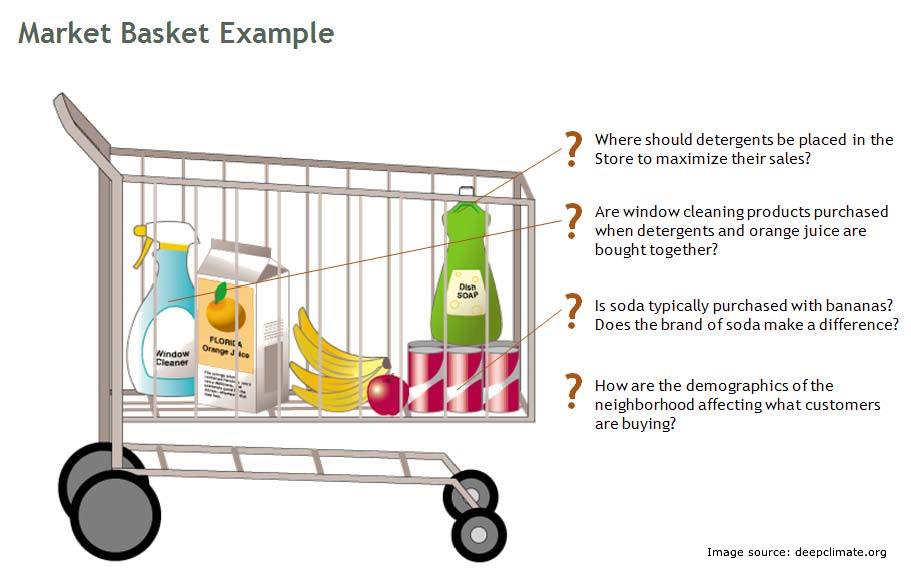
Cross selling—encouraging customers to purchase additional items related to what they are already buying—is a time-tested retail strategy for boosting revenue and profitability. By some estimates, cross selling can account for as much as 35% of total sales and 25% of profits for retailers.[^1] When done effectively, cross selling deepens customer relationships, increases share of wallet, and improves customer lifetime value.
However, determining which products to pitch to which customers is easier said than done. With thousands of SKUs and millions of possible product combinations, it‘s simply not feasible for marketers to manually identify the optimal cross sell bundles. That‘s where market basket analysis comes in.
Understanding Market Basket Analysis
Market basket analysis, also known as affinity analysis or association rule mining, is a data mining technique for uncovering relationships between items frequently purchased together. By analyzing historical transaction data, market basket analysis identifies statistically significant product associations, which can then be used to inform cross selling efforts.
The concept of market basket analysis dates back to a 1994 paper by IBM researcher Rakesh Agrawal.[^2] Agrawal and his colleagues developed the Apriori algorithm, which remains the most widely used method for mining association rules to this day. The algorithm works in two steps:
- Find all frequent itemsets that exceed a minimum support threshold
- Generate strong association rules from the frequent itemsets that meet a minimum confidence threshold
Let‘s unpack this a bit further. An itemset is simply a collection of one or more items. If an itemset appears in a sufficiently large proportion of transactions (the support), it is considered frequent. The Apriori principle states that if an itemset is frequent, then all of its subsets must also be frequent. This allows the algorithm to prune itemsets that can‘t possibly meet the support threshold, dramatically reducing the search space.
Once all frequent itemsets have been found, the algorithm then constructs rules of the form {A,B}➞{C}, meaning that if items A and B appear in a transaction, then C is also likely to appear. The strength of an association rule is measured by two key metrics:
- Support: The proportion of transactions that contain all items in the rule
- Confidence: The proportion of transactions containing the antecedent (left hand side) that also contain the consequent (right hand side)
Another important metric is lift, which measures how much more likely the consequent is to occur when the antecedent is present compared to its overall frequency in the dataset. A lift greater than 1 indicates a positive association between the items, while a lift less than 1 indicates a negative association.
Market Basket Analysis in Action
To illustrate how market basket analysis works in practice, let‘s walk through a simple example using a sample dataset of 1,000 supermarket receipts:
| Transaction ID | Items |
|---|---|
| 1 | {bread, milk, eggs} |
| 2 | {bread, peanut butter, jelly} |
| 3 | {milk, cereal, bananas} |
| 4 | {bread, peanut butter, milk} |
| … | … |
After applying the Apriori algorithm with a minimum support of 0.01 and a minimum confidence of 0.5, we get the following association rules:
| Rule | Support | Confidence | Lift |
|---|---|---|---|
| {bread} ➞ {milk} | 0.05 | 0.6 | 1.8 |
| {peanut butter} ➞ {jelly} | 0.02 | 0.8 | 6.4 |
| {bread, peanut butter} ➞ {milk} | 0.01 | 0.75 | 2.25 |
The first rule says that bread and milk appear together in 5% of transactions, and 60% of the time someone buys bread they also buy milk. The second rule indicates an even stronger affinity between peanut butter and jelly. And the third rule suggests that people buying both bread and peanut butter are especially likely to purchase milk as well.
We can visualize these associations using a network graph, where nodes represent items and edges represent rules:

Thicker edges indicate higher lift values. We can see that while milk is connected to many items, its strongest associations are with bread and cereal. Peanut butter and jelly have an especially strong link, which makes sense given that they are often consumed together.
So how can these insights be translated into cross selling actions? Here are a few ideas:
- Create a "PB&J Bundle" that offers a discount for purchasing peanut butter and jelly together
- Train cashiers to suggest milk to customers buying bread
- Position bananas close to the milk and cereal sections of the store
- Send targeted coupons for jelly to customers who frequently purchase peanut butter
Of course, real retail assortments are much larger and more complex than this toy example. Market basket analysis can surface thousands of potentially relevant associations, so it‘s important to prioritize rules based on their support, confidence, lift, and business impact.
Implementing Market Basket Analysis at Scale
While the Apriori algorithm is relatively straightforward, applying market basket analysis to big retail datasets with millions of transactions and SKUs poses significant computational challenges. Fortunately, there are a number of software tools and libraries that make the process much more manageable.
One popular open source option is the arules package in R.[^3] Arules provides a comprehensive set of functions for mining association rules and visualizing the results. It uses a sparse matrix representation to efficiently handle large transaction databases in memory.
Here‘s a code snippet showing how to perform market basket analysis in R using arules:
# Load libraries
library(arules)
library(arulesViz)

# Read in transaction data
txn_data <- read.transactions("receipts.csv", format = "basket", sep=",")

# Mine association rules
rules <- apriori(txn_data, parameter = list(supp = 0.001, conf = 0.5, maxlen = 3))

# Inspect rules
inspect(rules)

# Visualize rules
plot(rules, method = "graph", engine = "htmlwidget")
Other popular tools for market basket analysis include Python‘s mlxtend library, SAS Enterprise Miner, and RapidMiner. Each has its own strengths and weaknesses in terms of performance, scalability, and ease of use.
When evaluating market basket analysis solutions, look for the following key capabilities:
- Ability to handle large, high-dimensional datasets
- Efficient algorithms for frequent itemset mining and rule generation
- Flexible parameters for controlling rule thresholds
- Rule evaluation and scoring metrics
- Data preprocessing and ETL automation
- Integration with other analytics and visualization tools
Effective market basket analysis is as much about data engineering as it is about data science. Being able to efficiently wrangle transaction data from backend systems, perform necessary transformations, and load it into analysis-ready structures is critical for success.
Driving Results with Market Basket Analysis
Leading retailers and brands are using market basket analysis to drive significant cross selling breakthroughs. For example:
-
Walmart used market basket analysis to identify an unexpected association between strawberry Pop-Tarts and hurricanes. By acting on this insight and stocking up on Pop-Tarts before major storms, they increased sales by 7X.[^4]
-
Williams-Sonoma found that customers who purchased bread machines were also highly likely to buy gourmet coffee beans. Based on this association, they bundled both items together at an attractive price and saw sales of both increase significantly.[^5]
-
Zulily, an online retailer for moms, used market basket analysis to identify product affinities across non-intuitive categories. For instance, women who purchased baby clothes also tended to buy home decor. By seeding recommendation widgets with these cross-category associations, they boosted average order values by 17%.[^6]
These success stories underscore the power of market basket analysis to uncover profitable cross selling opportunities that may not be immediately obvious to human analysts. By leveraging these hidden associations, marketers can craft offers and experiences that increase customer engagement, loyalty, and lifetime value.
Market Basket Analysis in the AI Era
While market basket analysis is a powerful tool in its own right, it is increasingly being integrated with other artificial intelligence and machine learning techniques to enable even more sophisticated cross selling programs.
One promising direction is using deep learning algorithms like convolutional neural networks to automatically extract product attributes and relationships from unstructured data like images, video, and text. This can help identify cross selling opportunities for visually similar or functionally related products without requiring manual tagging.[^7]
Reinforcement learning is another AI paradigm that has shown promise for optimizing cross sell offers in real time based on customer responses. By framing cross selling as a sequential decision making problem, reinforcement learning agents can learn the most effective product bundles and discount levels to offer each customer based on their current context and past purchase history.[^8]
As marketers look to scale cross selling efforts across millions of customers and touchpoints, AI will become an increasingly essential tool for driving speed, automation, and personalization. However, realizing the full potential of AI for cross selling will require close collaboration between data scientists, marketing leaders, and IT teams to ensure the right data, models, and infrastructure are in place.
Ethical Considerations in Market Basket Analysis
As with any data-driven marketing practice, market basket analysis raises important questions about consumer privacy and data ethics. While analyzing anonymous, aggregated transaction data for cross sell insights is generally considered acceptable, marketers must be careful not to cross the line into invasive or manipulative tactics.
Some key ethical principles to keep in mind when implementing market basket analysis:
-
Transparency: Be clear with customers about what data is being collected and how it will be used for marketing purposes. Give them control over their data and the ability to opt out.
-
Fairness: Ensure that cross selling offers are based on legitimate product associations and not discriminatory factors like race, gender, or income level. Be mindful of algorithmic bias.
-
Value Exchange: Use market basket analysis to provide genuine value to customers in the form of relevant product recommendations, bundled discounts, and improved convenience—not just to maximize short-term revenue.
-
Consent: Obtain explicit consent before using sensitive data like prescription records or financial transactions for cross sell analytics. Adhere to all applicable privacy regulations.
As AI becomes more prevalent in marketing, it will be increasingly important for organizations to develop robust ethical frameworks to guide their data practices. By proactively addressing these issues, marketers can build trust with customers while still leveraging advanced analytics to drive business results.
Conclusion
Market basket analysis is a powerful technique for uncovering hidden patterns in customer purchase behavior and translating those insights into profitable cross selling strategies. By leveraging tools like association rule mining and AI, marketers can identify the most relevant product bundles and offers for each customer, driving increased revenue and loyalty.
As the pace of digital transformation continues to accelerate, market basket analysis will only become more essential for retailers and brands looking to stay ahead of the curve. However, successfully implementing market basket analysis at scale requires a combination of technical skills, business acumen, and ethical judgment.
Ultimately, the goal of market basket analysis should be to create win-win experiences that benefit both customers and the bottom line. By focusing on delivering genuine value and building long-term relationships, marketers can unlock the full potential of this powerful analytics approach while staying true to their core values. The future of cross selling is bright—and market basket analysis will be a key enabler of that future.
[^1]: McKinsey & Company, "Cross-Selling: What It Takes to Get It Right," August 2019.[^2]: Rakesh Agrawal, Tomasz Imieliński, and Arun Swami, "Mining Association Rules Between Sets of Items in Large Databases," Proceedings of the 1993 ACM SIGMOD Conference, 1993.
[^3]: Michael Hahsler, Bettina Gruen, and Kurt Hornik, "arules – A Computational Environment for Mining Association Rules and Frequent Item Sets," Journal of Statistical Software, 2005.
[^4]: Constance L. Hays, "What Wal-Mart Knows About Customers‘ Habits," The New York Times, November 14, 2004.
[^5]: Tom Davenport, Jeanne Harris, and Ajay Kohli, "How Analytics and AI Are Driving Smarter CRM," MIT Sloan Management Review, September 2020.
[^6]: Andrew Jones, "How Zulily Uses Market Basket Analysis to Drive Revenue," Harvard Business Review, April 16, 2019.
[^7]: Chen Li and Xue Liu, "DeepFM: A Factorization-Machine Based Neural Network for CTR Prediction," Proceedings of the Twenty-Sixth International Joint Conference on Artificial Intelligence, 2017.
[^8]: Xiangyu Zhao et al., "Model-Based Reinforcement Learning for Whole-Chain Recommendations," Proceedings of the 26th ACM SIGKDD International Conference on Knowledge Discovery & Data Mining, 2020.