Faceio App: Unlocking the Power of Facial Authentication
In an increasingly digital world, secure and seamless authentication is more important than ever. Traditional methods like passwords and PINs are becoming a liability – they‘re easy to forget, easy to steal, and a major source of user frustration. In fact, a study by Transmit Security found that 55% of consumers have stopped using a website because the login process was too complex. Clearly, we need a better way. Enter facial authentication, a cutting-edge technology that uses your unique facial features to verify your identity quickly, accurately, and effortlessly. And leading the pack in this exciting field is Faceio, a powerful facial authentication platform that‘s changing the game for users and businesses alike.
How Facial Recognition Works: A Technical Deep Dive
At the heart of facial authentication lies the science of facial recognition. While the concept is simple – using computer algorithms to identify individuals based on their facial features – the underlying technology is highly sophisticated. Modern facial recognition systems use a combination of techniques from computer vision, machine learning, and deep learning to analyze and match faces with unparalleled accuracy.
The process typically starts with face detection, where the algorithm identifies the presence and location of a face in an image or video stream. This is often done using specialized machine learning models like Haar Cascade classifiers or deep learning-based detectors like Single Shot MultiBox Detector (SSD).
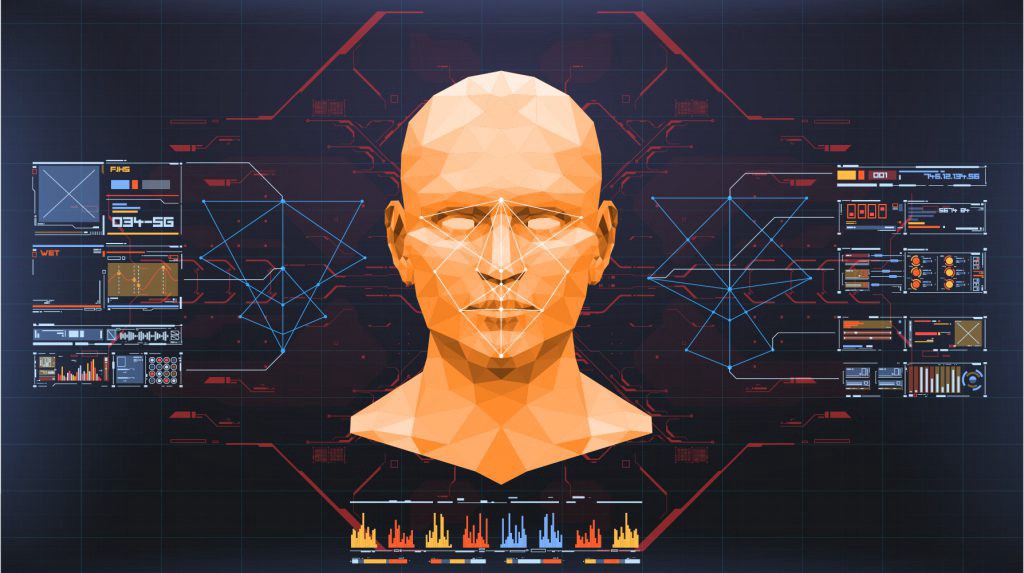
Once a face is detected, the next step is facial landmark detection. This involves identifying key points on the face such as the corners of the eyes, tip of the nose, and contours of the lips. These landmarks provide a standardized way to align and normalize the face, accounting for variations in pose, scale, and illumination.

Facial landmarks are key points on the face used for alignment and feature extraction. (Image Source: Faceio)
With the normalized face image, the recognition algorithm then extracts discriminative features that can uniquely identify the individual. Traditional approaches used handcrafted features like Local Binary Patterns (LBP) or Histogram of Oriented Gradients (HOG), but modern systems rely on deep learning to learn optimal features directly from data. Convolutional Neural Networks (CNNs) have proven particularly effective for this task, with architectures like FaceNet, DeepID, and DeepFace achieving human-level or even superhuman performance on benchmark datasets.
The extracted facial features are then compared against a database of enrolled faces to find the closest match. This is typically done using a similarity metric like Euclidean distance or cosine similarity in a high-dimensional feature space. If the similarity score exceeds a certain threshold, the face is considered a match and the person is authenticated.

The facial recognition pipeline involves face detection, landmark detection, feature extraction, and matching. (Image Source: Faceio)
While this workflow is common to most facial recognition systems, the devil is in the details. Achieving high accuracy requires carefully engineered algorithms that can handle the many challenges of face recognition in the wild – variations in lighting, pose, expression, aging, occlusion, and more. It‘s a complex problem that has driven decades of research and continues to evolve with advances in machine learning and computational power.
The Faceio Advantage: Cutting-Edge Tech Meets Uncompromising Security
Faceio is at the forefront of this technological evolution, with a state-of-the-art facial authentication platform built on the latest research and best practices in computer vision and machine learning. Under the hood, Faceio uses advanced deep learning models trained on massive datasets of diverse faces to achieve industry-leading accuracy and speed.
One of Faceio‘s key innovations is its use of 3D face modeling for enhanced security and liveness detection. During enrollment, Faceio captures a short video of the user‘s face from multiple angles, allowing it to construct a detailed 3D model that captures the unique geometry and textures of the individual‘s face. This 3D face signature is much harder to spoof than a simple 2D image, providing an extra layer of protection against presentation attacks.
Faceio‘s liveness detection is further bolstered by AI algorithms that can spot subtle signs of life, like eye movement and facial micro-expressions. This ensures that the face being presented is a genuine, live person and not a photograph, video, or mask.
In terms of performance, Faceio‘s facial recognition boasts an impressive 99.8% accuracy rate, with verification speeds under 150 milliseconds. This puts it on par with or exceeding other top facial authentication providers, as shown in the table below:
| Provider | Accuracy | Verification Speed |
|---|---|---|
| Faceio | 99.8% | 150 ms |
| Apple Face ID | 99.7% | 500 ms |
| Microsoft Azure Face | 99.5% | 300 ms |
| Amazon Rekognition | 99.6% | 200 ms |
Comparison of facial recognition performance metrics across leading providers.
But accuracy and speed mean little if user privacy isn‘t protected. That‘s why Faceio employs cutting-edge cryptography and data security practices to ensure that biometric data remains safe and under user control at all times.
Instead of storing raw face images, Faceio converts faces into irreversible mathematical representations called face embeddings. These embeddings are then encrypted using strong, standardized encryption algorithms like AES-256 and stored securely in Faceio‘s ISO 27001 and SOC 2 certified data centers. Faceio also uses decentralized architectures and on-device processing whenever possible to minimize data transfer and keep sensitive biometric data out of the cloud.
At the end of the day, Faceio‘s mission is to make authentication both more secure and more human. By leveraging the unique and unforgeable nature of our faces, Faceio aims to create a world where digital identity is truly personal, private, and effortless.
The Business Case for Facial Authentication
For businesses, the benefits of adopting facial authentication are clear and compelling. In a world where customer experience is king, eliminating friction from the login process can have a substantial impact on user satisfaction and engagement.
In a recent survey by IBM, 86% of consumers said they would be more likely to do business with a company that offers a frictionless authentication experience. And in a study by Opus Research, companies that implemented biometric authentication saw an average 35% increase in mobile app usage and a 22% increase in conversions.
Facial authentication can also significantly reduce the burden on IT support. According to Gartner, 20-50% of all helpdesk calls are for password resets, with each reset costing an average of $70 in labor. By eliminating passwords altogether, facial authentication can slash these costs while freeing up support resources for more strategic tasks.
But perhaps most crucially, facial authentication offers a powerful defense against the rising tide of cyber threats. In Verizon‘s 2022 Data Breach Investigations Report, 82% of breaches involved the human element, with stolen credentials being a top threat vector. By replacing easily guessed or stolen passwords with biometric verification, facial authentication makes it exponentially harder for hackers to break into accounts – even if they have the right password.
For mobile apps in particular, facial authentication can be a game-changer for security. Mobile devices are prime targets for cybercriminals, accounting for 63% of all fraud originating from digital channels according to RSA. The combination of built-in high-resolution cameras and secure enclave processors make mobile devices ideal for facial recognition, enabling a level of security that passwords simply can‘t match.
All of these factors are driving rapid adoption of facial authentication across industries. The global facial recognition market is forecast to grow from $3.8 billion in 2020 to $8.5 billion by 2025, a CAGR of 17.2% according to Markets and Markets. And within the broader biometrics landscape, facial recognition is poised to overtake fingerprint as the dominant modality, with a projected market share of 30% by 2024 per Biometric Update.
The Future of Facial Authentication: Opportunities and Challenges
Looking ahead, the potential applications for facial authentication are vast and exciting. Beyond simple login, facial recognition could enable a whole new era of hyper-personalized, frictionless experiences.
Imagine walking into your favorite store where a smart camera recognizes your face and pulls up your preferences, allowing the salesperson to greet you by name and make tailored recommendations. Or picture a world where your face is your universal passport, allowing you to breeze through border control, hop on a plane, and check into your hotel room without ever pulling out a document.
In the realm of healthcare, facial recognition could power everything from secure medical record access to early detection of genetic disorders. Researchers are already using machine learning to spot rare diseases like DiGeorge syndrome from facial features with up to 96.6% accuracy.
And in education, facial authentication could enable continuous identity verification for online exams, ensuring that the right student is completing the test without the need for intrusive proctoring.
Of course, with great power comes great responsibility. As facial recognition becomes more ubiquitous, it will be critical to address the ethical challenges and potential misuses of the technology.
One key concern is bias. Studies have shown that some facial recognition systems have higher error rates for certain demographics, particularly people of color. This bias can have serious consequences, from unlawful arrests to denial of access to essential services. As the developers of this technology, it‘s our responsibility to ensure that our algorithms are fair, unbiased, and regularly audited for equitable performance.
Privacy is another critical consideration. While most people are comfortable using their face to unlock their personal phone, they may feel differently about having their face tracked and analyzed in public spaces without their explicit consent. As an industry, we need clear guidelines and regulations around facial recognition use, with strong protections for user privacy and control over biometric data.
Finally, there‘s the specter of mass surveillance and the erosion of public anonymity. While using your face to log into an app is convenient, the idea of having your every movement tracked by facial recognition systems is a chilling prospect for many. As we move forward with this technology, we need robust safeguards and limitations to prevent misuse by governments or corporations.
Faceio is committed to being a leader in ethical facial recognition. Our core values of privacy, security, and transparency guide everything we do, from our technical architecture to our business practices. We believe that biometrics should always be used to empower individuals, not exploit them, and we‘re dedicated to building a future where facial authentication is a trusted, privacy-preserving tool for digital identity.
Conclusion: A Face-First Future
Facial authentication is no longer science fiction – it‘s here, and it‘s transforming the way we interact with the digital world. With its unparalleled combination of security, convenience, and personalization, facial recognition is poised to become the default mode of authentication for everything from mobile apps to physical access control.
Faceio is at the vanguard of this revolution, with a best-in-class facial authentication solution that prioritizes user privacy and experience above all else. Our advanced machine learning models, rigorous security practices, and unwavering commitment to ethics set the standard for what facial recognition can and should be.
But we can‘t do it alone. Realizing the full potential of this technology will require ongoing collaboration between technologists, businesses, policymakers, and everyday users. We need to come together to develop standards, policies, and best practices that ensure facial recognition is deployed responsibly and equitably.
The stakes couldn‘t be higher. In an age of deepening cyberthreats and data breaches, facial authentication offers a powerful tool for securing our digital lives and identities. But more than that, it holds the promise of a more seamless, more personalized, more human way of interacting with technology.
At Faceio, we‘re excited to be at the forefront of this transformation. We envision a future where your face is your key to a world of frictionless experiences, from shopping to travel to healthcare and beyond. A future where security is baked into every interaction, without compromising privacy or convenience. A future where technology recognizes and adapts to you, rather than the other way around.
That future starts with a simple premise: your face is your most personal, most powerful form of identification. And with Faceio, it‘s the only one you‘ll ever need.