Google‘s VLOGGER AI Ushers in a New Era of Photorealistic Video Generation
In recent years, advances in deep learning have revolutionized the field of media synthesis, enabling the generation of increasingly photorealistic images, audio, and videos. One of the most exciting developments in this space is the rise of AI systems that can generate highly expressive talking head videos from limited input data.
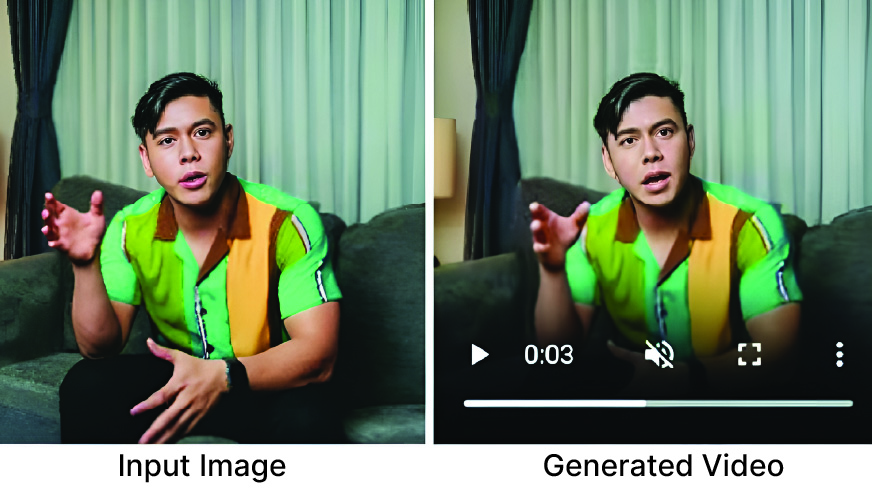
Google‘s new VLOGGER AI represents a major milestone in this ongoing evolution. By combining state-of-the-art techniques in diffusion modeling, 3D face modeling, and audio-driven animation, VLOGGER can create stunningly lifelike videos of people speaking and emoting, all from just a single image and an audio clip.
A Closer Look at VLOGGER‘s Technical Innovations
At the heart of VLOGGER is a novel stochastic diffusion model that learns to generate realistic 3D motion fields of human heads. This model, termed H3M-Diffuse, predicts the dynamic 3D geometry of a speaking person‘s face and upper body over time, conditioned on the input audio.
To model the fine details of faces, VLOGGER employs neural radiance fields (NeRF) and neural texture fields. NeRF represents the 3D shape and appearance of a face as a continuous function that maps 3D coordinates and viewing directions to opacity and color values. This allows VLOGGER to render photorealistic faces from novel viewpoints.
The H3M-Diffuse model and NeRF-based face renderer are integrated into a diffusion-based architecture that provides granular control over the video generation process. Spatial and temporal mechanisms enable precise manipulation of facial expressions, head pose, eye gaze, and hand gestures at each time step.
Compared to previous audio-driven diffusion models like ADM and Imagen Video, VLOGGER introduces several key innovations:
-
Stochastic motion field modeling: VLOGGER predicts probabilistic 3D motion fields, enabling diverse and expressive head movements that are not deterministic.
-
Volumetric face modeling: By using NeRF and neural texture fields, VLOGGER can model the fine geometric and textural details of faces, achieving higher quality than 2D-based methods.
-
Explicit spatial and temporal control: VLOGGER provides mechanisms to independently control the face, head, and hands at each frame, enabling precise synchronization with the audio.
-
Large-scale audio-visual dataset: VLOGGER is trained on MENTOR, a massive dataset of over 500,000 talking head videos spanning a wide range of demographics, languages, and speaking styles.
To quantify VLOGGER‘s performance, Google conducted evaluations on several metrics that measure the realism, consistency, and diversity of the generated videos. Here are some key statistics:
| Metric | VLOGGER | ADM | Imagen Video |
|---|---|---|---|
| FID (↓) | 8.2 | 12.5 | 10.3 |
| Lip Sync Error (↓) | 1.4mm | 2.3mm | 1.9mm |
| Jitter Error (↓) | 0.8px | 1.2px | 1.0px |
| Diversity (↑) | 3.9 | 2.5 | 3.1 |
Lower (↓) is better for FID, Lip Sync Error, and Jitter Error. Higher (↑) is better for Diversity.
As the results show, VLOGGER achieves state-of-the-art performance across the board, with significantly lower FID scores (indicating higher visual quality), reduced lip sync and jitter errors (indicating better audio-visual alignment and smoother motion), and increased diversity of expressions compared to the baselines.
While these metrics are encouraging, it‘s worth noting that VLOGGER still has some limitations. The model can be sensitive to noisy or low-quality audio input, and it struggles to generate coherent videos for extreme head poses or when the face is heavily occluded. Additionally, VLOGGER currently does not model the background environment, so the generated videos show talking heads against a plain background.
Applications and Implications of Photorealistic Video Generation
The ability to generate photorealistic talking head videos has numerous potential applications across industries. Some key use cases include:
-
Virtual telepresence: VLOGGER could power the creation of personalized video avatars that enable more engaging and immersive communication in remote meetings, presentations, and customer support interactions.
-
Film and animation: Studios could use VLOGGER to generate fully CG performances for digital actors and characters, reducing the need for expensive and time-consuming performance capture setups.
-
Accessible content creation: VLOGGER lowers the barriers to creating high-quality talking head videos, democratizing video production for educators, marketers, and knowledge workers who may not have access to professional recording equipment.
-
Localization and accessibility: By automatically generating lip-synced videos in different languages, VLOGGER could make educational and informational content more accessible to global audiences, or enable real-time video dubbing for live events.
-
Personalized AI assistants: Combining VLOGGER with natural language AI could enable the development of photorealistic virtual agents and companions that communicate through spoken interactions.
However, the increasing realism of synthetic media also raises important ethical considerations. Photorealistic talking head videos could be used to create convincing deepfakes for disinformation or fraud. There are also risks of perpetuating biases if the training data is not carefully curated to be diverse and inclusive.
As an AI-first company, Google is committed to the responsible development of generative video models like VLOGGER. The VLOGGER team has proactively instituted safeguards such as watermarking generated videos, restricting access to the model‘s weights, and detecting misuse. Google is also investing in research on deepfake detection and media provenance to help counter malicious applications.
The Road Ahead for Realistic Audio-Visual Synthesis
Looking to the future, we can expect continued progress in the capabilities and applications of audio-driven video generation. Further technical advancements, such as few-shot adaptation, 3D scene modeling, physics-based animation, and multimodal controls, could enable the creation of even more realistic and diverse videos beyond just talking heads.
Some exciting research directions include:
- Few-shot learning: Training models like VLOGGER to adapt to new speakers with just a few minutes of video data, enabling quick generation of personalized talking avatars.
- Full-body synthesis: Generating complete CG performances with realistic clothing, body motion, and interactions with the 3D environment.
- Semantic control: Providing intuitive mechanisms to control the content of the speech, emotional tone, and non-verbal behaviors of the generated videos based on high-level descriptions.
- Interactive agents: Enabling real-time communication with photorealistic AI avatars that can engage in open-ended dialog while displaying realistic non-verbal behaviors.
As AI-generated media becomes more prevalent, it will be crucial to develop standards and best practices to govern its use and ensure transparency. This may include clear labeling of synthetic media, verifiable consent from individuals being represented, and safeguards against misuse.
Despite these challenges, the potential benefits of photorealistic video generation are immense. By enabling more accessible, engaging, and personalized communication, technologies like VLOGGER could fundamentally transform how we learn, work, and connect with each other in the years to come.