
Accurate IP Geolocation API: Find User Location with IP Address
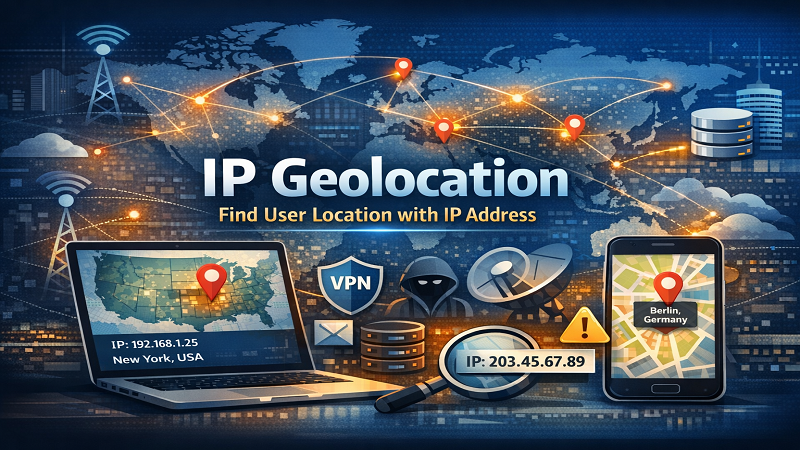
Have you ever wondered how websites know your location without asking? Or how Netflix shows different content based on where you're streaming from? The answer lies in IP geolocation—a powerful technology that maps IP addresses to physical locations.
I've spent years working with geolocation APIs, and I've seen businesses transform their user experiences through accurate location data. Let me walk you through everything you need to know about IP geolocation APIs, from how they work to choosing the right solution for your project.
What Is IP Geolocation?
IP geolocation is the process of determining the physical location of a device connected to the internet using its IP address. Every device that connects to the internet receives a unique identifier called an IP address.
While this address doesn't directly contain location data, it can be mapped to approximate geographic information through various databases and analysis techniques.
How IP Geolocation Works
The process involves several layers of data collection and analysis:
1. IP Address Assignment
Internet Service Providers (ISPs) receive blocks of IP addresses from regional registries. These IP blocks are associated with specific geographic regions. When an ISP assigns an IP address to a customer, that IP inherits the regional location of the IP block.
2. Database Aggregation
Geolocation providers compile data from multiple sources including:
- Regional Internet Registries (RIRs)
- ISP records and filings
- BGP (Border Gateway Protocol) routing tables
- User-submitted location data
- Wi-Fi access point triangulation
- Latency measurements
3. Location Inference
Algorithms analyze these data points to determine the most likely location for each IP address. The accuracy varies significantly based on the data quality and the type of IP address being queried.
Accuracy Levels: What Can You Expect?
One of the most common questions I hear is about accuracy. The truth is, IP geolocation accuracy varies widely depending on multiple factors:
| Accuracy Level | Radius | Use Cases | Data Requirements |
|---|---|---|---|
| Country Level | 100% | Content restriction, currency selection, compliance | Basic IP-to-country mapping |
| State/Province | 80-95% | Regional marketing, shipping calculations | ISP network analysis |
| City Level | 50-80% | Local SEO, targeted advertising | Multiple data sources |
| Postal Code | 25-60% | Local service delivery, weather data | High-quality ISP data |
| Street Level | <5% | Emergency services (with warrant) | ISP cooperation required |
These accuracy percentages aren't static—they depend heavily on whether you're dealing with residential IPs, mobile data, or corporate VPNs. Mobile users might show different locations based on which cell tower they're connected to, while VPN users might appear in completely different countries.
Why IP Geolocation Accuracy Matters
Understanding the limitations of IP geolocation is crucial for several reasons:
Fraud Prevention
Financial services and e-commerce platforms rely heavily on location data to detect suspicious transactions. A user who typically logs in from New York suddenly accessing their account from Russia within minutes would trigger fraud alerts.
Content Localization
Streaming services, news websites, and gaming platforms need accurate location data to comply with licensing agreements and regional content restrictions. Inaccurate geolocation could result in legal issues or poor user experience.
Regulatory Compliance
GDPR, CCPA, and other privacy regulations require businesses to understand where their users are located. Many companies need to implement different data handling practices based on geographic location.
Important Note: Always verify IP geolocation data with other signals. For critical applications like fraud detection, combine IP location with browser fingerprint analysis, device characteristics, and user behavior patterns for more reliable results.
Common Pain Points with IP Geolocation
After working with dozens of businesses implementing location-based features, I've identified several recurring challenges:
Pain Point #1: Inconsistent Data Across Providers
Different geolocation APIs often return different results for the same IP address. One might place a user in Chicago, while another shows suburbs 30 miles away. This inconsistency can lead to confusing user experiences and unreliable analytics.
Pain Point #2: VPN and Proxy Detection
According to industry research, approximately 25-30% of internet traffic passes through VPNs or proxies. When users mask their real IP addresses, standard geolocation becomes unreliable. This is particularly problematic for businesses that need to verify user authenticity.
A comprehensive network intelligence tool can help identify VPN and proxy usage, allowing you to flag suspicious traffic and maintain the integrity of your location-based services.
Pain Point #3: Mobile IP Instability
Mobile users frequently switch between Wi-Fi and cellular networks, causing their IP addresses to change throughout the day. This can make it difficult to maintain consistent user sessions and track behavior patterns.
Pain Point #4: Privacy Concerns and Browser Fingerprinting
Users are increasingly concerned about online privacy. Many browsers now implement anti-fingerprinting measures that can interfere with location detection. Additionally, users may employ privacy tools specifically to avoid geolocation.
Solutions: Overcoming Geolocation Challenges
Multi-Source Validation
Don't rely on a single geolocation provider. Implement a multi-source approach that combines data from multiple APIs and cross-references results. This helps identify outliers and provides more confidence in the final location estimate.
Consistency Checking
Validate IP geolocation against other signals like timezone, language settings, and browser characteristics. If an IP claims to be from Tokyo but the user's browser is set to EST and their timezone matches New York, something doesn't add up.
IP Quality Scoring
Assign quality scores to IP addresses based on factors like:
- IP reputation history
- Association with hosting providers
- VPN/proxy detection
- Consistency with other user signals
- ASN (Autonomous System Number) analysis
| IP Quality Score | Risk Level | Characteristics | Recommended Action |
|---|---|---|---|
| 90-100 | Low Risk | Residential IP, consistent signals, no VPN | Full access to features |
| 70-89 | Medium Risk | Some inconsistencies detected | Additional verification may be required |
| 50-69 | High Risk | Corporate VPN, hosting provider IP | Limit access, require strong authentication |
| <50 | Critical Risk | Known proxy, datacenter IP, Tor exit node | Block or require manual review |
Browser Fingerprint Cross-Validation
Advanced security platforms use browser fingerprinting to validate IP-based location data. By collecting canvas hashes, WebGL signatures, audio fingerprints, and other device characteristics, you can build a more complete picture of user authenticity.
For example, if an IP geolocates to Germany but the user's browser fingerprint matches a profile consistently associated with Brazilian IP addresses, this discrepancy might indicate VPN usage or account takeover attempts.
Choosing the Right IP Geolocation API
When selecting a geolocation solution, consider these factors:
Accuracy vs. Cost
Free APIs often provide country-level accuracy with limited precision. Premium services offer city-level or postal code accuracy but come at a higher cost. Determine what level of precision your use case actually requires before paying for more than you need.
Update Frequency
IP address allocations change frequently. Look for providers that update their databases daily or weekly rather than monthly. Stale data leads to inaccurate results, especially for mobile networks.
Privacy Compliance
Ensure your chosen provider complies with relevant privacy regulations. GDPR requires that you have a legitimate legal basis for processing location data, and you must be transparent with users about how you use this information.
Rate Limits and Scalability
Consider your expected query volume. Some free APIs have strict rate limits that might not scale with your growth. Enterprise plans offer higher limits and better performance but at significantly higher costs.
Implementing IP Geolocation: Best Practices
1. Cache Responses Wisely
IP addresses don't change location frequently (except for mobile networks). Implement caching with appropriate TTL values to reduce API calls and improve performance. I recommend 24-48 hour cache times for residential IPs and shorter windows for mobile networks.
2. Handle Errors Gracefully
What happens when the API is down or returns an error? Your application should have fallback logic—perhaps default to a less accurate cached result or prompt the user to manually select their location.
3. Respect User Privacy
Always inform users when you're using their location data and provide clear opt-out options where legally required. Building trust with users is more valuable than any short-term gains from invasive tracking.
4. Monitor for Abuse
Watch for unusual patterns that might indicate bot traffic or scrapers attempting to exhaust your API quota. Implement rate limiting on your end even if your provider has built-in protection.
Advanced Techniques: Beyond Basic Geolocation
For organizations that need more sophisticated location intelligence, consider these advanced approaches:
ASN-Based Analysis
Autonomous System Numbers provide network-level context about IP addresses. You can identify whether an IP belongs to a specific ISP, hosting provider, or organization. This helps distinguish between residential users and corporate environments.
TLS Fingerprinting
By analyzing TLS handshake parameters, you can detect automated tools and bots that might be spoofing their location. Different browsers and automation frameworks have distinct TLS signatures.
Timezone Validation
Cross-reference IP-based location with the user's browser timezone. Significant discrepancies often indicate VPN usage or location spoofing attempts.
Real-World Use Cases
E-Commerce Platform
An online retailer uses IP geolocation to automatically detect customer location and display prices in the correct currency. They combine this with timezone-aware shipping estimates and regional product availability. When they detected a pattern of orders from IP addresses geolocating to Russia but shipping to addresses in Florida, they implemented additional verification that reduced fraud by 40%.
Content Delivery Network
A streaming platform uses geolocation to route users to the nearest content server, improving video quality and reducing buffering. They also use it to enforce regional licensing restrictions, ensuring content is only available in approved markets.
Financial Services
A bank uses IP geolocation as part of their fraud detection system. When a user's account shows login attempts from locations thousands of miles apart within minutes, they trigger additional authentication steps. This approach has prevented millions in potential fraud losses.
Industry Statistics: The Impact of Accurate Geolocation
| Industry | Use Case | Impact | Accuracy Requirement |
|---|---|---|---|
| E-Commerce | Fraud detection | 42% reduction in chargebacks | City level preferred |
| Media & Streaming | Content licensing | Compliance with 98% of regions | Country level sufficient |
| Financial Services | Transaction monitoring | 35% faster fraud detection | State/Province level |
| Ad Tech | Targeted advertising | 28% higher CTR | Postal code ideal |
| Gaming | Server selection | 45% lower latency | City level sufficient |
The Future of IP Geolocation
The geolocation landscape continues to evolve with several emerging trends:
IPv6 Adoption
As the world transitions to IPv6, geolocation databases are becoming more granular. IPv6 provides larger address blocks that can be mapped to more specific locations, potentially improving accuracy for certain use cases.
Machine Learning Integration
Advanced algorithms are being used to improve accuracy by learning from historical data and identifying patterns that traditional methods miss. These systems can account for factors like network topology changes and mobile user behavior patterns.
Privacy-First Approaches
New privacy regulations and browser restrictions are pushing the industry toward more transparent and privacy-conscious geolocation methods. This includes federated learning approaches and on-device processing when possible.
Integration with Web Standards
The Geolocation API provides browser-based location detection that's more accurate than IP-based methods but requires user permission. Smart applications combine both approaches, using IP geolocation as a fallback when permission is denied.
Frequently Asked Questions
Is IP geolocation legal?
Yes, IP geolocation is generally legal, but how you use the data matters. Many privacy regulations require transparency about data collection and purpose. Always ensure compliance with local laws and obtain proper consent where required.
How accurate is IP geolocation?
Accuracy varies widely by provider and IP type. Country-level accuracy typically exceeds 99%, while city-level accuracy ranges from 50-80%. Mobile IPs are generally less accurate than residential fixed-line connections.
Can users hide their real location?
Yes, users can mask their location using VPNs, proxies, or Tor. This is why combining IP geolocation with other validation methods like browser fingerprint analysis and device signals is important for security-critical applications.
Does IP geolocation work with IPv6?
Yes, but implementation varies by provider. IPv6 offers potential improvements in accuracy due to larger address blocks, but widespread adoption is still ongoing. Most modern geolocation APIs support both IPv4 and IPv6.
How often should I update my geolocation data?
For most applications, real-time queries to your API provider are sufficient. If you're building a local cache, residential IPs can be cached for 24-48 hours, while mobile IPs should have shorter TTL values.
Conclusion
IP geolocation is a powerful tool, but it's not magic. Understanding its limitations and implementing proper validation strategies is key to building reliable location-based features. By combining IP geolocation with other signals like browser fingerprints, device characteristics, and user behavior patterns, you can achieve much more accurate and trustworthy results.
Whether you're building fraud detection systems, personalized user experiences, or compliance-driven features, the right approach depends on your specific use case. Start with clear requirements, choose an appropriate accuracy level, and always have fallback strategies for when location data is unreliable.
Ready to Test Your Browser's Location Signals?
Understanding how your browser appears to geolocation APIs is the first step toward building better location-based features. Try a comprehensive browser fingerprint and network analysis to see what signals websites can detect from your connection.
