
Kavana Venkatesh‘s AI Odyssey: Dreaming in Data, Thriving in Tech
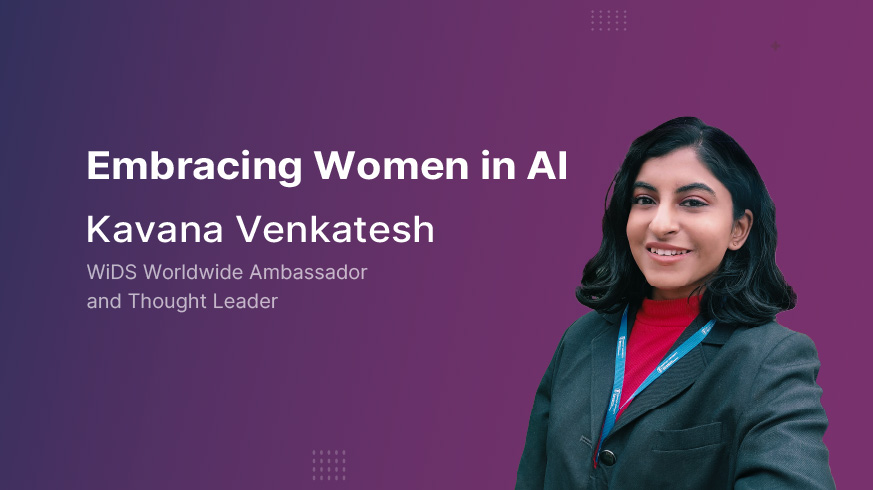
In a world where artificial intelligence is rapidly reshaping industries and societies, a new generation of innovators is emerging – and women like Kavana Venkatesh are leading the charge. A data scientist, author, and global ambassador for gender equity in tech, Kavana‘s journey from small-town dreamer to AI trailblazer is one of resilience, purpose, and the power of relentlessly chasing one‘s passions.
Defying Expectations, Defining Success
Kavana‘s story begins in a close-knit family in a small Indian town, where strong female role models surrounded and inspired her from day one. Her mother, a retired headmistress known for her compassion and tireless community work, and her sister, who always unapologetically chased her dreams, set an early example that barriers were meant to be broken.
Kavana‘s late father instilled in her a love for people, an unwavering self-confidence, and the courage to use her voice for good. With her family‘s support and her own insatiable curiosity, Kavana dreamed big and achieved greatly. By age five, she was already writing poetry. At nine, she became a radio artist. And by fourteen, she was a published author.
Kavana‘s early ambitions spanned medicine, law, writing, and music – everything, it seemed, except computer science. But when the time came to choose a path, she found herself drawn to the world of data and its power to transform lives. Pursuing a master‘s degree in data science in the U.S. was a bold leap into uncharted territory, but one she was determined to make.
However, not everyone believed in Kavana‘s vision at first. Some doubted whether she would be "overqualified" or "too ambitious" as a woman in tech. Others misconstrued her gentle demeanor as weakness, her assertiveness as bossiness. Requests for mentorship and growth opportunities were often met with skepticism about her age and experience.
These roadblocks spoke to a larger pattern of gender bias in STEM fields, where women‘s capabilities are systematically underestimated. Despite making up 48% of the U.S. workforce, women hold only 27% of STEM roles, a figure that‘s barely budged in decades. The disparities are even starker for women of color, who make up just 5% of the science and engineering workforce.
But for Kavana, the challenges only fueled her determination to succeed and lift other women up in the process. She recognized that the very qualities others dismissed – empathy, creativity, collaborative leadership – were precisely what made women‘s contributions to AI and data science so invaluable.
Mind of a Poet, Skills of a Scientist
What sets Kavana apart as a data scientist is her interdisciplinary background bridging technology and the arts. With a natural gift for storytelling honed through her early authorship, she brings a uniquely human lens to an often hyper-technical field.
Her ability to translate complex concepts into relatable insights has made her a sought-after thought leader and speaker. Kavana understands that for AI to serve people, it must be built by people from all walks of life – not just a narrow slice of the population.
This ethos shines through Kavana‘s projects and passions in the data science world. At the lab where she works, she leads a research team using natural language processing to make digital mental health tools more culturally responsive for underserved communities.
She has also spearheaded initiatives to improve the fairness and transparency of AI systems, ensuring they do not amplify societal biases around gender and race. As an ambassador for Women in Data Science (WiDS), a global organization inspiring women to pursue careers in data, she mentors aspiring female practitioners and advocates for greater industry representation.
Kavana‘s impact on the AI field transcends technical innovation alone. She is part of a growing movement to ensure the technology reflects our highest values and brings about positive change for all. Achieving this mission starts with empowering people from diverse backgrounds to help shape AI‘s development.
Humans Behind the Algorithms
Despite the vast potential of artificial intelligence to transform our world for the better, the humans behind it are often obscured from view. For AI to truly serve people, Kavana believes, we must first see and support the people who power it.
Women have been at the forefront of computer science since its inception, from pioneers like Grace Hopper and Katherine Johnson to current luminaries like Fei-Fei Li and Timnit Gebru, yet their contributions remain undersung. Stereotypes, sexism, and systemic barriers have long deterred women from entering and thriving in the field.
But a powerful shift is underway, and role models like Kavana are leading the charge. Through her work with WiDS, she is helping build a global network of women leveraging data science to drive change. From using satellite imagery to combat illegal logging in the Amazon to developing AI chatbots to support domestic violence survivors, these innovators are harnessing data for good.
Kavana‘s own research focuses on developing AI systems that are not only highly accurate but also transparent, accountable, and attuned to real human needs. She recognizes that realizing the full potential of data science requires cultivating public trust through responsible practices.
Her team has developed novel methods for detecting bias in AI models, enabling businesses and policymakers to audit their systems for fairness before real-world deployment. They are also working on interpretability techniques to make complex "black-box" models more understandable to everyday users.
Kavana‘s commitment to using AI for social good extends beyond the lab as well. She regularly volunteers with local schools and youth programs to get girls excited about coding and data early on. By seeing themselves reflected in real-life role models, Kavana hopes, more girls will feel empowered to pursue their STEM passions.
The road to gender equity in AI is long, but change-makers like Kavana are paving the way through tireless advocacy and boundary-breaking work. As she often says, "talent is evenly distributed, but opportunity is not." It‘s on all of us to help close that gap.
The Future Is Female
For young women looking to enter the data science field today, Kavana has three key pieces of advice:
-
Build a strong technical foundation. Focus on honing core programming and statistics skills through online courses, bootcamps, or degree programs. Don‘t be afraid to start small and continuously learn on the job.
-
Find your community. Join groups like WiDS, Women Who Code, or R-Ladies to connect with other women in data, access resources, and hear from experts in the field. Attend conferences and local meetups to grow your network.
-
Identify your unique edge. Combine your data skills with your distinct passions and perspectives to carve out a niche. The most exciting innovations happen at the intersections of disciplines.
Most importantly, Kavana encourages aspiring data scientists to stay curious, bold, and mission-driven. The path to success is rarely linear, especially for those breaking barriers and forging new ground. Trust your talent, know your worth, and don‘t let anyone dim your light.
The business case for diversity in data science could not be clearer. Companies with diverse teams are 45% more likely to report growth in market share and 70% likelier to capture new markets. Diverse companies are also more innovative, make better decisions, and retain top talent.
Despite this, women still make up less than a third of employees at major tech companies, and progress toward parity is slow. Until data teams reflect the populations they aim to serve, we will continue to see AI systems that fail in the real world and products that leave entire user groups behind.
Change will take collective effort from educators, employers, policymakers, and each one of us as citizens. We must examine our biases, expand our circles, and relentlessly advocate for inclusion at every level. The future of AI – and our world – depends on it.
Towards an Smarter, Fairer Future
Kavana‘s story is one of dreaming big, shattering expectations, and harnessing data to build a better world for all. Through her groundbreaking research, advocacy for ethics in AI, and mentorship of the next generation, she is helping to write a new playbook for what leadership looks like in technology.
This International Women‘s Day, we celebrate Kavana and countless others who are showing what‘s possible when women dare to pursue their callings unapologetically. But the work of gender equity is far from finished. It‘s on all of us to help create a future where diverse voices are not only welcomed but uplifted in shaping our digital world.
This month and beyond, we invite you to join the movement by supporting initiatives expanding access to AI skills, celebrating women‘s contributions to the field, and pushing for greater representation wherever you have influence. Together, we can code a brighter, more inclusive future.
The power of data, after all, lies not in the algorithms or the technology itself – it comes from the diverse minds and hearts behind it all, solving human problems and dreaming up new possibilities. When people like Kavana bring their whole authentic selves to the table, there is no limit to how intelligent our machines or how wise our world can be.


