Male vs Female English Springer Spaniel: A Detailed Comparison
As a lifelong dog lover and Springer Spaniel aficionado, I‘m often asked whether a male or female English Springer Spaniel makes a better pet. The truth is, both genders have their own unique charms and quirks. While individual personality plays a bigger role than sex alone, there are some fascinating differences between male and female Springers that are worth exploring.
In this ultimate guide, we‘ll dive snout-first into the world of male and female English Springer Spaniels. We‘ll explore everything from physical attributes to temperament to health considerations. As a special treat, we‘ll focus extra attention on the lovely ladies of the breed – the female Springers who steal our hearts with their elegance, sensitivity, and maternal instincts.
Whether you‘re a first-time Springer owner or a seasoned spaniel servant, this in-depth analysis will help you choose the perfect gender for your lifestyle and family. Let‘s jump in!
English Springer Spaniel Breed Overview
First, let‘s review what makes the English Springer Spaniel breed so special. These medium-sized sporting dogs were originally bred to flush and retrieve game birds for hunters. The "springing" in their name comes from their ability to startle birds out of hiding with their quick, bouncy gait.
Today, while many Springers still excel in the field, they‘ve also won the hearts of families worldwide as loving, devoted companions. Hallmarks of the breed include:
- Friendly, outgoing, eager-to-please personality
- Exceptional intelligence and trainability
- High energy level and love of activity
- Strong prey drive and scenting ability
- Medium-length coat with feathering, requiring regular grooming
- Average size of 19-20 inches tall and 40-50 lbs (males slightly larger)
- Affinity for water and swimming
- Tendency to be mouthy and "talkative" with barking and whining
Now that we‘ve set the stage with an overview of Springers in general, let‘s explore how males and females differ within this delightful breed.
Physical Differences Between Male and Female English Springer Spaniels
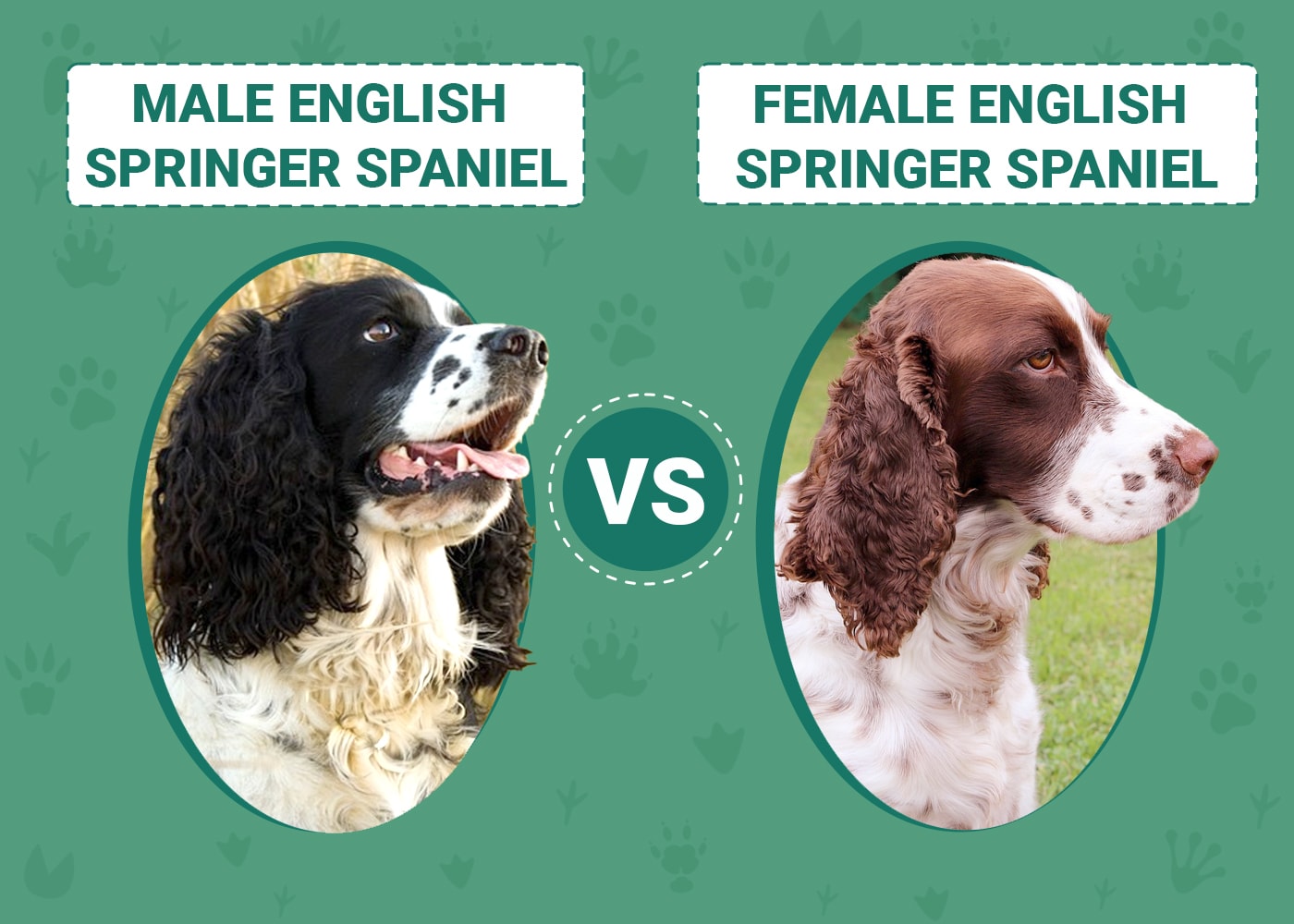
At first glance, male and female English Springer Spaniels look very similar. Both have the breed‘s signature lively expression, drop ears, sturdy body, and gorgeous coat. However, there are some subtle physical differences between the sexes:
| Trait | Male | Female |
|---|---|---|
| Height | 20-21 inches (51-53 cm) | 19-20 inches (48-51 cm) |
| Weight | 50-55 lbs (23-25 kg) | 35-45 lbs (16-20 kg) |
| Head | Slightly broader, more masculine | More refined and feminine |
| Muzzle | Tends to be slightly longer and wider | Usually more delicate and narrower |
| Body | Somewhat stockier and more substantial | Lighter, more elegant build |
| Coat | May have slightly coarser outer coat | Tends to have a softer, silkier texture |
Of course, these are generalizations and there will always be some male Springers who are smaller and more refined than the norm, and some females who are sturdier and more substantial.
Ultimately, the differences in build between male and female Springers are relatively modest compared to some breeds with more extreme sexual dimorphism. Both genders should adhere to the breed standard, with a balanced, athletic appearance.
Temperament Differences Between Male and Female English Springer Spaniels
While every dog is an individual, certain personality traits tend to be more associated with male or female English Springer Spaniels. These are not hard and fast rules, but rather general trends observed by many Springer owners and breeders:
| Trait | Male | Female |
|---|---|---|
| Overall demeanor | Goofier, more playful and puppy-like | Calmer, more serious and mature |
| Interaction style | More physical and rambunctious | More reserved and gentle |
| Attention-seeking | Demands attention from everyone | Content with attention from "their people" |
| Independence | More likely to wander and think for self | Tends to stick closer to owner |
| Sensitivity | Often oblivious to owner‘s moods | Very attuned to owner‘s emotions |
| Trainability | Eager to please but easily distracted | Focused, eager to please, fast learner |
| Prey drive | High prey drive, loves to chase | Slightly less intense prey drive |
As a Springer lover, I‘ve lived with both males and females over the years. One memorable female, Daisy, embodied many of the traditionally feminine Springer traits. She was my shadow, always attuned to my moods and whereabouts. Daisy learned new commands with laser focus and never let me out of her sight on off-leash adventures. She had a special affinity for children, calmly sitting for ear rubs from even the most rambunctious toddlers.
In contrast, my goofy male Jasper was the class clown, always ready with a game of keep away or tug of war. He had no concept of personal space, gleefully body slamming everyone he met. Jazz was a champ at agility and dock diving, but sometimes his excitement got the best of him and he zipped around the course without waiting for cues. While not as sensitive as Daisy, he charmed everyone with his tail-wagging, ball-obsessed zest for life.
As these anecdotes illustrate, male and female Springers both make delightful companions, but their personalities may suit different households. Females tend to be a better fit for homes that prefer a calmer, more intuitive pet, while males match well with active families who don‘t mind a little extra goofiness and physicality.
Training Male vs Female English Springer Spaniels
Trainability is one area where female English Springer Spaniels have a slight edge over their male counterparts. This is largely due to two factors: the females‘ higher sensitivity and faster mental maturity.
Female Springers tend to be more responsive to physical and verbal praise, making them a joy to train with positive reinforcement methods. They often aim to please and are more attentive to their handler‘s tone of voice and body language. Females reach mental maturity earlier than males, around 18-24 months of age.
In contrast, male English Springer Spaniels can be a bit more challenging to train, particularly during adolescence. They mature more slowly mentally, taking up to 2-3 years to outgrow their headstrong teenage phase. Males are often more distractible and may choose to investigate a scent or chase a squirrel rather than focusing on their handler. They aren‘t as naturally attuned to people‘s emotions.
Despite these sex-based trends, both male and female English Springer Spaniels are highly intelligent, eager to learn, and well-suited for advanced training. Some of the top agility, obedience, and field trial champions have been males, so it‘s clear that both genders have immense potential.
The key to training any Springer is early socialization, clear communication, and positive reinforcement with treats, toys, or praise. Force-free methods bring out the best in these sensitive souls. With patient, consistent training and plenty of outlets for their energy, both male and female Springers can be a dream to work with.
Health Issues in Male vs Female English Springer Spaniels
As with all purebred dogs, English Springer Spaniels are prone to certain inherited health issues. Responsible breeders perform genetic tests and screen their dogs for common problems like hip and elbow dysplasia, eye disorders, and heart disease.
While male and female Springers are at risk for most of the same conditions, research shows some sex-based differences:
| Condition | Male | Female |
|---|---|---|
| Hip dysplasia | Slightly higher risk | Slightly lower risk |
| Elbow dysplasia | Higher risk | Lower risk |
| Phosphofructokinase deficiency | More common | Less common |
| Lymphoma | Slightly higher risk | Lower risk |
| Hemangiosarcoma | Higher risk | Lower risk |
| Mammary cancer | N/A | 50% risk if unspayed |
| Pyometra (uterine infection) | N/A | 23-24% risk if unspayed |
Sources: Banfield Pet Hospital, Encyclopedia of Canine Clinical Nutrition, Veterinary Cancer Society
As this data reveals, male Springers are slightly more prone to orthopedic issues like hip and elbow dysplasia, as well as certain cancers. Females have unique reproductive health concerns, with unspayed females facing a 50% chance of developing mammary cancer after the age of 7. Pyometra, a life-threatening uterine infection, affects nearly a quarter of intact females.
For female Springers not intended for breeding, veterinarians typically recommend spaying between 6-12 months of age to dramatically lower the risk of mammary tumors and eliminate the possibility of pyometra. Some research suggests waiting until full skeletal maturity at 18-24 months may further reduce the risk of orthopedic problems and certain cancers.
As a Springer mom, I‘ve experienced the heartbreak of losing a beloved female to cancer far too soon. While we can never entirely prevent illness, focusing on preventative care, a healthy lifestyle, and prompt treatment can help our Springers live their best lives. Regular vet check-ups, a high-quality diet, weight management, joint supplements, and plenty of mental and physical exercise all contribute to the longevity of both male and female English Springer Spaniels.
Choosing Between a Male or Female English Springer Spaniel
With so much overlap between male and female Springer Spaniels, how do you decide which gender is right for your household? As a longtime Springer owner and enthusiast, here are my tips:
-
Consider your lifestyle and activity level. If you‘re a couch potato, a lower-key female might be a better fit than a rambunctious male. If you‘re always on the go hiking and playing, a male‘s endless energy could be perfect.
-
Think about your training goals. If you want a dog who‘s laser-focused and extremely handler-oriented, a female‘s sensitivity and work ethic may suit you best. For a more laid-back approach, a happy-go-lucky male could be ideal.
-
Evaluate your grooming preferences. All Springers need regular brushing and trimming, but males‘ coats tend to be slightly thicker and coarser. If you want the easiest possible grooming, a female‘s silkier coat may be lower maintenance.
-
Be honest about your tolerance for mess. Female Springers tend to be a bit daintier and less prone to joyful destruction than their male counterparts. If you‘re fastidious about your home, a tidy female could be a better match than a male who tracks in mud and drool.
-
Assess your experience level. First-time dog owners often find females easier to handle and train due to their responsiveness and lower tendency to wander. Experienced owners may relish the challenge of a more independent and adventures male.
-
Factor in your other pets. In multi-dog households, opposite sex pairings tend to be most harmonious. If you have an existing male dog, a female Springer could be the best choice, and vice versa.
-
Decide whether to spay/neuter. Keeping a female intact requires dealing with heat cycles and increased cancer risks. Keeping a male intact means a higher chance of roaming, marking, and aggression. Most pet Springers are altered, but there are health benefits to waiting until maturity, especially for females.
-
Listen to your heart. At the end of the day, the male/female decision often comes down to a gut feeling. Some people have a strong personal preference for one gender that defies logic. If one gender speaks to your soul, that‘s your answer!
When in doubt, talk to reputable Springer Spaniel breeders about their experience with male vs female puppies in their lines. Meet adult dogs of both genders to get a feel for their energy and personalities. With an open mind and an honest assessment of your needs, you‘re sure to find your perfect match in a male or female Springer.
A Closer Look at Female English Springer Spaniels
As a female-owned-and-operated Springer household, I can‘t resist focusing extra attention on the unique joys of life with a lady Springer Spaniel. While they share most traits with their male counterparts, female Springers have some special qualities that win the hearts of owners worldwide.
First and foremost, female Springers tend to be the ultimate Velcro dogs, wanting to be wherever you are, all the time. Whether that means curling up on the couch, shadowing you from room to room, or riding shotgun in the car, these girls make it their mission to be your constant companion.
This attachment also translates to impressive sensitivity and emotional intelligence. Female Springers are often exquisitely tuned in to their owners‘ feelings, seeming to know when you need a snuggle or a sympathetic ear. They may even try to comfort you if you‘re sad, sick, or stressed out.
Female Springers also tend to be naturally nurturing, transferring their motherly instincts to their human pack. Many females adopt their families‘ children, acting as self-appointed guardians and playmates. This maternal nature can be a huge asset for households with kids.
Some of history‘s most famous English Springer Spaniels have been females, from the first Springer registered with the AKC (Fannie, born in 1910) to Richard Nixon‘s beloved pet (Checkers, the subject of the infamous Checkers Speech). Today, social media stars like Freja the Spaniel delight their audiences with the photogenic good looks and vibrant personalities of female Springers.
As much as I adore my own female Springer for her sweetness, smarts, and versatility, there‘s no denying that girlhood comes with some inconveniences. If you choose not to spay your female Springer, you‘ll need to deal with twice-yearly heat cycles that involve messy bleeding, moodiness, and determined suitors. You‘ll also face tough decisions around the increased risks of mammary cancer and pyometra in intact females.
Even with these challenges, I wouldn‘t trade my close bond with my female Springer for anything. Watching her confidently navigate an agility course, tenderly care for orphaned kittens, or snuggle under the covers on a cold night, I‘m endlessly grateful for the love, sensitivity, and zest for life these special girls bring to our world.
Final Thoughts
At the end of the day, both male and female English Springer Spaniels make phenomenal companions for the right households. As long as you choose a responsible breeder, socialize and train diligently, and provide plenty of exercise and affection, you‘re likely to be delighted with either gender.
If you‘re drawn to the calm, intuitive, ultra-loyal nature of a female Springer, hopefully this guide has armed you with the knowledge needed to make an informed decision. While no dog is perfect, the highs of life with a female Springer – from her doting devotion to her versatile athleticism to her gentle way with children – far outweigh the lows.
Once you‘ve welcomed a female Springer Spaniel into your heart and home, I‘m confident you‘ll understand why so many of us are hopelessly smitten with these special girls. With her soulful eyes, soft ears, and mischievous smile, your female Springer will quickly become the center of your universe… and you wouldn‘t have it any other way.