The Captivating Cardigan Welsh Corgi: A Complete Guide for Dog Lovers
Introduction
As a dog lover and veterinarian, I‘ve had the pleasure of working with many amazing breeds over the years. But few have captured my heart quite like the Cardigan Welsh Corgi. With their quirky proportions, outgoing personalities, and rich history, these long, low-riding herders are impossible not to fall for.
Whether you‘re already smitten with this uncommon breed or are just learning about them for the first time, this comprehensive guide will give you all the info you need to decide if a Cardigan is the right dog for you. We‘ll cover their origins, traits, care needs, and more. By the end, you‘ll see why Cardigan fans say it‘s not just a dog – it‘s a lifestyle!
History of the Cardigan Welsh Corgi
To really understand the Cardigan Welsh Corgi, we need to go back in time – way back. This ancient breed‘s story began over 1000 years ago, when Celtic tribes migrated from central Europe to Wales, bringing with them the low-slung, long-bodied dogs that would become the Cardigan. In fact, "corgi" comes from the Welsh words for "dwarf dog" – a fitting name for these short but substantial herders.
For centuries, Cardigans served as invaluable working partners to Welsh farmers. Their short stature allowed them to nip at the heels of cattle and avoid kicks, driving livestock from field to field. They were also prized as watchdogs and ratters, boldly sounding the alarm at any sign of trouble.
Though they share obvious similarities and were even considered one breed until the 1930s, the Cardigan is distinct from their more well-known cousin, the Pembroke Welsh Corgi. Cardigans are slightly larger, have more rounded ears, and come in a wider range of colors, including merle patterns not seen in Pembrokes. And while a Pembroke‘s tail is docked, a Cardi‘s long, bushy tail is a breed hallmark.
Today, most Cardigans enjoy a pampered life as beloved companions rather than farmhands. But those herding instincts still run strong. Channel that working drive with training, play, and dog sports and you‘ll have an adoring, loyal friend for life.
Cardigan Welsh Corgi Breed Standard and Appearance
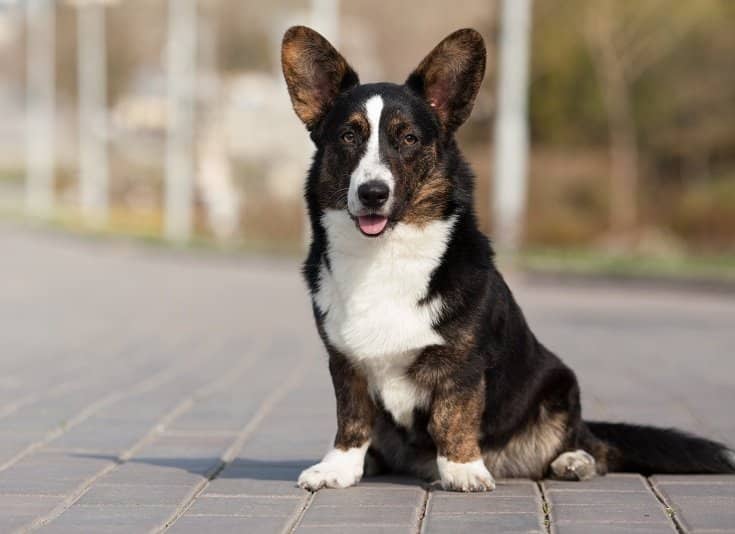
The Cardigan Welsh Corgi is a sturdy, muscular dog wrapped up in an adorably compact package. According to the breed standard set by the American Kennel Club (AKC), an ideal Cardigan has the following characteristics:
- Height: 10.5 to 12.5 inches at the shoulder
- Weight: 25-38 pounds, with males typically larger than females
- Head: Foxy in shape and appearance, with medium-sized, slightly rounded ears
- Eyes: Moderate size, clear, and dark in color with an intelligent, alert expression
- Body: Long and low with deep chest, strong loin, and slightly arched neck. Topline level.
- Tail: Long, bushy, and set in line with the body. Carried low when at rest.
- Coat: Medium length double coat with a thick undercoat and slightly harsh outer coat. Comes in all shades of red, sable, and brindle, as well as black and blue merle, with or without white markings.
One of the most distinctive features of the Cardigan is their disproportionately short legs. But far from being a defect, this unique build served an important purpose. Those stubby legs kept Cardigans low to the ground and agile as they herded cattle, allowing them to avoid flying hooves.
Temperament and Personality
There‘s a saying among Cardigan lovers: "A Corgi‘s ears make up half their height so they can hear your every word, and the other half is so they can ignore you." It perfectly sums up the combo of keen intelligence and stubborn independence that makes this breed so endearing.
Cardigans may be little, but they have big personalities. This is a dog that knows their own mind and isn‘t afraid to use their surprisingly deep bark to let you know it. That boldness, combined with loyalty and smarts that made them excellent watchdogs and ratters on the farm, is still very much present in companion Cardis today.
Though they can be a bit reserved with strangers at first, a well-socialized Cardigan will warm up quickly and turn on the charm. These affectionate dogs live to be with their people and thrive on attention. They‘re more than happy to spend a lazy day snuggling on the couch, but also make cheerful, up-for-anything companions on all your adventures.
As much as they adore their humans, Cardigans aren‘t pushovers. This is a highly intelligent working breed that needs a job to do, whether that‘s learning new tricks, playing games, or competing in dog sports like agility or herding trials. Positive, reward-based training is a must to keep them engaged and bring out their best.
Health and Care
Like many purebred dogs, Cardigan Welsh Corgis are prone to certain hereditary health conditions. According to the Canine Health Information Center (CHIC), responsible Cardigan breeders should screen their dogs for:
- Hip dysplasia: Abnormal development of the hip joint, which can lead to arthritis and lameness. Reported in 16.2% of Cardigans tested between 1974-2021.
- Degenerative myelopathy (DM): Progressive neurological disorder that causes hind limb weakness and paralysis. Estimated to affect 11-12% of Cardigans.
- Eye disorders: Such as progressive retinal atrophy (PRA), a deterioration of the retina that leads to blindness.
While not required by CHIC, Cardigans should also be screened for cardiac issues like patent ductus arteriosus (PDA) and pulmonic stenosis. A 2011 UK Kennel Club survey found that the median age of death for Cardigans was 12 years 2 months, with the most common causes being cancer (26.1%) and old age (17.4%).
One issue that all Cardigan owners need to watch for is back problems. The long spine and short legs that give this breed its distintive shape also put stress on the back, making conditions like intervertebral disc disease (IVDD) more common. Using ramps instead of stairs, keeping them at a healthy weight, and avoiding high-impact activities can help prevent issues. Any signs of pain or difficulty walking require an immediate vet visit.
Grooming a Cardigan is relatively straightforward. Brush their thick double coat weekly to remove dead hair and keep shedding under control. They tend to shed more heavily as the seasons change in spring and fall. Regular nail trims, ear cleaning, and dental care will keep them looking and feeling their best.
Training and Exercise Needs
Cardigan Welsh Corgis are whip-smart dogs that pick up new commands quickly – when they feel like it, that is. Stubborn streaks are common in this independent thinker of a breed, so make training fun with lots of positive reinforcement in the form of praise, playtime, and treats.
Early socialization is a must for Cardigans, who can be aloof with strangers if not exposed to lots of people and new situations from a young age. Puppy kindergarten is a great way for your Corgi to learn doggy social skills while getting used to strange sights, sounds, and people.
As a herding breed, Cardigans need daily exercise to stay physically and mentally fit. Aim for about an hour of activity per day, divided into walks, playtime, and brain games. Monitor their weight carefully, as this food-motivated breed can pack on the pounds quickly if not kept active.
While a Cardigan probably won‘t say no to a morning jog or hike, their short legs and long backs aren‘t suited for miles of running or jumping. Opt for lower-impact activities like swimming, short walks, and nosework instead. Many Cardigans excel at dog sports like rally, obedience, and barn hunt that challenge their minds and let them strut their stuff.
Finding a Cardigan Welsh Corgi
If you‘ve fallen head over heels for the Cardigan Welsh Corgi, you‘re not alone – but you may have to do some detective work to track one down. This uncommon breed is still much rarer than their Pembroke cousins, with just a few hundred Cardigan puppies registered with the AKC each year compared to several thousand Pembrokes.
A Cardigan puppy from a responsible breeder typically costs between $1200-2500, depending on location and the dog‘s breeding. Avoid breeders offering merle-to-merle pairings, as this can produce deaf or blind puppies. Look for a breeder who does health testing, provides a written contract, and insists on meeting you before selling a puppy.
You can search for a breeder through the Cardigan Welsh Corgi Club of America, or reach out to local breed clubs in your area. Attend a dog show to meet breeders and their dogs in person, and ask lots of questions.
If you‘re open to an older dog, adopting a Cardigan is another great option. Breed-specific rescues like the Cardigan Rescue Network can help you find a Cardi in need of a new home. Petfinder and Adopt a Pet are also good resources for locating Corgi-mix and purebred Cardigans nearby.
Costs of Owning a Cardigan Welsh Corgi
Before bringing home a Cardigan, make sure you‘re prepared for the costs of caring for one. According to a 2020 survey by the American Pet Products Association, dog owners spent an average of $1,381 per year on basic expenses like food, vet care, toys, and treats.
Some other Cardigan-specific expenses to budget for:
- Food and treats: Expect to spend about $35-50 per month to feed a Cardigan a high-quality diet, plus another $10-30 per month on treats and chews.
- Veterinary care: Cardigan puppies need a series of vaccines, deworming, and checkups that can cost $300-800 in their first year. Annual exams, vaccines, and preventatives for an adult Cardi average $200-600 per year.
- Grooming: Budget about $30-50 every 6-8 weeks for a bath and trim at a groomer, unless you learn to do it yourself.
- Training: Group obedience classes or private sessions with a trainer can range from $100-1000+, depending on your needs and location.
- Supplies: Initial costs for a crate, bed, leash, collar, food bowls, and toys can run $200-500. Plan to replace worn items as needed.
- Emergency care: Setting aside money in a savings account for unexpected vet bills is always wise. According to Embrace Pet Insurance, the average emergency vet visit costs $800-1500.
Famous Cardigan Welsh Corgis
While Pembrokes have long hogged the Corgi spotlight, Cardigans are slowly but surely making a name for themselves on social media and beyond. A few famous Cardis to follow:
- Geordi La Corgi: With over 248,000 followers on Instagram, this fun-loving tri-color Cardi is winning fans with his adorable antics and infectious smile.
- Pavlov the Corgi: This handsome blue merle Cardigan has over 28,000 Facebook fans who love watching his adventures hiking, camping, and posing regally on the beach.
- Kreacher: Also known as "The Creature," this fluffy red-and-white character is a familiar face at Corgi Beach Day in California, where he struts his stuff in costume alongside hundreds of other Corgis.
Conclusion
From their humble beginnings as Welsh farm dogs to their growing popularity as social media darlings, Cardigan Welsh Corgis have come a long way. But one thing hasn‘t changed: their huge personalities and even bigger hearts.
Living with a Cardigan means constant entertainment, limitless love, and a stubborn streak that will keep you on your toes. It‘s a life filled with sloppy kisses, belly laughs, and more shedding than you ever thought possible. In short, it‘s a gift.
As veterinarian and Corgi expert Dr. Diane Roberts Morgan puts it: "Cardigan Welsh Corgis are like potato chips; it‘s hard to have just one." So don‘t be surprised if after falling for your first Cardi, you find yourself wanting to double the fun. After all, life is just better with a long dog by your side!
Sources
- Cardigan Welsh Corgi Club of America. "About the Cardigan." https://cardigancorgis.com/cwcca/about-the-cardigan/
- American Kennel Club. "Cardigan Welsh Corgi." https://www.akc.org/dog-breeds/cardigan-welsh-corgi/
- Canine Health Information Center. "Cardigan Welsh Corgi." https://www.ofa.org/diseases/breed-statistics#detail
- UK Kennel Club. "Purebred Breed Health Survey 2004." https://www.thekennelclub.org.uk/media/749932/cardigan_welsh_corgi.pdf
- Orthopedic Foundation for Animals. "Hip Dysplasia by Breed." https://www.ofa.org/diseases/hip-dysplasia/breed-statistics
- Cardigan Welsh Corgi Health Foundation. "Health Concerns." http://cardiganhealth.com/health-concerns/
- Embrace Pet Insurance. "Cost of Emergency Vet Visits." https://www.embracepetinsurance.com/coverage/cost-of-vet-care
- Roberts Morgan, Diane. "So You Want To Get A Cardigan Welsh Corgi?" https://cardigancorgis.com/cwcca/wp-content/uploads/2014/01/so_you_want_to_get_a_corgi.pdf