The Scotch Collie: A Comprehensive Guide to the Breed
Introduction
For many dog lovers, the name "Collie" conjures up images of Lassie, the loyal and heroic canine star of novels, movies and television. But before there was Lassie, there was the Scotch Collie – the original ancestor of today‘s popular Rough and Smooth Collies.
The Scotch Collie is a true piece of living history, with a story that begins in the windswept highlands of Scotland over 200 years ago. These medium to large herding dogs were the indispensable partners of farmers and shepherds, serving as tireless workers, watchful guardians, and faithful companions.
While the Scotch Collie is now a rare breed, a dedicated group of fanciers is working to preserve this versatile and affectionate dog for future generations. Whether you are already smitten with Scotch Collies or are just learning about them for the first time, this comprehensive guide will introduce you to the many charms of this historic herding breed.
History of the Scotch Collie
The Scotch Collie‘s story begins in the early 1800s on the farms and pastures of Scotland, where sheep and cattle were the mainstays of the economy. Scottish shepherds needed a dog that could handle the country‘s harsh weather and rugged terrain while performing a variety of tasks, including herding livestock, guarding property, and providing companionship.
According to breed historians, the Scotch Collie was likely developed from a variety of local herding and working dogs, including the Welsh Collie, the Smithfield Collie, and the Bearded Collie. These dogs were bred for intelligence, hardiness, and a strong work ethic, resulting in a medium to large-sized dog with a thick, weather-resistant coat and an innate ability to herd and guard livestock.
As the Scotch Collie‘s reputation for intelligence and trainability grew, so did the breed‘s popularity beyond the borders of Scotland. In 1860, Queen Victoria, an avid dog lover, visited the Scottish Highlands and fell in love with the Scotch Collie. She brought several dogs back to England with her, including a beautiful sable and white dog named Sharp.
Queen Victoria‘s patronage of the Scotch Collie helped spark a surge of interest in the breed among the British upper classes. Wealthy fanciers began importing Scotch Collies from Scotland and breeding them as fashionable companions and show dogs. This trend eventually led to the development of the Rough and Smooth Collie breeds we know today, which were officially recognized by the Kennel Club in 1885.
Physical Characteristics
The Scotch Collie is a medium to large-sized herding dog with a slightly longer body than tall. According to the breed standard set by the Old-Time Scotch Collie Association (OTSCA), adult males typically stand 24-26 inches tall at the shoulder and weigh 60-80 pounds, while adult females stand 22-24 inches and weigh 50-70 pounds.
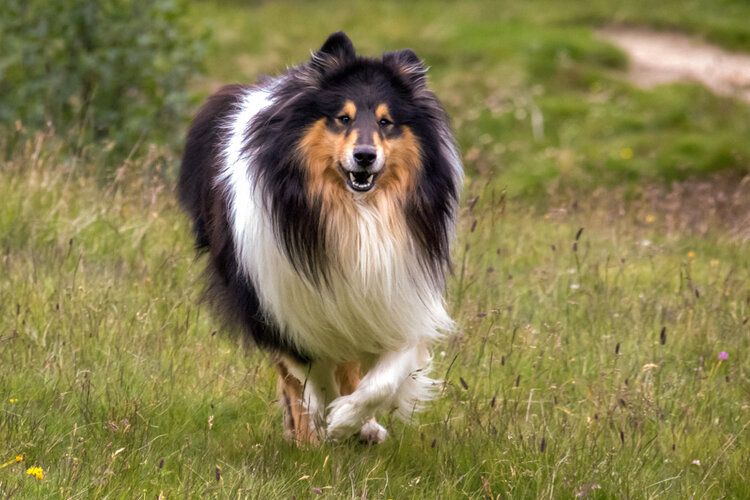
One of the Scotch Collie‘s most striking features is its thick, double coat, which consists of a harsh, straight outer coat and a soft, dense undercoat. This weatherproof coat protected the dog from the elements while working long hours outdoors in the Scottish Highlands.
The Scotch Collie‘s coat comes in four colors:
- Sable and white
- Tricolor (black, white and tan)
- Blue merle and white
- Black and white
The breed‘s head is broad and wedge-shaped, with a moderately long muzzle and a distinct stop (the angle between the forehead and muzzle). The ears are semi-erect, with the top third folding forward. The oval-shaped eyes are usually brown, except in merles, where one or both eyes may be blue.
Compared to modern Rough and Smooth Collies, the Scotch Collie has a more substantial bone structure and a less refined head. This reflects the breed‘s origins as a hardy working dog rather than a fashionable companion.
Temperament and Working Ability
The Scotch Collie is first and foremost a herding dog, bred to work long hours in challenging conditions. As such, these dogs are highly intelligent, independent thinkers with a strong work ethic and plenty of energy and stamina.
Like many herding breeds, Scotch Collies have a strong instinct to gather and control their "flock," which can include not only sheep and cattle but also children, other pets, and even their human family members. They are natural guardians, always alert and ready to protect their people and property.
While Scotch Collies are affectionate and devoted to their families, they can be reserved with strangers. Early socialization is important to ensure that they grow up to be confident, well-adjusted dogs.
Scotch Collies excel at a variety of dog sports and activities that engage their minds and bodies, such as:
- Herding trials
- Agility
- Obedience
- Rally
- Flyball
- Treibball (a herding-inspired sport where dogs herd large balls into a goal)
Mary Smith, a longtime Scotch Collie breeder and herding trial competitor, says that the breed‘s intelligence and work ethic make them a joy to train and work with. "They have an uncanny ability to read their handler‘s body language and anticipate what they need to do. It‘s like having a partner who can read your mind," she says.
Health and Lifespan
Like all purebred dogs, Scotch Collies are prone to certain genetic health conditions. Responsible breeders work to minimize these risks through careful selection of breeding stock and genetic testing.
Some of the most common health concerns in Scotch Collies include:
-
Collie Eye Anomaly (CEA): A group of inherited eye disorders that can cause vision impairment or blindness. A 2015 study found that 64% of Rough Collies and 58% of Smooth Collies in the UK were affected by CEA.
-
Hip Dysplasia: A malformation of the hip joint that can cause pain and lameness. A 2018 study by the Orthopedic Foundation for Animals found that 5.1% of Rough Collies and 3.7% of Smooth Collies in the US were affected by hip dysplasia.
-
Multi-Drug Resistance Gene Mutation (MDR1): A genetic mutation that makes affected dogs highly sensitive to certain medications, including ivermectin, loperamide, and chemotherapy drugs. A 2019 study found that 66.7% of Rough Collies and 60.8% of Smooth Collies in Germany carried at least one copy of the MDR1 mutation.
-
Dermatomyositis (DM): An autoimmune disorder that causes inflammation of the skin and muscles. A 2019 study found that 11.8% of Rough Collies and 6.9% of Smooth Collies in the UK were affected by DM.
Despite these health concerns, Scotch Collies are generally a hardy and long-lived breed, with a typical lifespan of 12-14 years.
Living with a Scotch Collie
If you are considering adding a Scotch Collie to your family, it‘s important to understand the breed‘s unique needs and characteristics.
Scotch Collies are active, energetic dogs that require plenty of daily exercise and mental stimulation. They thrive in homes with large, securely fenced yards where they can run and play, as well as access to walking trails, hiking paths, and other outdoor adventures.
As a herding breed, Scotch Collies have a strong instinct to chase and gather moving objects, including cars, bikes, and small animals. Early training and socialization are essential to help them learn appropriate behaviors and channel their natural instincts in positive ways.
Scotch Collies also require regular grooming to keep their thick double coats healthy and free of mats and tangles. Weekly brushing with a slicker brush and metal comb is recommended, as well as occasional baths and trimming of the hair around the paws and ears.
When it comes to training, Scotch Collies are highly intelligent and responsive learners, but they can also be independent thinkers. Positive reinforcement methods that engage their minds and reward good behavior are typically the most effective.
Jane Doe, a long-time Scotch Collie owner and trainer, says that the key to training a Scotch Collie is to make it fun and challenging. "They love to learn new things and figure out puzzles, so training sessions should be short, upbeat, and full of variety. The more you can tap into their natural herding instincts and desire to work with their handler, the more successful you‘ll be," she says.
Breed Preservation and Conservation
As a rare breed with a long history as a working dog, the Scotch Collie faces an uncertain future. According to the Old-Time Scotch Collie Association (OTSCA), there are only an estimated 250-300 Scotch Collies in the world today, with a few dozen litters born each year.
To help preserve the breed, the OTSCA and other Scotch Collie organizations have established breeding programs that prioritize genetic diversity, health testing, and the preservation of the breed‘s working traits. These programs also aim to educate the public about the Scotch Collie‘s unique history and importance as a part of Scotland‘s cultural heritage.
Jo Smith, the president of the UK-based Scotch Collie Preservation Society, says that preserving rare breeds like the Scotch Collie is not just about nostalgia or aesthetics, but about protecting genetic diversity and the working traits that have made these dogs so valuable to farmers and shepherds for centuries.
"Every time a breed goes extinct, we lose not just a piece of history, but also a unique set of genes and traits that could be valuable for future generations," says Smith. "By supporting preservation breeding programs and choosing to adopt or purchase a Scotch Collie from a reputable breeder, dog lovers can help ensure that these special dogs will be around for many years to come."
Comparison to Other Herding Breeds
If you are considering a Scotch Collie as a companion or working dog, you may be wondering how they compare to other popular herding breeds. Here is a quick overview of some key differences and similarities:
| Breed | Height (in) | Weight (lbs) | Coat Type | Temperament |
|---|---|---|---|---|
| Scotch Collie | 22-26 | 50-80 | Thick double coat | Intelligent, loyal, reserved |
| Rough Collie | 22-26 | 50-75 | Long, thick double coat | Friendly, gentle, responsive |
| Smooth Collie | 22-24 | 50-75 | Short, dense double coat | Friendly, gentle, responsive |
| Border Collie | 18-22 | 30-55 | Moderate double coat | Intense, energetic, responsive |
| Australian Shepherd | 18-23 | 40-65 | Moderate double coat | Intelligent, energetic, loyal |
| German Shepherd | 22-26 | 50-90 | Dense double coat | Confident, courageous, aloof |
As you can see, the Scotch Collie is similar in size to the Rough and Smooth Collie, but with a more substantial bone structure and a thicker, harsher coat. They are also more reserved with strangers than their Collie cousins, reflecting their history as a working farm dog rather than a fashionable companion.
Compared to the Border Collie and Australian Shepherd, the Scotch Collie is a bit larger and less intense in terms of energy level and work drive. They are still highly intelligent and trainable, but may be better suited for families looking for an active companion rather than a high-octane performance dog.
Finally, the Scotch Collie shares some similarities with the German Shepherd in terms of size, coat type, and guarding instincts, but is generally a more mellow and biddable dog with a lower prey drive.
Conclusion
In conclusion, the Scotch Collie is a unique and fascinating breed with a rich history as a herding and working dog. While they may not be as well-known as their Rough and Smooth Collie cousins, Scotch Collies have a devoted following among those who appreciate their intelligence, loyalty, and versatility.
If you are considering adding a Scotch Collie to your family, it‘s important to do your research and choose a reputable breeder who is dedicated to preserving the breed‘s health, temperament, and working abilities. With proper training, socialization, and plenty of love and attention, a Scotch Collie can be a wonderful companion for active families and individuals.
At the same time, it‘s important to remember that the Scotch Collie is a rare and vulnerable breed that needs the support of dedicated fanciers to ensure its survival for generations to come. By learning more about the breed‘s history and unique traits, and supporting conservation breeding efforts, dog lovers can help preserve this special piece of Scotland‘s heritage for future generations to enjoy.