True-Blue Beauty: The Iconic Australian Cattle Dog

Loyal, tough, and whip-smart, the Australian Cattle Dog is a true icon among the herding breeds. With their striking coat, muscular build, and tireless work ethic, these dogs have captured the hearts of ranchers and dog lovers alike. As an admirer of this true-blue beauty, let‘s dig into what makes the Australian Cattle Dog such a stand-out.
A Uniquely Australian Creation
The Australian Cattle Dog, also known as the Blue Heeler, Queensland Heeler, or ACD, was born of necessity on the unforgiving outback in the early 1800s. European settlers found their existing herding dogs just couldn‘t cut it under the harsh Australian conditions. Not only did they lack the stamina to move stubborn cattle over long distances in scorching temperatures, but their bark-and-bite style was ill-suited for handling the free-ranging, almost feral herds.
In 1840, a man named Thomas Hall set out to create the perfect dog for the job. He crossed Smooth-Coated blue merle Collies imported from England with the native Australian Dingo, producing a dog called the Hall‘s Heeler. Ranchers were impressed by the unmatched toughness, tenacity, and "heeling" instinct (nipping at the heels of cattle) of these dogs.
Over the following decades, other breeds like the Dalmatian, Kelpie, and Bull Terrier were introduced to refine and standardize the breed. The result was a unique herding dog perfectly sculpted for the Australian outback, with Dingo-like independence and efficiency combined with the trainability and work ethic of domesticated breeds. By the 1890s, the Australian Cattle Dog as we know it today had emerged.
Built for Business

One look at the Australian Cattle Dog reveals a body built for hard work. Standing 17 to 20 inches at the shoulder and weighing 35 to 50 pounds, this is a compact, muscular herding machine.
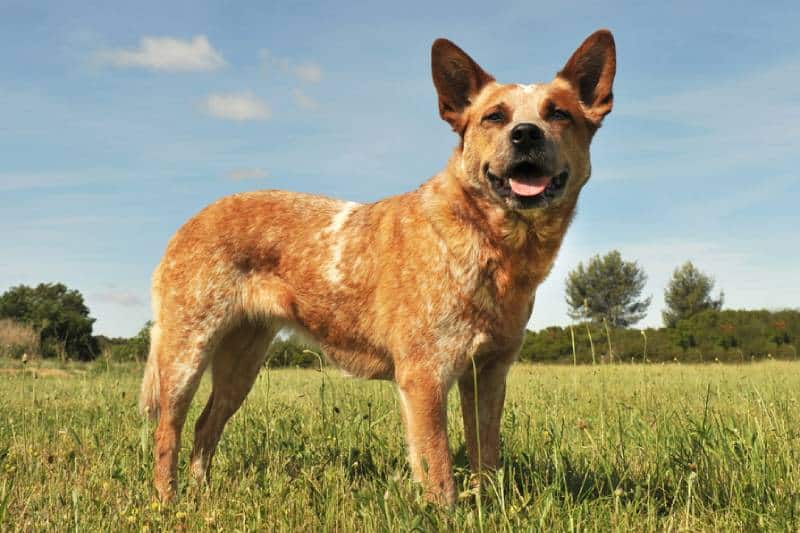
As a breed developed for long days in the harsh Australian sun, the ACD has a short, dense undercoat topped by a straight, rain-resistant outer coat. This double coat not only protects from heat and cold, but from the sharp horns and hooves of unruly cattle. The slight arch to the neck, deep chest, and powerful hindquarters equip the Australian Cattle Dog for bursts of speed and quick direction changes, allowing them to easily outsmart and outmaneuver their herd.
Topping off the business-like appearance are alert, intelligent eyes, upright ears, and a low-set bushy tail constantly in motion as the dog works. This is a pooch always on the job, missing nothing and ready for action.
True-Blue Coloring

The Australian Cattle Dog‘s most distinctive feature is undoubtedly their striking coat color. Most often seen in a blue or red speckled or mottled pattern, it‘s these coat colors that have earned the breed two of its most popular nicknames: the Blue Heeler and the Red Heeler.
But these colorful coats start out very differently than they end up. Australian Cattle Dog puppies are born completely white, regardless of their adult color. By 6 weeks, any black hairs will start to appear, but it can take up to 3 years for the full intensity of the blue or red to develop.
Blue heelers in particular often have an almost black coat as puppies before lightening to the stunning blue-gray shade of adulthood. The blue coloring is actually caused by a dilution gene affecting black pigment, not by the presence of any truly blue hairs. Speckling occurs when small patches of white intermingle with the darker base color.
Interestingly, it‘s not unusual for ACDs to have a mask of darker fur over one or both eyes and a white blaze up the center of the forehead. White patches on the chest, neck, face, and tail tip are also common. The breed standard allows for a variety of coat colors beyond the typical blue or red speckle, including solid blue, blue mottled, and blue or red speckle with black or tan markings.
Not Just a Pretty Face

While the Australian Cattle Dog‘s unique coat is certainly eye-catching, this is a breed built for brains and brawn, not just beauty. Spend a little time with an ACD and you‘ll quickly see the intelligence, independence, and intensity that make them such phenomenal workers.
Weighing up to 50 pounds, the Australian Cattle Dog can easily keep up with a steer ten times their size through a combination of smarts and sheer willpower. Rather than using force, this cunning canine controls their herd with strategic positioning, quick feints, and nips at the heels (thus the "heeler" moniker). Always thinking several steps ahead, the ACD is a master of efficiency, avoiding unnecessary confrontations and conserving their energy for the long haul.
This tireless work ethic comes from a place of near obsessive dedication to task. As one Australian Cattle Dog owner put it, "They don‘t have an off switch. If they decide they‘re going to do something, they‘re going to do it, and they‘ll keep going until they drop."
That drive and determination is a big part of what has made the Australian Cattle Dog such a popular choice for ranchers and farmers. But it also means this is not a breed for the casual owner. Their boundless physical and mental energy must be channeled through consistent training and stimulation, or destructive behavior is sure to follow.
Color Concerns

As striking as the Australian Cattle Dog‘s coat is, those considering the breed should know that color can come with certain health concerns. Dogs with large amounts of white on the head and body have an increased risk of deafness.
This is because the same cells that create pigment in the skin also play a crucial role in the development of the cochlea, the spiral cavity of the inner ear. Without enough of these pigment cells, the cochlea doesn‘t form properly, leading to deafness. It‘s estimated that 2.8% of Australian Cattle Dogs are affected by deafness, with the risk increasing to 14.8% for dogs with excessive white according to one study.
Another color-related issue seen rarely in the breed is a gene mutation called MRD1. Dogs with this mutation can have a severe and potentially fatal reaction to certain common drugs like ivermectin. MRD1 is associated with a particular coat pattern where more than 50% of the body is white with patches of darker color on the head and sometimes the base of the tail.
For these reasons, the breed standard specifies that no more than one-third of the Australian Cattle Dog‘s body should be white. Reputable breeders will avoid producing dogs with excessive white markings. If you‘re considering a pup with a lot of white, be sure to have their hearing tested and discuss any increased health risks with your veterinarian.
Popularity and Presence

While still a relatively rare breed compared to the likes of Labrador Retrievers or German Shepherds, the Australian Cattle Dog has seen a steady rise in popularity over the past few decades. In 2021, the breed ranked 55th out of 197 breeds in registrations with the American Kennel Club, up from 64th a decade prior.
Despite their growing fan base, the Australian Cattle Dog remains first and foremost a working breed. It‘s estimated that over two-thirds of ACDs in Australia and the United States still earn their keep on ranches and farms. This is a testament to the breed‘s unparalleled skill and stamina in moving stubborn stock over vast distances.
For those looking to welcome an Australian Cattle Dog into their home as a companion, expect to pay anywhere from $600 to $1,200 for a puppy from a reputable breeder. Due to their unique grooming, training, and exercise needs, this is not a breed for first-time or hands-off owners. But for experienced dog handlers prepared to put in the time and effort, the loyal, hardworking, and strikingly beautiful Australian Cattle Dog can be the ultimate four-legged partner in work and play.
| Breed | Height (in) | Weight (lbs) |
|---|---|---|
| Australian Cattle Dog | 17-20 | 35-50 |
| Australian Shepherd | 18-23 | 40-65 |
| Australian Kelpie | 15-20 | 25-45 |
| Border Collie | 18-22 | 30-55 |
Comparison of Australian Cattle Dogs to similar herding breeds