
Generative Adversarial Networks | GANs for Image Data
Why are Generative Adversarial Networks (GANs) So Famous and How Will GANs Be Used in the Future?
Introduction to GANs
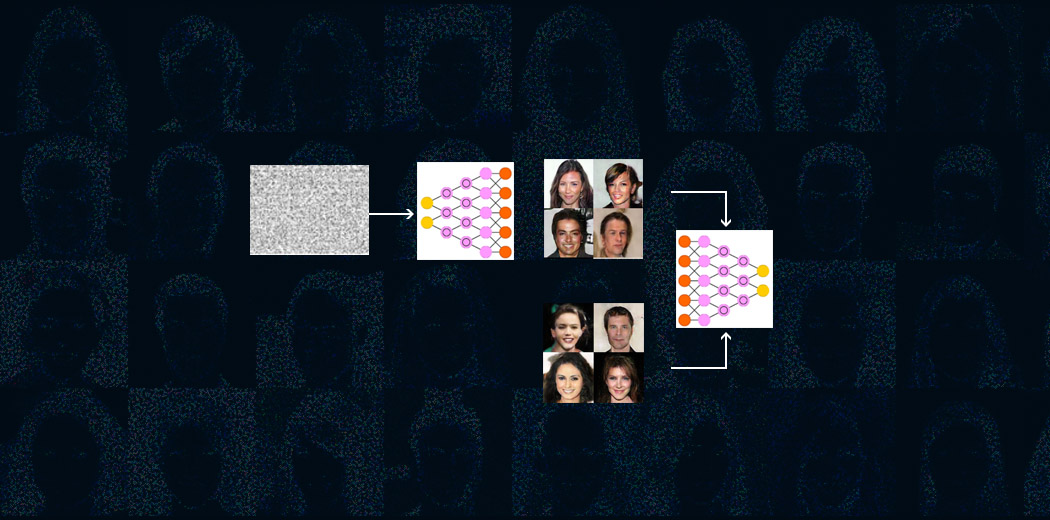
Generative adversarial networks, or GANs for short, are a groundbreaking class of machine learning frameworks first introduced by Ian Goodfellow and his colleagues in 2014. GANs consist of two neural networks – a generator and a discriminator – that are trained simultaneously in a competitive zero-sum game.
The generator learns to map from a random noise vector to generate new plausible examples (such as images) that are intended to look like they came from the same distribution as the training data. Meanwhile, the discriminator is trained to distinguish between "real" examples from the actual training dataset and "fake" examples produced by the generator. As the generator gets better at generating realistic fakes, the discriminator must also improve its ability to spot them. This back-and-forth adversarial training process continues until eventually the generator is producing examples that are essentially indistinguishable from real data.
The key innovation of GANs was providing a way to train a generative model to produce highly realistic data in a purely unsupervised fashion, without needing labeled examples. This has opened up a whole new frontier of possibilities in generative AI and made GANs one of the most exciting and intensely researched ideas in machine learning over the past decade.
The Rise of GAN Popularity
Since the seminal 2014 paper that introduced GANs, research into and applications of GANs have exploded in popularity. Some of the key reasons why GANs have generated so much excitement include:
-
Ability to generate incredibly realistic synthetic data, particularly images. GANs took the machine learning world by storm with their ability to generate images that looked increasingly indistinguishable from real photos. Trained on datasets of real images, GAN generators learned to produce completely novel photorealistic portraits, landscapes, objects, and more.
-
Unsupervised learning approach. GANs don‘t require labeled training data, making them very powerful and flexible. Their unsupervised adversarial learning framework was a major innovation.
-
Beyond just generating data from scratch, GANs can enhance and modify existing data in remarkable ways. For example, GANs have been used to increase the resolution of blurry images, translate images from one domain to another (e.g. day to night or horses to zebras), and seamlessly swap faces in videos.
-
GANs have enabled all sorts of new applications that weren‘t really possible before, from generating synthetic medical images to converting text descriptions into photorealistic scenes. Creative uses of GANs continue to be devised as the technology progresses.
-
The adversarial training process itself, where the generator and discriminator networks push each other to improve, has proven to be a very powerful framework. It tends to produce much sharper results than traditional training using a fixed loss function.
Notable GAN Accomplishments
Over the years, there have been a number of significant research breakthroughs and eye-catching demonstrations that have further fueled the massive popularity and hype around GANs:
-
Progressively trained GANs that can generate high-resolution, highly realistic faces, landscapes, and other types of images from scratch. People have been blown away seeing GANs dream up faces of people who don‘t actually exist.
-
Super-resolution GANs that can take a low-resolution image and fill in realistic details to produce a higher resolution version. This showed the potential of GANs not just for generating new data from scratch but for enhancing existing data.
-
Cyclic/unpaired image-to-image translation with GANs, enabling translation between two image domains without needing perfectly matched pairs. For example, converting horses to zebras, Monet paintings to landscape photos, and so on.
-
Conditional GANs that can generate images from text descriptions, sketches, semantic label maps, and other input modalities. The ability to translate between different data representations using GANs has been thoroughly explored.
-
The rise of Deepfakes and face swapping with GANs. While highlighting concerning implications, it undeniably showcased GANs‘ ability to seamlessly modify real video footage in a photorealistic way.
-
A GAN-generated painting selling for over $400,000 at a Christie‘s auction in 2018. While controversial in the art world, this sale drew mainstream attention to how GANs were pushing the boundaries of what was possible with AI.
Future Potential of GANs
GANs have come a long way and significantly pushed forward the state-of-the-art in generative AI over the past decade. However, there is still much exciting untapped potential and many open challenges to tackle as GANs continue to evolve and mature. Some key areas to watch include:
- Training GANs with differential privacy to protect sensitive data
- Improving the stability, robustness and reproducibility of GAN training
- Scaling up GANs to work with even higher resolution, more diverse, and less curated datasets
- Gaining a deeper understanding of how to control and direct the GAN generation process, and how to promote disentanglement of semantically meaningful factors of variation
- Applying GAN techniques to modalities beyond 2D images, such as 3D shapes, video, audio, and text
- Leveraging GAN-generated synthetic data to train other machine learning models – especially useful for domains where labeled real data may be limited or expensive to collect (e.g. medical images)
- Improving GAN architectures and training techniques via incorporation of self-supervised learning, contrastive learning, multi-task learning, meta-learning, and other approaches
- Hybridizing GANs with other generative models and architectures like variational autoencoders (VAEs), autoregressive models, diffusion models, transformers, and more
- Deploying GANs as a core component of general-purpose AI systems for open-ended content generation
GANs have come a long way since 2014 and are now capable of generating images, video, and audio that can be nearly indistinguishable from real data to humans. Over the next decade, we can expect GAN architectures, training techniques and applications to continue to advance in leaps and bounds.
Conclusion
From generating photorealistic faces and converting sketches to landscapes to creating Deepfakes and producing new drug molecules, GANs have captured the imagination of researchers and the public alike over the past decade. Their ability to produce incredibly realistic and diverse data from scratch or expertly modify existing data, all through an unsupervised adversarial learning process, has proven to be a very powerful framework and opened up a new paradigm of generative AI possibilities.
While there are still many challenges to overcome, GANs will no doubt continue to evolve and mature, powering more and more applications and becoming a key component of cutting-edge AI systems. One day GANs and their successors may routinely generate not just highly realistic images, but also video, audio, 3D models, and maybe even complex multi-modal combinations thereof on demand. Generating rich, interactive virtual worlds and amplifying human creativity across various domains are just some of the exciting future possibilities to ponder.
One thing is for certain – generative AI and GANs are going to continue to be an incredibly hot area of research and technology to keep an eye on. These are still the early days and the future looks bright for GANs. As the saying goes, "You ain‘t seen nothing yet!"


