
Cavalier King Charles Spaniel vs Cocker Spaniel: Key Differences (With Pictures)
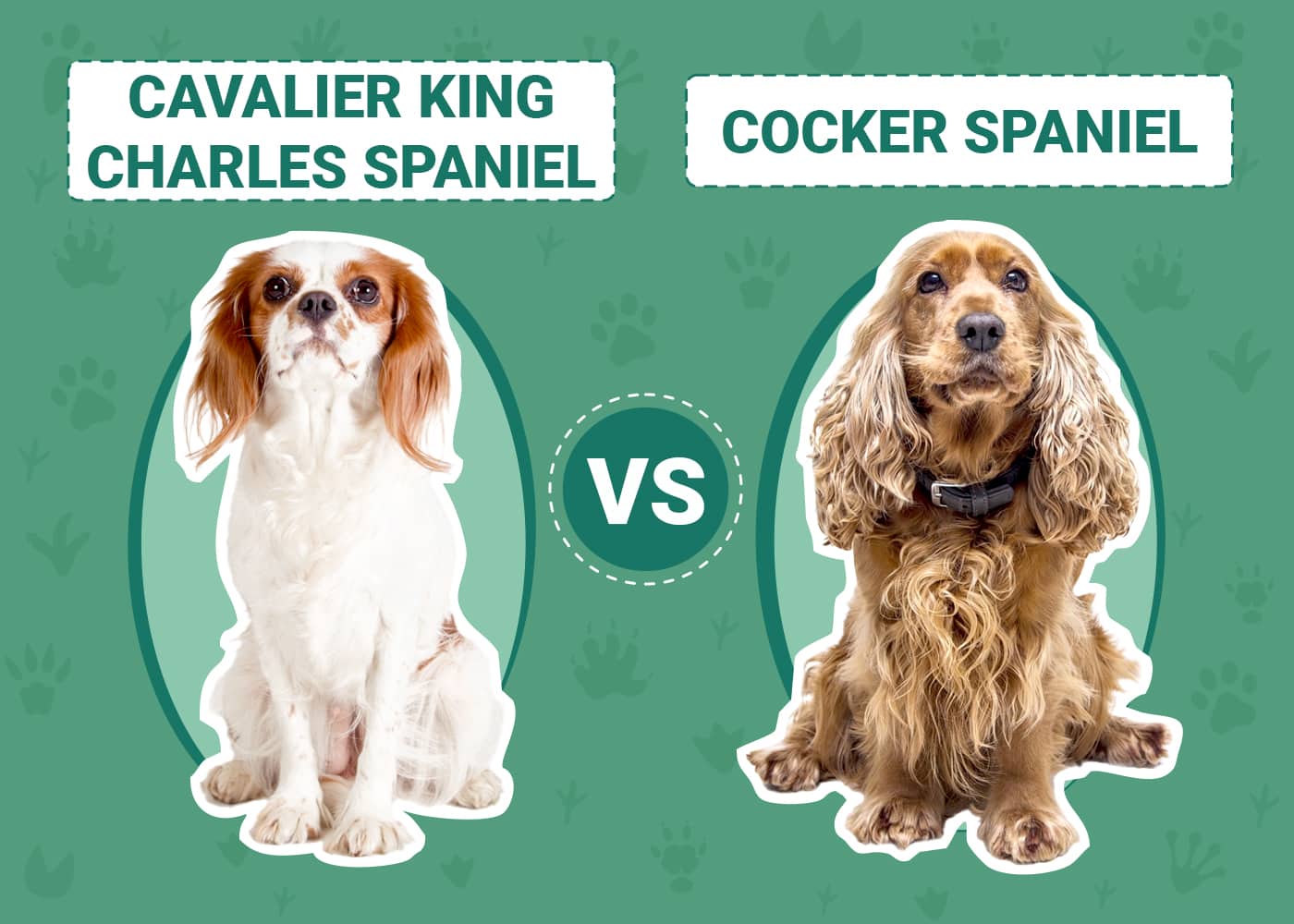
Are you torn between the charming Cavalier King Charles Spaniel and the classic Cocker Spaniel as your next canine companion? While both breeds belong to the spaniel family and share some similarities, each has its own unique qualities that may make one a better fit for your lifestyle than the other. In this comprehensive guide, we‘ll take a closer look at the key differences between Cavalier King Charles Spaniels and Cocker Spaniels to help you make an informed decision.
Breed Origins and History
The Cavalier King Charles Spaniel and Cocker Spaniel may look quite similar at first glance, but their histories are quite different. Here‘s a brief overview of each breed‘s origins:
Cavalier King Charles Spaniel
Despite their regal name, Cavalier King Charles Spaniels actually originated in the 1920s as an attempt to recreate the small toy spaniels seen in portraits of King Charles I and his son, Charles II. These original spaniels had become interbred with pugs and other flat-faced breeds, resulting in the modern English Toy Spaniel.
American Roswell Eldridge sought to bring back the traditional spaniel appearance with a longer muzzle and flatter head. He sponsored a dog show offering prize money for "Blenheim Spaniels of the Old World type." These dogs formed the foundation of the modern Cavalier breed, which was officially recognized by the Kennel Club in the UK in 1945.
Cocker Spaniel
Cocker Spaniels have a much longer history, dating back to 14th century Spain. The term "spaniel" likely derives from the dogs‘ country of origin. Originally bred as hunting companions, Cocker Spaniels specialized in flushing out woodcock birds, thus the "cocker" in their name.
In the 19th century, Cocker Spaniels were brought to England, where they were further developed and refined. The breed grew in popularity both as hunting dogs and family pets. In 1946, the American Cocker Spaniel was recognized as a separate breed from the English Cocker Spaniel by the AKC due to differing breed standards that had emerged.
Physical Characteristics
While both breeds are unmistakably spaniels, there are some key physical differences to note:
Size
– Cavalier King Charles Spaniels are smaller, typically weighing 13-18 pounds and standing 12-13 inches tall at the shoulder.
– Cocker Spaniels are medium-sized dogs, usually weighing 24-28 pounds (males) or 22-26 pounds (females) and standing 14.5-15.5 inches tall.
Coat
– Both breeds have silky, medium-length coats with feathering on the ears, chest, legs and tail.
– Cavaliers have slightly wavy coats that come in four color varieties: Blenheim (chestnut and white), tricolor (black/white/tan), black and tan, and ruby.
– Cocker Spaniels can have straight or slightly wavy coats in a wider range of colors including black, liver, red, golden, and parti-colors.
Head and Face
– Cavaliers have flatter, more rounded heads with full, cushioned muzzles and large, dark round eyes. Their ears are long and set high.
– Cocker Spaniels have a more dome-shaped head with a squared-off, chiseled muzzle. Their ears are long and low-set, and their almond-shaped eyes have an alert, intelligent expression.
Temperament and Personality
Both breeds are known for being friendly, affectionate companions, but there are some general differences in temperament:
Cavalier King Charles Spaniel
– Cavaliers are known for their sweet, gentle nature. They are rarely timid or nervous and tend to get along well with everyone, including children and other dogs.
– They are adaptable and will happily be active companions or cuddle on the couch, depending on their owner‘s lifestyle. Cavaliers crave human companionship and don‘t do well if left alone for long periods.
– Cavaliers tend to be softer in temperament and more sensitive to correction, responding best to positive reinforcement training methods.
Cocker Spaniel
– Cocker Spaniels are known for being merry, active, and outgoing. Their sporty nature makes them more energetic and playful than Cavaliers.
– They are intelligent and eager to please, excelling in obedience and agility. However, Cockers can be sensitive at times and stubborn if not given proper training and leadership.
– Cockers are generally good with children, but may be more reserved with strangers compared to Cavaliers. Early socialization is important to build confidence.
Exercise and Grooming
Both Cavaliers and Cocker Spaniels have moderate to high grooming needs and require regular exercise. However, there are some differences to consider:
Exercise
– Adult Cavaliers typically need 30-60 minutes of moderate exercise per day, such as walks, playtime or visits to the dog park. They enjoy short bursts of activity but also love to relax.
– Cocker Spaniels generally have higher energy levels and stamina. They need about 1-2 hours of more vigorous daily exercise, including brisk walks, running, hiking, swimming, and games like fetch.
– Cockers also need plenty of mental stimulation through training, puzzle toys, scent work, or participation in dog sports. Insufficient activity can lead to behavior issues.
Grooming
- Both breeds require regular brushing (at least 2-3 times per week) to prevent tangles and mats. Professional grooming every 2-3 months is recommended to trim their coats.
- Cavaliers tend to be average shedders while Cockers may shed a bit more seasonally. Regular brushing and occasional baths help control loose fur.
- Cavaliers and Cockers also need frequent ear cleaning to prevent infections, since their long, floppy ears can trap moisture and debris. Nail trims and dental care are other important grooming tasks.
Training and Socialization
– Both breeds are intelligent and responsive, making them fairly easy to train with positive, reward-based methods. Cavaliers tend to be a bit softer and more sensitive than Cockers.
– Early socialization (exposing puppies to various people, animals, and environments) is essential for both breeds to ensure they grow up to be confident, well-adjusted dogs.
– Cockers have a stronger prey drive and retrieving instinct due to their hunting background. They may be more easily distracted outdoors and have a greater urge to chase small animals.
– Housetraining can sometimes take longer for Cavaliers, as they can be sensitive to cold, rainy weather. Consistency and positive reinforcement are key.
Health and Lifespan
– Cavalier King Charles Spaniels have an average lifespan of 9-14 years. Like many small breeds, they can be prone to certain health issues including mitral valve disease (MVD), syringomyelia (SM), patellar luxation, and eye disorders.
– Cocker Spaniels typically live 10-14 years. They may be prone to certain eye problems like progressive retinal atrophy and glaucoma, skin allergies, hip dysplasia, and hypothyroidism.
– Responsible breeders screen for common genetic disorders, but all dogs should receive regular veterinary checkups. Maintaining a healthy weight and providing age-appropriate exercise can help prevent or manage some health conditions.
Which Breed Might Be Right For You?
Deciding between a Cavalier King Charles Spaniel and a Cocker Spaniel ultimately depends on your lifestyle, activity level, grooming commitment, and the temperament you‘re looking for. Here are a few factors to consider:
A Cavalier King Charles Spaniel may be a good fit if you:
- Want a gentle, affectionate lap dog who loves to snuggle
- Live in an apartment or have a more low-key lifestyle
- Enjoy short walks and play sessions rather than vigorous hikes
- Want a smaller, more portable dog to travel with
A Cocker Spaniel may be the better choice if you:
- Are seeking an active, energetic companion for outdoor adventures
- Want a dog who excels at training and dog sports
- Don‘t mind a bit more grooming and shedding
- Have a house with a yard for play (though Cockers can adapt to apartments with sufficient exercise)
Of course, these are generalizations and each individual dog‘s personality can vary. Meeting several dogs of each breed can give you a better sense of their temperaments. Whichever breed you choose, you‘ll be gaining a loving, devoted spaniel companion to share your life with!


)