The AFT 465 Exemption Is Gone: What Actually Happens If Your Army WHtR Is 0.550+
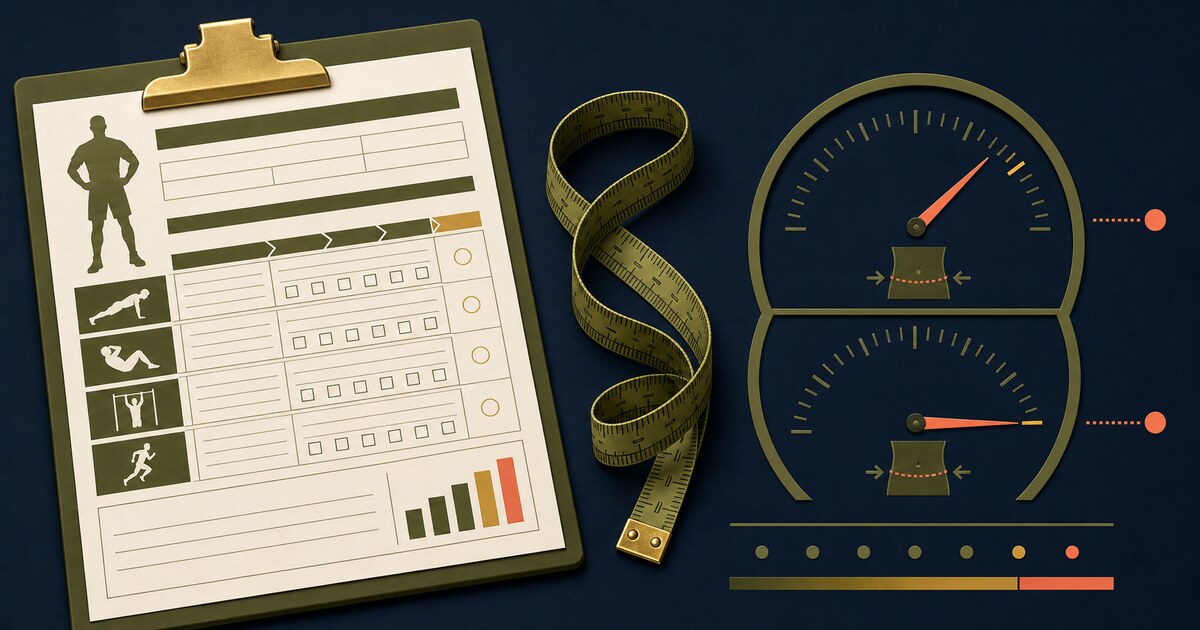
Short answer: Under the current Army Body Composition Program, a high Army Fitness Test score does not create a body-composition exemption. Army Directive 2026-13 replaces the old screening-table and tape-test workflow with waist-to-height ratio (WHtR). If the recorded ratio is 0.550 or higher, it does not meet the standard. A recorded 0.549 does.
That change is easy to misunderstand because many older pages still describe the high-score exemption and body-fat percentage charts. This guide focuses on the practical question Soldiers are asking now: what does the new rule mean, how should you read a borderline number, and what happens after an initial failed measurement?
This is an explanatory article, not an official determination of a Soldier’s status. A unit’s trained measurement team, DA Form 5500 entry, and commander-led process control any official action. For the policy text itself, read Army Directive 2026-13.
The Army Publishing Directorate’s active publication record for Army Directive 2026-13 is a useful status check when older search results show a different rule or date.
What changed in July 2026?
The directive is dated July 1, 2026 and says it is effective immediately. Army Public Affairs explained the change publicly on July 7. The important operational point is the same: WHtR is now the only authorized ABCP standard. The former height-and-weight screening tables are discontinued, and the circumference-based tape test or another supplemental body-fat method cannot be used to challenge a WHtR result.
The directive applies across the Regular Army, Army National Guard/ARNGUS, and U.S. Army Reserve, with additional coverage for the cadet, retention, and institutional-training contexts listed in the policy. It is not a retroactive re-scoring rule; the document says the new policy is effective going forward.
| Common old assumption | Current rule |
|---|---|
| A high AFT score, often called the “465 exemption,” waives body-composition requirements. | AFT score exemptions are eliminated. A strong score is still a fitness result, not a WHtR waiver. |
| If WHtR is unfavorable, the Soldier can fall back to a tape or body-fat percentage calculation. | WHtR is the authorized ABCP standard; the old supplemental methods are not a challenge path. |
| Exactly 0.550 is close enough to pass. | The recorded standard is strictly less than 0.55. Recorded 0.550 does not meet it. |
| An initial failed number automatically means immediate separation. | A confirmation measurement and the directive’s administrative and review safeguards come first. |
The exact WHtR rule: why 0.549 passes and 0.550 fails
The basic ratio is:
WHtR = average waist circumference in inches ÷ height in inches
The boundary is not “about 0.55.” It is a strict comparison. The Army’s public explainer says the ratio is recorded to three decimal places without rounding: digits after the third decimal are discarded. That creates an important difference between the underlying calculation and the number written on the record.
| Underlying calculation | Recorded ratio | Result |
|---|---|---|
| 0.549888 | 0.549 | Meets the “less than 0.55” standard |
| 0.550000 | 0.550 | Does not meet the standard |
| 0.550742 | 0.550 | Does not meet the standard |
In other words, ordinary rounding is the wrong mental model. A value such as 0.549888 is not rounded up to 0.550 for the recorded result; it is truncated to 0.549. A value that records as 0.550 is not rescued by being only a few thousandths over the line.
That is why a self-check is most useful when it shows the inputs and the recording rule, rather than displaying a vague green or red label. The Army WHtR calculator can help you make a private preliminary check before a scheduled screening, but it cannot replace the unit’s trained measurement or official paperwork.
Measurement details matter more than a calculator decimal
Two people can enter the same nominal height and waist and still get different results if they use different measurement conventions. The Army’s implementation guidance and DA Form 5500 specify a field procedure that is more precise than “wrap a tape around your waist once.”
- Height: measure without shoes, in socks, and record it to the nearest half inch.
- Waist location: measure at the navel (belly button), not at the narrowest point of the torso or wherever a clothing waistband happens to sit.
- Three readings: take three waist measurements. Each reading is rounded down to the nearest half inch under the implementation procedure.
- Outlier handling: if one of the three readings differs by more than one inch from the other two, take an additional reading and average the closest three.
- Trained team: the official process uses a two-person measurement team and the specified PT-uniform conditions, normally with same-sex personnel when available.
Those details are especially important near 0.550. A half-inch change in a normalized input can move the recorded result across the pass/fail boundary. A home estimate is therefore a planning aid, not evidence that a unit result is wrong.
What happens after an initial failed measurement?
The first number is not the end of the process. Army Directive 2026-13 requires a confirmation measurement by a different team on the same duty day before commander action. That safeguard is one reason a result near the boundary should be treated calmly and documented carefully rather than debated from memory.
If the confirmed recorded ratio is 0.550 or higher, the directive says the Soldier is flagged and enrolled in the Army Body Composition Program. The WHtR is recorded on DA Form 5500 and in ATIS within the transition period described by the directive; DA Form 5501 is rescinded. Commanders oversee the program directly, and the article should not be read as a substitute for local counseling, medical guidance, or command instructions.
The directive also addresses timing around physical fitness testing. Units should allow at least seven days between an AFT or CFT and the WHtR measurement, although commanders may deviate when operational circumstances require it. If your unit schedules the events closer together, ask for the applicable local instruction instead of assuming an online calculator can resolve the issue.
Does a failed WHtR mean immediate separation?
No. The directive contains a specific separation guardrail: units may begin the applicable administrative process, but no Soldier will be separated for ABCP failure until HQDA completes a 180-day assessment and issues further guidance. That does not erase a confirmed failure or guarantee a particular command outcome. It does mean that “I failed one screen, so I am being separated today” is not an accurate summary of the current directive.
Medical questions are separate from the ratio calculation. Existing pregnancy and postpartum protections remain in the policy, and the directive describes different medical-exam pathways for Regular/AGR Soldiers and Reserve-component Soldiers. A calculator cannot decide whether an exemption applies to an individual; take that question to the appropriate medical and command channels.
What the AFT score still does—and does not—do
AFT performance still communicates physical readiness and remains important to a Soldier and unit. The change is narrower but consequential: the score no longer waives the WHtR standard. The directive explicitly eliminates AFT score exemptions and rescinds the prior exemption directive. So a high score can coexist with a WHtR result that requires the ABCP process.
This is also why old search results can be misleading. A page that says “score 465 or higher to avoid tape” may have described an earlier policy window. It should not be used to predict a current screening outcome after Army Directive 2026-13 took effect.
Do not mix the current WHtR rule with old body-fat calculators
The current ABCP decision is a waist-to-height ratio, not a body-fat percentage. Older calculators may still show age bands, sex-based percentage limits, BMI screens, or the former tape equations. Those tools can be useful for historical comparison or personal fitness planning, but they are not the current WHtR decision method described in the directive.
When checking a number privately, record the exact height, each waist reading, the half-inch normalization, and the three-decimal recorded ratio. Keep the result private if you do not want it stored. Then use the unit’s official measurement and documentation process for anything that affects your status.
Quick answers
Does a 465 AFT score still exempt me?
No current AFT score exemption is preserved by Army Directive 2026-13. The directive eliminates AFT score exemptions. Existing medical, pregnancy, and postpartum provisions are different questions and must be handled through the proper channels.
Is 0.550 a pass?
No. The threshold is strictly less than 0.55. The Army’s three-decimal recording examples treat 0.549 as meeting the standard and 0.550 as not meeting it.
Can I ask for a tape test to challenge the result?
Not as a current ABCP challenge method. The directive discontinues the old tables and says supplemental methods, including the circumference tape test, are not authorized to challenge WHtR.
What should I do with a borderline self-check?
Save the inputs, do not change the measurement to chase a preferred result, and ask the unit for its trained measurement procedure. The official same-day confirmation rule matters more than an argument over a home decimal.
Bottom line
The practical update is simple even though the transition is not: high AFT performance no longer creates the former exemption, WHtR is the current ABCP standard, and the pass line is recorded below 0.550. The most useful preparation is to understand the measurement protocol, know the difference between an initial screen and a confirmed result, and avoid relying on stale body-fat or tape-test pages.
For the source-backed policy language and implementation details, consult the directive and the Army’s current guidance linked below. For personal preparation, a private calculator can help you understand the arithmetic; it cannot issue an official Army result.
The Army Resilience Army Body Composition Program page is the service’s current program hub for related explanations and updates.