Are Akitas Good With Other Dogs? A Dog Lover‘s Guide
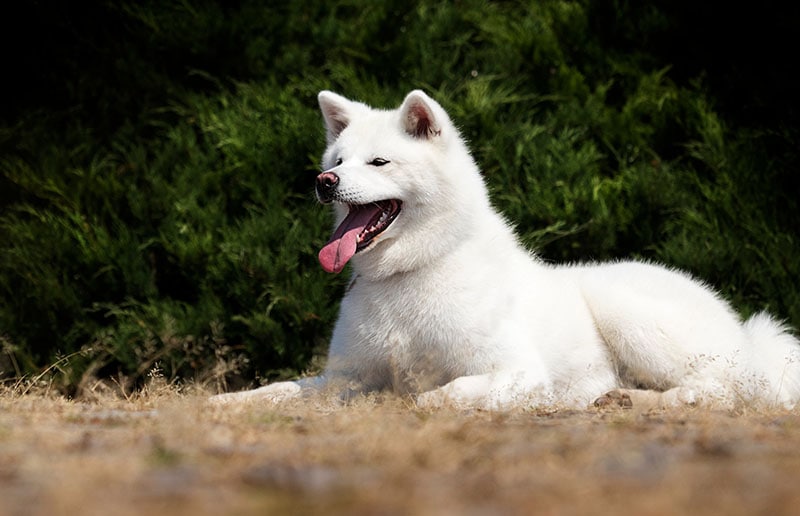
Akitas are a striking and powerful breed known for their loyalty, courage, and dignity. Originally bred in Japan to hunt large game like wild boar and bears, these independent thinkers have a long history as guardians and companions to royalty. Today, Akitas are still revered in their native country as symbols of good health and long life.
But while Akitas can make wonderful family pets in the right home, they are not always the easiest breed to integrate with other dogs. Their dominant personality, territorial nature, and high prey drive mean Akitas often prefer to be the sole king or queen of their castle.
As dog lovers, it‘s important to understand the Akita breed and set them up for success in a world full of other canines. Let‘s dive into what makes Akitas tick and how to help them thrive with four-legged friends.
The Regal Akita: Born to Stand Out in a Crowd
Akitas are impressive animals, standing 24-28 inches tall and weighing up to 130 pounds. Their large, bear-like head with small, deep-set eyes gives them an intense, intimidating expression. Upright ears, a tightly curled tail, and a thick double coat complete the look of a classic spitz breed built for cold weather.
But it‘s not just their physical presence that sets Akitas apart from other dogs. These independent spirits have a mind of their own and are not as eager to please as some breeds. They were developed to work autonomously, making decisions without human guidance. This means Akitas demand mutual respect and will not tolerate harsh handling or training.
While fiercely devoted to their family, Akitas are naturally aloof with strangers and can be territorial towards unknown people and dogs. They have strong guarding instincts and will not hesitate to defend their home or loved ones if they perceive a threat. Early and extensive socialization is a must to teach Akitas what is a normal part of their world.
Akita Breed Traits and Same-Species Aggression
Dog aggression is a well-documented trait in Akitas, particularly among dogs of the same sex. Their ancestors hunted in groups but typically lived on their own as adults, only coming together to breed. Modern Akitas still carry those ingrained instincts to carve out their territory and defend it from rivals.
A 2012 study in the Journal of Veterinary Medical Science looked at aggression in over 5000 dogs of 17 breeds. Akitas ranked as one of the most aggressive breeds, displaying higher than average aggression towards both familiar and unfamiliar dogs. Intact males were the most likely to exhibit serious aggression resulting in injuries.
It‘s thought that same-sex aggression in Akitas is tied to their natural hierarchical pack structure. Two dominant dogs of the same sex will instinctively vie for the top spot, even if they previously got along. Fights between Akitas tend to be intense and bloody due to their size, strength, and determination. They also have a high pain tolerance that allows them to continue fighting even when seriously hurt.
While some Akitas, especially those raised together from puppyhood, can peacefully coexist with other dogs in the home, there are no guarantees. An Akita that has shown no signs of aggression may suddenly decide to stake their claim as top dog once fully mature. Owners must always be prepared to manage their Akita‘s interactions with other dogs to prevent tragedy.
Setting Akitas Up For Success With Other Dogs
Socializing an Akita with other dogs is not a simple or quick process. It requires extensive positive exposure from an early age, lifelong management, and a healthy dose of realism. Even with the best training and intentions, some Akitas may never be fully comfortable around unfamiliar dogs.
According to renowned dog trainer and behavior expert Patricia McConnell, proper socialization is about quality, not quantity. Brief, positive encounters with a variety of dogs in different locations teaches Akitas that other dogs are a normal part of life, not a threat. The key is keeping the interactions upbeat and ending on a high note before the Akita becomes uncomfortable.
Reputable Akita breeders and rescues play a vital role in educating potential owners about the breed‘s training needs and dog intolerance. Placing Akitas in homes with experienced owners who have realistic expectations is crucial for the dog‘s wellbeing. Many will only adopt out Akitas to one-dog households to minimize risks and set the dog up for success.
For Akita puppies, a well-run puppy class guided by a knowledgeable instructor is a great way to build social skills. Structured playtime with tolerant adult dogs can also help them navigate interactions safely. The goal is teaching bite inhibition, cooperative play, and the ability to disengage when things get too rowdy.
It‘s equally important to teach the Akita to focus on their handler around other dogs. Basic obedience commands like "watch me," "leave it," and "let‘s go" give the owner tools to redirect the Akita if a situation starts to go south. A rock solid recall is a must for off leash control.
Real Life With an Akita and Other Dogs
Living with an Akita and another dog under the same roof is possible but not without challenges. It requires constant management, a keen eye for body language, and the ability to pivot when things aren‘t working.
Take Bella, a 2 year old female Akita who shares her home with a male Golden Retriever named Charlie. Bella and Charlie were best buds growing up, playing and snuggling together from the time they were puppies. But as Bella matured, she became less tolerant of Charlie invading her personal bubble.
One day, a scuffle broke out over a toy that left Charlie with a torn ear. Bella‘s owners knew they had to make a change to keep the peace. They started keeping the dogs separated when home alone and closely supervising their time together. Bella drag leash at all times to allow for quick intervention. Toys, chews, and food were picked up to prevent resource guarding.
With time and training, Bella learned to coexist with Charlie by focusing on her owners and respecting Charlie‘s space. The two are not best friends but can now relax in the same room and enjoy parallel play. It‘s not a perfect setup but one that works for this particular Akita and family.
Not all situations have such a happy ending. In homes with multiple dominant dogs, Akitas may gang up on the perceived weakest link or redirect their aggression onto their owners. The stress and tension of trying to keep the peace can be too much for both the dogs and the people.
In these cases, finding a more suitable home for the Akita or the other dog may be the most responsible choice. Akitas pushed too far may act out with dangerous or even deadly consequences. Sometimes the greatest act of love is admitting when a dog would be happier in a different environment.
There‘s No Shame in a One-Dog Lifestyle
At the end of the day, Akitas are often at their best when they can be the center of their human‘s world. They thrive with consistent training, clear boundaries, and plenty of one-on-one attention. Asking them to share their home and hearts with another dog can be asking too much.
Luckily, there are many ways to keep a solo Akita happy and fulfilled that don‘t involve dog parks or doggie daycare. Participating in dog sports like tracking, carting, and obedience trials allows Akitas to strut their stuff without direct contact with other dogs. Taking long sniffy walks or hikes in nature keeps their body and mind engaged.
Interactive games like hide and seek, puzzle toys, and nose work build cooperation and strengthen the bond between Akita and owner. Even just relaxing on the couch together watching Netflix counts as quality time for this devoted breed.
It may mean passing up on puppy playdates and trips to the dog beach. But for Akita lovers, the rewards of living with this magnificent breed are worth the sacrifices. By working with their dog‘s natural instincts and advocating for their needs, owners can give their Akita the life they deserve – even if that life is a party of two.
The Bottom Line
Akitas are a complex and challenging breed when it comes to getting along with other dogs. They require extensive socialization, lifelong training, and management to successfully share space with another canine. Even then, some Akitas will never be fully comfortable around other dogs and are best suited as the only dog in the home.
It‘s up to responsible breeders, rescues, trainers, and owners to be upfront about the Akita‘s dog selectivity and set them up for success. By understanding their unique needs and respecting their boundaries, we can create a world where Akitas can shine – with or without a doggie sidekick.
Sources
-
American Kennel Club. (2021). Akita. Retrieved from https://www.akc.org/dog-breeds/akita/
-
Hasegawa, M., Ohtani, N., & Ohta, M. (2014). Dogs‘ body language relevant to learning achievement. Animals, 4(1), 45-58. https://doi.org/10.3390/ani4010045
-
McConnell, P. B. (2002). The other end of the leash: Why we do what we do around dogs. Ballantine Books.
-
Mogi, K., Nagasawa, M., & Kikusui, T. (2011). Attachment between humans and dogs. Japanese Psychological Research, 53(3), 209-221. https://doi.org/10.1111/j.1468-5884.2011.00454.x
-
Nagasawa, M., Mitsui, S., En, S., Ohtani, N., Ohta, M., Sakuma, Y., Onaka, T., Mogi, K., & Kikusui, T. (2015). Oxytocin-gaze positive loop and the coevolution of human-dog bonds. Science, 348(6232), 333-336. https://doi.org/10.1126/science.1261022
-
Sacks, J. J., Lockwood, R., Hornreicht, J., & Sattin, R. W. (1996). Fatal dog attacks, 1989-1994. Pediatrics, 97(6), 891-895. PMID: 8657532.
-
Takeuchi, Y., Kaneko, F., Hashizume, C., Masuda, K., Ogata, N., Maki, T., Inoue-Murayama, M., Hart, B. L., & Mori, Y. (2009). Association analysis between canine behavioural traits and genetic polymorphisms in the Shiba Inu breed. Animal Genetics, 40(5), 616-622. https://doi.org/10.1111/j.1365-2052.2009.01892.x
-
Tonoike, A., Nagasawa, M., Mogi, K., Serpell, J. A., Ohtsuki, H., & Kikusui, T. (2015). Comparison of owner-reported behavioral characteristics among genetically clustered breeds of dog (Canis familiaris). Scientific Reports, 5, 17710. https://doi.org/10.1038/srep17710
-
Tonoike, A., Sato, N., Fujita, K., Nagasawa, M., Mogi, K., & Kikusui, T. (2012). Aggression toward unfamiliar dogs in four dog breeds. Journal of Veterinary Medical Science, 74(1), 127-130. https://doi.org/10.1292/jvms.11-0365