
Border Collie vs Australian Shepherd: The Differences (With Pictures)
Border Collies vs. Australian Shepherds: How to Choose the Right Herding Dog for You
Are you trying to decide between a border collie and an Australian shepherd for your next canine companion? As someone who has lived with and loved both of these brilliant herding breeds, I know firsthand how challenging it can be to choose between them. While they have a lot in common, border collies and Aussies also have some key differences that are important to understand before bringing one home. In this in-depth guide, we‘ll compare border collies and Australian shepherds in terms of appearance, temperament, exercise needs, trainability, and more to help you determine which breed is the best fit for your lifestyle.
Breed History and Overview
The border collie originated along the borders of England, Scotland and Wales, where they were used to herd sheep in the challenging terrain of the British Isles. Bred purely for working ability rather than appearance, border collies are often considered the world‘s premier herding dogs. They first came to the United States in the late 19th century and have excelled in herding trials and canine sports ever since.
Australian shepherds, contrary to their name, were actually developed in the western United States, not Australia. Basque shepherds who emigrated to America in the 1800s brought their herding dogs with them. These dogs likely had collie or shepherd-type ancestry, but were bred over time into a distinct breed suited to the ranching and herding needs of the American west. While still used as working dogs today, Aussies have also gained popularity as versatile family companions.
Physical Characteristics
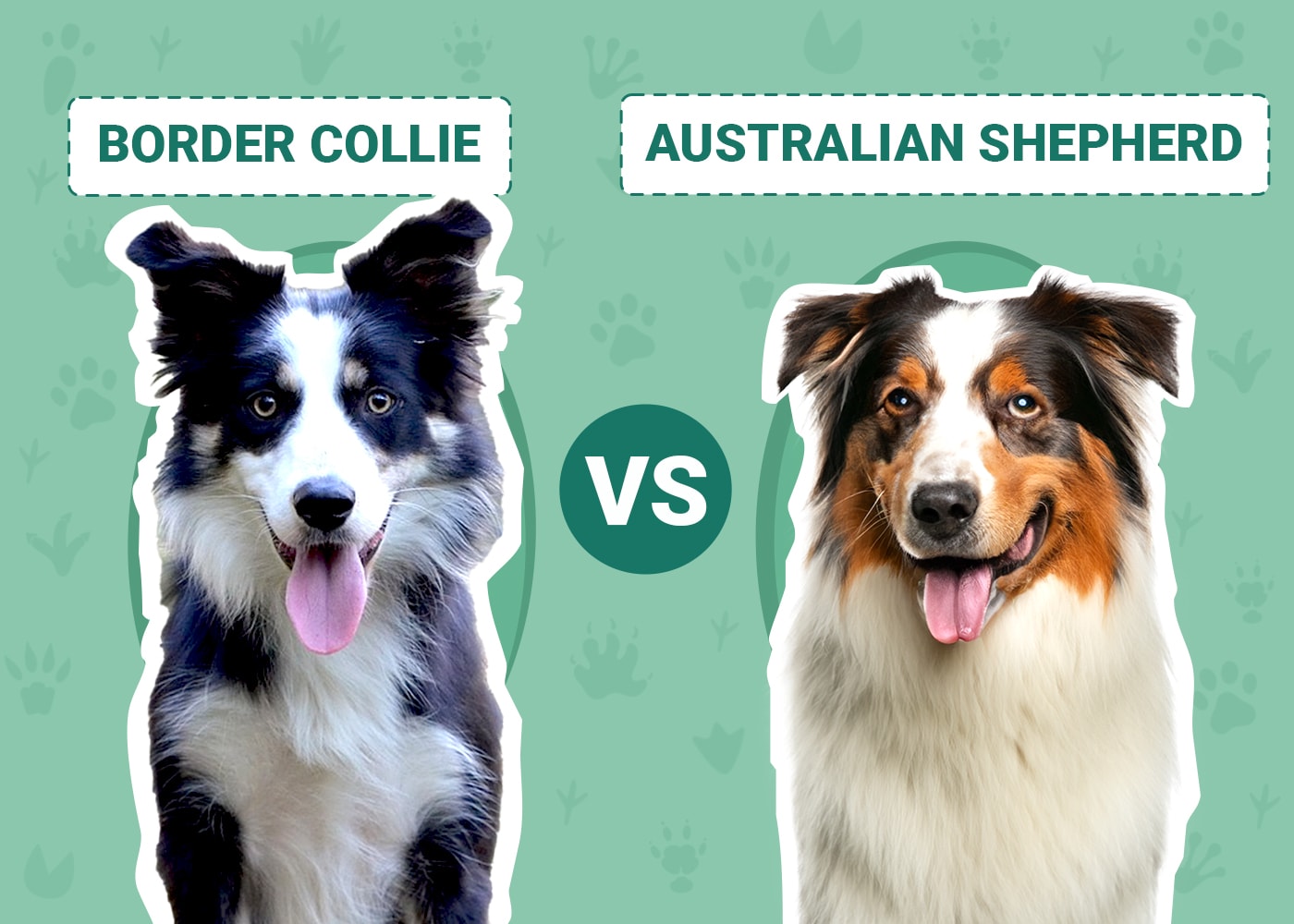
One of the most noticeable differences between border collies and Australian shepherds is their appearance. Border collies are a medium-sized breed, typically weighing 30 to 55 pounds. They have a lean, athletic build designed for speed, agility and endurance. The border collie coat is most commonly seen in black and white, but can come in a variety of colors including red and white, tricolor, and blue merle. They have a thick double coat with a coarse outer coat and soft undercoat.
Australian shepherds are a bit larger and more substantial than border collies, usually ranging from 40 to 65 pounds. Aussies are slightly longer than tall, with a muscular build and striking coat. They are perhaps best known for their beautiful blue merle coats, although they also come in black, red merle, and red tricolor. Aussies have a medium-length double coat that is weather resistant and sheds seasonally.
It‘s worth noting that while both breeds can have blue eyes or differently colored eyes, this is more common in Aussies. Some border collies may have one or both eyes blue, but brown is the typical eye color for the breed. Aussies frequently have blue, amber, hazel or bi-colored eyes.
Temperament and Personality
Both border collies and Australian shepherds are intelligent, active, and eager to please. They bond deeply with their families and thrive on human companionship. Neither of these breeds is content to be a couch potato – they need a job to do, whether that‘s herding livestock, learning new tricks and skills, or accompanying you on adventures.
Border collies are famous for their intense gaze and "eye," which they use to control livestock. They are laser-focused and determined, with incredible stamina and work ethic. While affectionate with their people, they can be reserved or aloof with strangers. Border collies have strong herding instincts and may try to round up children, other pets, and anything else that moves if not given proper outlets for these drives.
Aussies share the border collie‘s work ethic and devotion to family, but tend to have a slightly more gregarious, happy-go-lucky attitude. They are usually friendly and outgoing with everyone, although early socialization is still important. Aussies can definitely still display herding behaviors like nipping at heels, but they have a slightly "softer" approach compared to the border collie‘s relentless focus and precision. They‘re known for their goofy sense of humor and playful spirit.
Exercise Needs and Energy Level
As high-energy working breeds, both border collies and Australian shepherds need substantial daily exercise to stay happy and well-behaved. For border collies, a bare minimum of 60 to 90 minutes of intense physical activity per day is a must, but many individuals need even more than that. In addition to physical exercise, border collies require a lot of mental stimulation in the form of training, puzzle toys, games, and challenging tasks to keep their big brains busy.
Aussies are also a high-energy breed, but most can get by with a bit less exercise than the border collie. Aim for at least an hour per day of running, hiking, playing fetch, or participating in dog sports. Like border collies, Aussies are smart cookies who need regular mental exercise in addition to physical activity. Teaching them new skills and providing puzzle feeders and interactive toys is a must to stave off boredom and destructive behaviors.
Trainability and Intelligence
Border collies and Australian shepherds are both extremely intelligent and trainable breeds. In Dr. Stanley Coren‘s book "The Intelligence of Dogs," border collies ranked as the #1 brightest dog breed when it comes to obedience and working intelligence. Aussies were not far behind at #42 out of 138 breeds tested.
Both breeds excel at learning complex tasks quickly and make devoted working partners. They respond very well to reward-based training methods and positive reinforcement. The border collie‘s keen responsiveness and drive means basic obedience usually comes easily to them. However, they can be quite sensitive, so keeping training sessions fun and upbeat is important.
Aussies are also highly trainable, but some may be a bit more independent-minded than border collies, especially as puppies. They do best with patient, consistent training and lots of motivating rewards. Aussies can be a good choice for beginner dog sports enthusiasts, as they‘re not quite as intense as border collies but still have that signature herding breed work ethic and desire to please.
Grooming and Shedding
With their thick double coats, both border collies and Australian shepherds require regular brushing to keep shedding under control and prevent matting. Expect to brush them at least a few times per week, and more often during shedding season in the spring and fall.
Neither breed needs frequent bathing – once every month or two is usually sufficient unless they get into something messy. Both are relatively easy to groom at home, although those with very thick, long coats may benefit from occasional professional grooming to remove undercoat and keep things tidy.
Aussies tend to shed a bit more than border collies, so allergy sufferers may do better with a border collie. However, no herding breed is truly hypoallergenic, so either one will leave some fur and dander around your home.
Health and Longevity
Border collies and Australian shepherds are both generally healthy, long-lived breeds provided they come from responsible breeders who health test their dogs. A typical lifespan for a border collie is 12 to 15 years. For Aussies, it‘s 11 to 15 years.
Some genetic health issues to be aware of in border collies include:
- Hip dysplasia
- Progressive retinal atrophy (PRA)
- Epilepsy
- Collie eye anomaly (CEA)
- Deafness (associated with merle coloring)
In Australian shepherds, potential health concerns include:
- Hip and elbow dysplasia
- Epilepsy
- Cataracts
- Collie eye anomaly
- Multiple drug sensitivity (MDR1 gene mutation)
Finding a breeder who does comprehensive health testing on their breeding dogs is crucial for getting a healthy puppy of either breed. Adopting an adult dog from a rescue can also be a great option, as many health issues will already be apparent.
Which Breed is Right For You?
Both border collies and Australian shepherds can make wonderful companions for the right person or family. The key is to be realistic about what you can provide in terms of exercise, training and mental stimulation. If you lead an active lifestyle and are willing to put a lot of time and effort into exercising your dog‘s mind and body each day, either breed could be a good fit.
Border collies are best suited for:
- Experienced dog owners
- Homes without small children
- People with a lot of time and energy to devote to their dog
- Those interested in canine sports like agility, flyball, disc dog, etc.
- Families looking for a running/hiking/biking buddy
Australian shepherds can adapt well to:
- First-time dog owners who are committed to training and socialization
- Families with older children
- Moderately active households
- Those interested in getting started in dog sports
- Therapy or service dog work
Of course, these are just generalizations – there is a lot of individual variation within each breed. The best way to find out if a border collie or Aussie is right for you is to spend time with dogs of that breed. Talk to owners, breeders and rescue volunteers to learn more about what it‘s really like to live with them. Meeting the breeder‘s adult dogs and the puppy‘s parents will also give you a good idea of what to expect as your puppy grows up.
Tips for Raising a Happy Herding Breed
Whichever breed you decide on, raising a happy, well-adjusted herding dog requires a commitment to meeting their physical and mental needs each day. Some tips:
- Provide plenty of daily exercise through long walks, hikes, runs, fetch, dog sports, etc. A tired dog is a good dog!
- Use reward-based training to teach essential obedience skills, tricks, and fun games.
- Give them a job to do, whether that‘s simple chores around the house or formal herding training.
- Make sure they get used to being handled all over from a young age for grooming and veterinary care. Desensitize them to having their paws, ears and mouths touched.
- Take a proactive approach to socialization by exposing them to many different people, animals, places and experiences in a positive way.
- Redirect herding behaviors like chasing and nipping to toy play or tug instead.
- Invest in durable puzzle toys and interactive feeders to keep their mind busy.
With the right exercise, training and mental stimulation, border collies and Australian shepherds make deeply devoted, delightfully entertaining companions. Their keen intelligence, incredible work ethic, and desire to be your partner in all of life‘s adventures is truly special. While not the easiest breeds to own, all that energy and intensity is well worth it for those who appreciate the unique charms of these brilliant herding dogs.



)