F1 vs F2 Goldendoodle: A Dog Lover‘s Guide to Choosing Your Ideal Doodle
As a self-proclaimed dog lover and veterinarian, I can‘t help but gush about Goldendoodles. This charming cross of the Golden Retriever and Poodle has skyrocketed in popularity to become one of the most coveted companion dogs in the U.S. and beyond. According to recent registration statistics from the American Canine Hybrid Club, Goldendoodles have consistently ranked in the top 10 most popular hybrid breeds since 2015.
But with this rise in demand has come an overwhelming array of Goldendoodle types to choose from. Breeders have gotten creative with backcrossing and multigenerational breeding, resulting in an alphabet soup of varieties like the F1, F1b, F2, F2b, and even F3 Goldendoodle. For prospective owners, deciphering these different generations and deciding which one is the best fit can feel like a daunting task.
As both a Goldendoodle admirer and a veterinary professional, I‘m here to break down the distinctions between two of the most common types – the F1 and F2 Goldendoodle – to help you choose your ideal doodle. Let‘s dive in!
Understanding Goldendoodle Generations
Before we can compare the F1 and F2 Goldendoodle, it‘s important to understand what these labels actually mean. The "F" stands for "filial hybrid" and refers to the generation or stage of breeding. Here‘s a quick rundown of the generations you‘re most likely to encounter:
-
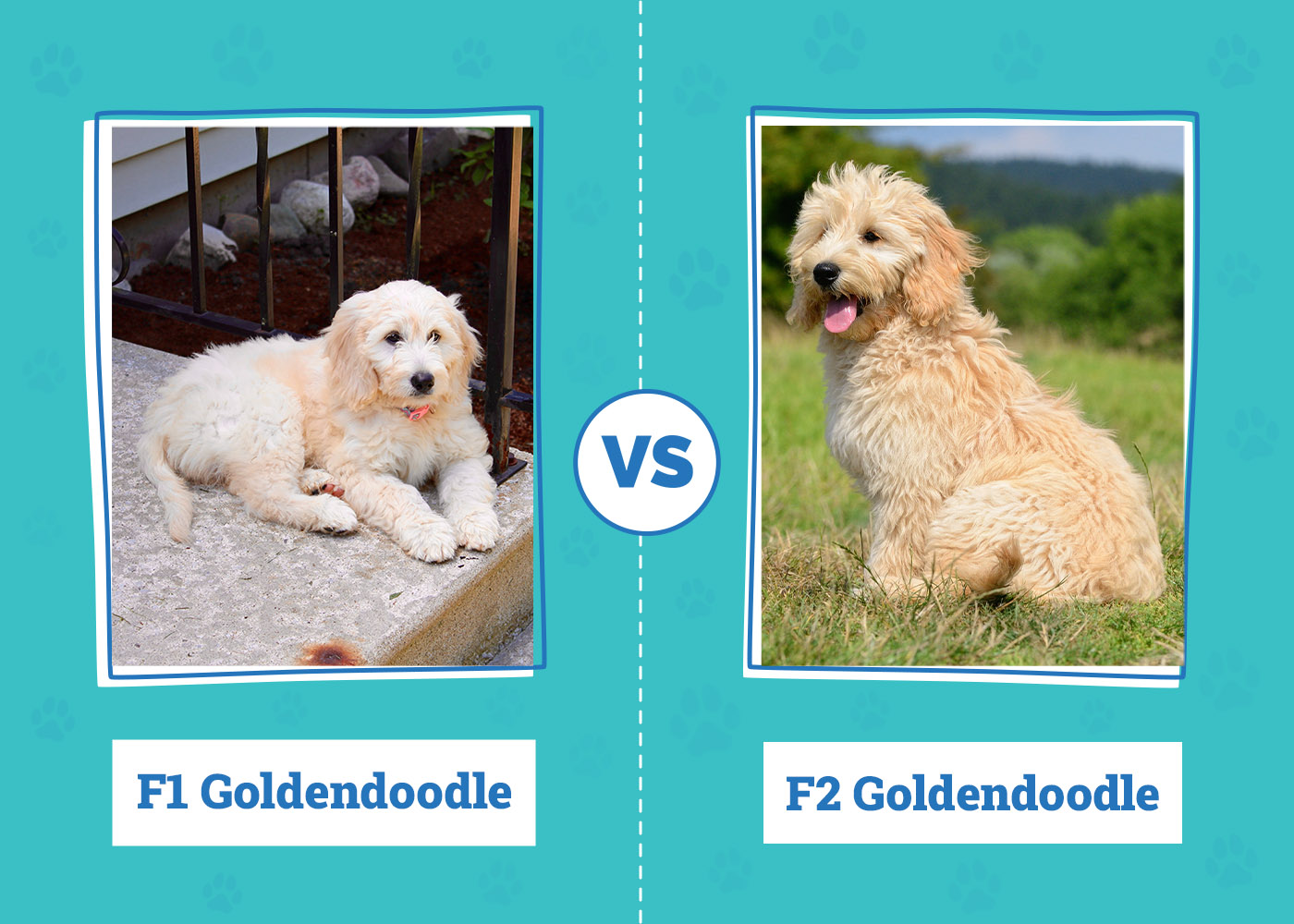
F1 Goldendoodle: 50% Golden Retriever and 50% Poodle. An F1 results from breeding a purebred Golden Retriever to a purebred Poodle.
-
F1b Goldendoodle: 75% Poodle and 25% Golden Retriever OR 75% Golden Retriever and 25% Poodle, depending on which purebred parent the F1 is bred back to. An F1b has one F1 Goldendoodle parent and one purebred parent.
-
F2 Goldendoodle: Roughly 50% Golden Retriever and 50% Poodle, just like an F1, BUT both parents are F1 Goldendoodles instead of purebreds. An F2 is produced by breeding two F1 Goldendoodles together.
-
F2b Goldendoodle: Roughly 62.5% Poodle and 37.5% Golden Retriever OR 62.5% Golden Retriever and 37.5% Poodle. One parent is an F2 Goldendoodle and one parent is an F1 Goldendoodle.
-
F3 / Multigen Goldendoodle: The result of breeding two F2 or higher generation Goldendoodles together. Multigen Goldendoodles are the most consistent in terms of appearance and temperament.
Now that we‘ve covered the basics, let‘s take a closer look at the key differences between an F1 and F2 Goldendoodle.
F1 Goldendoodle: Pros and Cons
An F1 Goldendoodle is the original hybrid cross that started the Goldendoodle craze. As the first generation offspring of a purebred Golden Retriever and a purebred Poodle, F1 Goldendoodles are known for their hybrid vigor. This means they tend to be healthier and more robust than their purebred parents thanks to a more diverse gene pool.
One of the main draws of an F1 Goldendoodle is the element of surprise in each litter. Because the puppies are an equal mix of two different breeds, there can be a lot of variation in coat type, color, and size. Some F1 Goldendoodles may inherit the straighter, shedding coat of the Golden Retriever, while others may have the curlier, lower-shedding coat of the Poodle. For owners who don‘t mind a bit of unpredictability and appreciate the uniqueness of each puppy, an F1 can be an exciting choice.
However, this same variability can also be a downside for some owners. If you have your heart set on a particular look or coat type, there‘s no guarantee you‘ll get it in an F1 litter. Allergic individuals should also be aware that not all F1 Goldendoodles will inherit the Poodle‘s hypoallergenic coat. According to a study by the Goldendoodle Association of North America, about 50% of F1 Goldendoodles will have a low- to non-shedding coat, while the other 50% will have a moderate to high shedding coat.
In terms of size, F1 Goldendoodles can vary depending on the size of the Poodle used (Toy, Miniature, or Standard). On average, an F1 Standard Goldendoodle will stand 20-24 inches tall and weigh 50-70 pounds. F1 Mini Goldendoodles typically range from 14-17 inches and 25-35 pounds.
Pros of F1 Goldendoodles:
- Greater genetic diversity and hybrid vigor
- Unique, one-of-a-kind appearance in each puppy
- Often less expensive than later generation Goldendoodles
Cons of F1 Goldendoodles:
- Less predictable coat type, color, and shedding level
- Not ideal for severe allergy sufferers due to shedding potential
- Wait times may be longer since two purebred parents are required
F2 Goldendoodle: Pros and Cons
To create an F2 Goldendoodle, two F1 Goldendoodles are bred together. Because both parent dogs are already a hybrid of Golden Retriever and Poodle, the resulting F2 puppies will still be roughly 50/50 in terms of breed composition. However, they will have a more homogenized appearance and coat type compared to the varied looks of an F1 litter.
The main advantage of an F2 Goldendoodle is consistency. By selectively breeding two F1 parents with the traits they wish to pass on, breeders have more control over the physical characteristics and temperament of the F2 puppies. This is why many F2 Goldendoodles have that signature teddy bear look with a wavy or curly hypoallergenic coat.
According to grooming experts, about 90% of F2 Goldendoodles will have a low- to non-shedding coat that is ideal for allergy sufferers. The curlier coats do require more frequent brushing and professional grooming to prevent matting, but most owners find this a fair trade-off for the minimal shedding. On average, F2 Goldendoodles will need a full groom every 6-8 weeks, which can cost anywhere from $60 to $150 depending on the area and groomer.
Another perk of an F2 Goldendoodle is the rainbow of possible coat colors and patterns. From partis and phantoms to sables and brindles, the coat color combinations in an F2 litter are endless. Breeders can strategically pair F1 parents with certain color genetics to achieve these eye-catching shades. For owners looking for a unique or rare colored Goldendoodle, an F2 or multigen litter may be the way to go.
In terms of size and temperament, F2 Goldendoodles are very similar to their F1 counterparts. Most F2s will fall in the same height and weight range as an F1 when fully grown. They share the same friendly, outgoing, eager-to-please personality that makes Goldendoodles such wonderful family pets. Like all dogs, F2 Goldendoodles need early socialization and positive reinforcement training to become well-rounded canine citizens.
F2 Goldendoodle owner Karen T. shares her experience: "I chose an F2 Goldendoodle because I loved the look of the wavy teddy bear coat and wanted a dog that would be good with my allergies. My F2 girl Rosie has been an absolute dream – her coat is so soft and doesn‘t make me sneeze at all. She‘s the sweetest, most trainable dog I‘ve ever had. The only downside is the frequent grooming appointments, but it‘s so worth it for a dog that brings me this much joy."
Pros of F2 Goldendoodles:
- More predictable coat type and shedding level
- Ideal for allergy sufferers due to high percentage of low-shedding coats
- Greater variety of coat colors and patterns through selective breeding
- Consistency in size and temperament
Cons of F2 Goldendoodles:
- Higher grooming needs and costs due to curlier coats
- Slightly less genetic diversity compared to an F1
- Often more expensive and longer wait times due to high demand
| Trait | F1 Goldendoodle | F1b Goldendoodle | F2 Goldendoodle | F2b Goldendoodle |
|---|---|---|---|---|
| Genetics | 50% Golden Retriever, 50% Poodle | 75% Poodle, 25% Golden OR 75% Golden, 25% Poodle | 50% Golden Retriever, 50% Poodle | 62.5% Poodle, 37.5% Golden OR 62.5% Golden, 37.5% Poodle |
| Coat Type | Varies from straight to curly | Mostly wavy to curly | Mostly wavy to curly | Mostly wavy to curly |
| Shedding | Low to moderate | Minimal to low | Minimal to low | Minimal to low |
| Grooming | Brushing 2-3x per week, groom every 8-12 weeks | Brushing 3-4x per week, groom every 6-8 weeks | Brushing 3-4x per week, groom every 6-8 weeks | Brushing 3-4x per week, groom every 6-8 weeks |
| Allergy Friendly | Varies | Yes | Yes | Yes |
| Coat Colors | Cream, gold, red, apricot | Cream, gold, red, apricot, black, chocolate, parti | Any color or pattern | Any color or pattern |
| Trainability | High | High | High | High |
| Family Friendly | Yes | Yes | Yes | Yes |
| Price | $1500 – $2500 | $2000 – $3500 | $2500 – $4000 | $2500 – $4000 |
Choosing an Ethical Goldendoodle Breeder
Regardless of whether you decide on an F1 or F2 Goldendoodle, the most important factor is finding a responsible, ethical breeder. Sadly, the popularity of Goldendoodles has led to a rise in puppy mills and backyard breeders looking to cash in on the trend without any regard for the health and well-being of their dogs.
A reputable Goldendoodle breeder will:
- Perform genetic health testing on all breeding dogs (hips, elbows, eyes, heart)
- Provide health certificates and a written warranty/contract
- Allow you to visit their facility and meet the parent dogs
- Ask you questions to ensure their puppies are going to good homes
- Be knowledgeable about the Goldendoodle breed and different generations
- Offer guidance and support even after you take your puppy home
Red flags to watch out for include breeders who always have puppies available, cannot provide health clearances, or do not allow you to see where their dogs are raised. Responsible breeders often have long waitlists and are very selective about their puppy placements.
Some reputable Goldendoodle associations and clubs to contact for breeder referrals include:
- Goldendoodle Association of North America (GANA)
- International Goldendoodle Association (IGA)
- Goldendoodle Club of America (GCA)
You can also search for a Goldendoodle rescue organization if you‘re open to adopting an adult or senior dog in need of a loving home.
Final Thoughts
As a veterinarian and dog lover, I believe both F1 and F2 Goldendoodles make exceptional companions for the right owner. While the choice ultimately comes down to personal preference, here is my professional opinion:
If you value genetic diversity, don‘t mind some unpredictability in coat type, and want a lower price point, an F1 Goldendoodle may be your best bet. On the other hand, if you have allergies, prefer the look of a curlier coat, and are willing to invest more in grooming, an F2 Goldendoodle will likely be a better fit.
Whichever generation you choose, be prepared for a dog that will steal your heart with their goofy smile, endearing personality, and unwavering loyalty. As Goldendoodle owner Sarah M. puts it: "My F1 Goldendoodle Finn is the light of my life. No matter what kind of day I‘m having, his wagging tail and happy-go-lucky attitude never fail to cheer me up. He‘s so smart and well-behaved, but also has just the right amount of silly quirkiness. I can‘t imagine my life without him."
With proper care, training, and love, an F1 or F2 Goldendoodle will be by your side through all of life‘s adventures for many years to come. As the saying goes, "A house is not a home without a Goldendoodle." Happy doodle searching!