Remembering the Lost Dogs of History: 30 Extinct Dog Breeds and Their Stories
Throughout the long and intertwined history of humans and canines, countless dog breeds have emerged to fulfill various roles as our helpers, guardians, hunters and companions. Sadly, many of these breeds are no longer with us today, having gone extinct due to factors like changing human needs, crossbreeding, disease, or displacement by other dogs.
By examining the extinct dog breeds of the past, we gain a greater understanding of the breadth of canine diversity that once existed and insight into how dogs have evolved alongside humans over time. Though lost to history, these breeds live on through records of their unique characteristics, capabilities and the important niches they once occupied. Learning their stories gives us a more complete picture of the rich history and heritage of man‘s best friend.
In this article, we‘ll profile 30 extinct dog breeds from ancient times to the modern era and from all corners of the globe. We‘ll explore what made each of these breeds unique, the functions they served, and the circumstances that ultimately led to their demise. Where available, photos and illustrations will help bring these lost dogs to life in the mind‘s eye.
Ancient Extinct Breeds
Some dog breeds have origins dating back thousands of years to the very dawn of canine domestication. Many of these ancient breeds are now long extinct but they laid important foundations for the dogs that followed.
The Molossus
The Molossus was a large, muscular dog breed that originated in ancient Greece as early as 2,500 years ago. Considered one of the progenitors of today‘s mastiff-type dogs, the Molossus was treasured by the Greeks and Romans as a guard dog and warrior dog. They famously served in battles alongside Roman legions. Their strength, courage and loyalty were legendary. As the Roman Empire declined, so too did the fortunes of the Molossus breed. They gradually disappeared after the fall of Rome.
[Include photo of Molossus statue or artistic rendering]The Tesem
The Tesem was an ancient Egyptian breed characterized by a sleek, greyhound-like body, pricked ears and a curly tail. Depictions of Tesem-like dogs have been found on Egyptian artifacts dating back to 3200 BC. These swift, keen-sighted dogs were used for hunting game like hares, antelope and ibex. They were also beloved companions to the Egyptian upper class and royalty. Mummified remains of Tesems have been discovered in Egyptian tombs. The breed is thought to have disappeared sometime after 1000 BC for unknown reasons.
[Photo of Egyptian painting/relief featuring Tesem dogs]Extinct Hunting and Sporting Breeds
Over the centuries, humans developed many specialized dog breeds to assist with hunting and other sporting pursuits. Changing practices and preferences, as well as crossbreeding with other dogs, led to the extinction of some of these sporting breeds.
The Talbot
Popular during the Middle Ages in Europe, the Talbot was a medium-sized white hunting dog known for its excellent sense of smell. Believed to be an ancestor of the Beagle and Bloodhound, Talbots had long, drooping ears and a deep, baying voice that made them well-suited for hunting in packs. Despite their popularity from the 11th-16th centuries, Talbots began to fall out of favor as newer scenthounds were developed. The breed is thought to have gone extinct sometime in the 1700s as Foxhounds and other breeds supplanted them.
[Engraving or woodcut of a Talbot]The English Water Spaniel
Before their extinction in the early 20th century, English Water Spaniels were prized for their skills in hunting ducks and other waterfowl. Strong swimmers with medium-sized, curly-coated bodies, these spaniels would dive underwater to retrieve game. According to legend, William Shakespeare was a fan of the breed and may have referenced them in his play "Macbeth." Theories for their decline include the rise of other retriever breeds, the demise of their primary breeding kennels, and the end of several wars that utilized the dogs‘ skills.
[Vintage illustration of English Water Spaniel]Extinct Guardian and Fighting Breeds
In addition to hunting helpers, humans also developed breeds of dogs specifically for protection, guarding livestock and property, and blood sports like bull-baiting and dogfighting. Changing views on animal welfare and new laws against dogfighting hastened the demise of some of these breeds.
The Cordoba Fighting Dog
Originating in Argentina in the 1920s, the Cordoba Fighting Dog was a large, muscular mastiff-type breed developed solely for the purpose of dogfighting. With their extremely high pain tolerance, fearless nature and fighting prowess, they dominated the dogfighting circuit for decades. Notably, they continued fighting even with broken bones or mortal wounds. Amid crackdowns on dogfighting in the 1950s, Argentine breeders crossed the remaining Cordobas with other breeds like Bulldogs to eliminate their hyper-aggressive tendencies. By the 1970s, the Cordoba as a distinct breed was extinct.
[Photo of Cordoba Fighting Dog]The Old English Bulldog
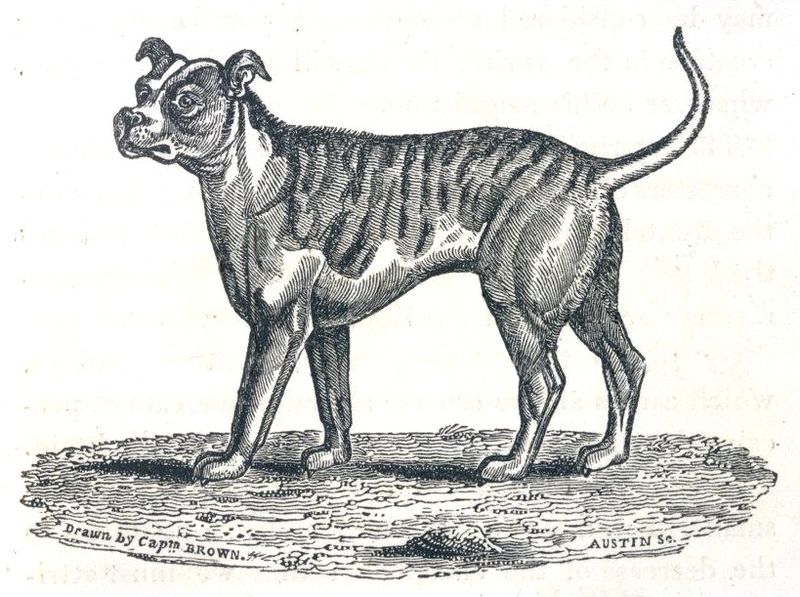
Descended from ancient breeds like the Alaunt and Mastiff, the original Old English Bulldog emerged in the 1500s for the cruel sport of bull-baiting, in which a pack of dogs was set upon a tethered bull. Muscular and tenacious with powerful jaws, the Bulldogs would attempt to grab the bull by the nose and pin it to the ground. When bull-baiting was outlawed in 1835, the Old English Bulldog lost its primary purpose. The breed split into two branches – the Bulldog and the Bull Terrier – and the original Old English Bulldog eventually faded away.
[Painting of Old English Bulldogs bull-baiting]Extinct Companion Breeds
Not all extinct dog breeds served working or sporting functions – some were bred purely for companionship. Changing tastes and the emergence of new companion breeds pushed some of these breeds to extinction.
The Toy Trawler Spaniel
The tiny Toy Trawler Spaniel emerged in the early 1900s as a companion breed, possibly descended from the King Charles Spaniel. Known for their diminutive size, round heads and short muzzles, these lapdogs came in a variety of colors including black and tan, ruby and blenheim. Toy Trawler Spaniels briefly enjoyed popularity among the English upper class but struggled to gain widespread recognition. As Pugs, Pekingese and other small companion breeds rose in popularity, the Toy Trawler Spaniel faded into obscurity and eventual extinction by the mid-20th century.
[Vintage photo of a Toy Trawler Spaniel]The Paisley Terrier
Named for the town of Paisley in Scotland, the Paisley Terrier was a small, silky-coated companion breed that emerged in the 1800s. These spunky, affectionate dogs stood about 7-8 inches tall and came in colors ranging from blue and tan to solid red. They made popular lapdogs and show dogs for a time. However, when Paisley Terrier breeders developed the Yorkshire Terrier by crossing the Paisley with English Black and Tan Terriers, the Yorkie quickly overshadowed the Paisley in the public‘s favor. The last known Paisley Terrier died in 1920.
[Drawing of a Paisley Terrier]Parting Thoughts
The 30 extinct dog breeds profiled here represent just a fraction of the countless others that have vanished over the centuries and millenia of human-canine history. While we may not have photos or even detailed descriptions for some of the earliest lost breeds, they still played important roles in their times and places.
Although it may seem strange to mourn for types of dogs we‘ve never known, their extinction represents a loss of genetic diversity, unique traits and special abilities that can never be recreated. At the same time, their legacy lives on in the hundreds of fascinating dog breeds that still share our world today, and in some cases descend directly from extinct ancestors. The extinct breeds of the past are woven into the very DNA of our beloved companions in the present.
By remembering these lost dogs and sharing their stories, we honor the longstanding bond between humans and canines. Hopefully the modern breeds we cherish today can avoid the fate of extinction, but even if they don‘t, they will have made their mark on the rich and colorful history of the dog.