The Mesmerizing Merle Pug: An In-Depth Look at This Eye-Catching Canine

As a lifelong dog lover and pug enthusiast, I have always been fascinated by the endless diversity within the canine kingdom. From towering Great Danes to tiny Chihuahuas, fluffy Pomeranians to hairless Xoloitzcuintlis, there is a dog to suit every taste and lifestyle. But one relatively recent development in the dog world that has been turning heads is the merle pug.
With their mottled coats and striking eyes, merle pugs are undeniably arresting. But as someone who has adored the squishy faces and clownish antics of pugs for decades, I was initially skeptical about this new color pattern entering the gene pool. Are merle pugs just a passing fad, a marketing gimmick aimed at cashing in on the latest designer dog craze? Or are they a legitimate and sound development in this historic breed?
To find out, I‘ve done a deep dive into the world of merle pugs. I‘ve scoured scientific literature on coat color genetics in dogs, interviewed pug breeders and breed experts, pored over pug pedigrees, and even met some merle pugs in the flesh (fur?) to learn everything there is to know about these intriguing canines. In this comprehensive guide, I‘ll share my findings and observations on merle pugs so that you, too, can appreciate (or beware of) these one-of-a-kind pooches.
Untangling the Genetics of Merle
To really understand merle pugs, we first have to unpack some complex coat color genetics. Dog coat color and pattern is determined by interactions between various genes, with different genes affecting pigment color, intensity, and distribution [1]. The merle gene is a dominant gene, signified by the letter M, that acts as a modifier on other coat color genes to create unique patterns [2].
A dog needs only one copy of the merle gene (Mm) to display some degree of merling, which appears as irregularly shaped patches where the coat color has been diluted. The specific color and level of merling can vary widely depending on the dog‘s base coat color and other pattern genes. A so-called "cryptic" or minimal merle may have only small areas of diluted pigment, while a full merle will have an immediately obvious marbled pattern covering much of the coat.
If a dog inherits two copies of the merle gene (MM), known as a "double merle", their coat becomes predominantly white and they are unfortunately at much greater risk for vision and hearing defects. This is because the merle gene doesn‘t just dilute pigment in the coat, but also in the eyes and inner ear [3]. Dogs with no merle genes (mm) will display no merle patterning at all and are considered non-merles.
When a merle dog (Mm) is bred to a non-merle (mm), according to typical dominant gene inheritance patterns, each puppy has a 50% chance of being merle (Mm) and a 50% chance of being non-merle (mm). Breeding two merles together greatly increases the risk of producing double merle puppies, while breeding a cryptic merle to a non-merle can lead to "surprise" merle puppies in a litter expected to be non-merle [4].
The Massively Misunderstood Merle Pug
So now that we have a basic understanding of merle genetics, let‘s zero in on merle pugs. As mentioned in the intro, merle is not a naturally occurring pattern in the pug breed. The breed standards set by major kennel clubs like the AKC only recognize two coat colors in pugs – fawn and black [5]. There is no mention of merle, because the pug breed was long established before the introduction of the merle gene.
According to the Pug Dog Club of America, the first documented merle pugs appeared in the early 2000s, ostensibly a result of crosses made between pugs and merle-carrying breeds like Chihuahuas [6]. While there is no official census, estimates suggest that merle pugs currently make up less than 1% of the total pug population in the US [7]. Their scarcity, along with the novelty factor of their eye-catching coats, has made merle pugs quite desirable among some dog owners enamored with rare and unusual pets.
However, merle pugs are highly controversial within the dog fancy, with many pug breeders and enthusiasts believing that the merle coloration has no place in this storied breed. Pug breed clubs around the world have denounced the intentional breeding of merle pugs, arguing that it is not only a disservice to the breed but potentially dangerous, as many merle pugs end up in shelters or with health issues related to their coloring [8].
One common misconception about merle pugs is that they are a separate breed from standard fawn or black pugs. This is simply not true – a merle pug is still 100% pug, just with an additional gene modifying their coat color. In fact, according to geneticists, it only takes a few generations of careful breeding to "fix" a foreign gene like merle into a breed‘s gene pool [9].
Another myth is that all merle pugs have health issues. While it is absolutely true that pugs with two merle genes often have debilitating hearing and vision defects, pugs with only one merle gene are at no greater risk for these specific issues than non-merles. However, all pugs are still prone to certain health problems due to their flat faces, protruding eyes, and stout bodies, regardless of coat color [10].
The Merle Spectrum
One of the most fascinating things about merle pugs (and merle dogs in general) is the incredible diversity in their coat patterns. No two merle pugs look exactly alike! The merle gene interacts with the existing coat color genes to create unique swirls, splotches, and streaks.
Some common variations of merle pugs include:
- Blue merle pugs: Silvery-grey background with darker grey or black markings
- Red merle pugs: Fawn, apricot or red background with darker red or liver markings
- Chocolate merle pugs: Brown or liver colored background with darker brown markings
- Fawn merle pugs: Light fawn background with darker fawn or reddish markings
- Cryptic aka phantom merle pugs: Small areas of barely discernible merle against the base coat color
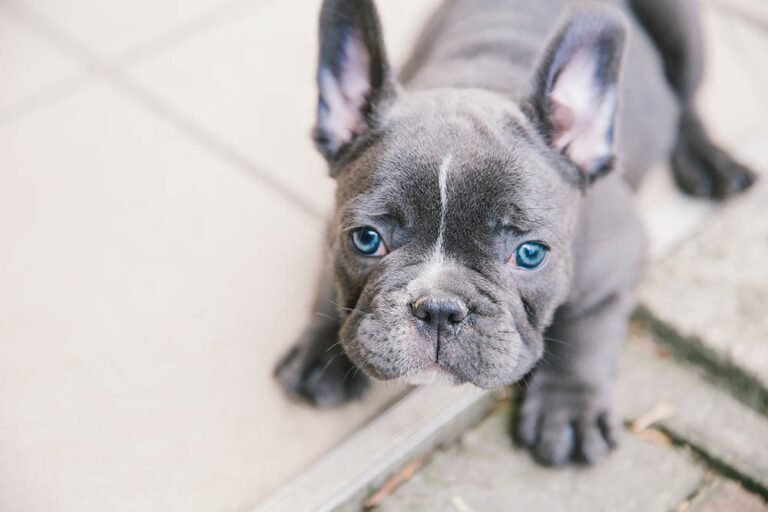
Beyond coat color, one of the most striking features of many merle pugs is their eyes, which are often bright blue, green, or particolored. While blue eyes are not unheard of in non-merle pugs, they are much more common in merles due to the way the M gene interacts with eye pigment cells [11].
| Trait | Standard Pug | Merle Pug |
|---|---|---|
| Coat color | Fawn or black only | Fawn, black, blue, chocolate, or red base with merle pattern |
| Eye color | Brown, with rare blue | Often blue, bi-colored, or parti-colored |
| Nose & paw pads | Black | Often pink or mottled |
| Breed recognition | Recognized by all major kennel clubs | Not recognized by any major kennel clubs |
| Potential health issues | Brachycephalic airway syndrome, eye disorders, arthritis, encephalitis | Same as standard plus potential for merle gene-related deafness & blindness in double merles |
| Average price | $600-$1,500 | $2,500-$8,000 |
| Occurrence | Common | Rare, less than 1% of pugs |
Living with a Merle Pug
As someone who has owned several pugs over the years, I can attest that they are truly unique and endearing companions. From their charming wrinkled faces and curly tails to their goofy, fun-loving personalities, pugs pack a lot of dog into a small package.
I recently had the opportunity to meet a merle pug puppy in person and I must admit I was smitten. Little Gizmo, with his fluffy grey and black patched coat and one blue, one brown eye, was the center of attention everywhere he went. Strangers flocked to coo over his adorable face and unusual coloring, and Gizmo ate up the adoration with typical pug aplomb. His owner told me that while she loved having such an unusual pug, she had to be very proactive in educating people that Gizmo was a happy accident from a backyard breeder, not an example of responsible breeding.
Indeed, most ethical pug breeders are strongly opposed to breeding merles, believing that intentionally introducing the merle gene is gambling with the breed‘s already precarious health. The UK Pug Breed Council‘s official statement on merle pugs minces no words: "The Kennel Club will not register merle colored Pugs and no reputable breeder will be breeding merle colored pugs. Breeding of merle colored Pugs can cause severe health problems and any breeder doing so purely to produce an unusual color is not putting the health and welfare of the dogs first." [12]
Even setting aside the pattern, pugs are not the dog for everyone. These highly social, people-oriented dogs require a lot of interaction and do not tolerate being left alone for long periods. They can also be willful and slow to housetrain – one pug owner told me "pugs are the clowns of the dog world… but like clowns, you‘re never sure if they‘re laughing with you or at you." But for the right person, pugs make deeply devoted and loving, if sometimes maddening, companions.
Owning a merle pug comes with additional challenges beyond those of a typical pug. Since merle pugs are rare, they tend to command premium prices from breeders – one merle pug owner reported paying over $5,000 for her dog. Merle pugs may face discrimination from those who see their color as a shameful mutation rather than a mere novelty. And there is always the worry about unscrupulous breeders trying to cash in on the merle fad with no regard to health or temperament.
If you have your heart set on a merle pug, you must do your homework to find a reputable breeder who conducts genetic testing and breeds for the betterment of pugs, not just for profit. Don‘t be afraid to ask questions and walk away if something seems off. And be prepared to handle the extra attention (both positive and negative) your eye-catching pup will inevitably attract.
The Bottom Line on Merle Pugs
In conclusion, merle pugs are a complicated and often misunderstood addition to the global pug population. While there is no question that their coats are striking, the jury is still out on whether merle pugs represent a legitimate new direction for this beloved breed or a worrisome trend that prioritizes aesthetics over ethics.
As a pug lover, I can certainly appreciate the appeal of merle pugs – who wouldn‘t want a pug puppy that looks like a soft stormy sky come to life? But I also believe strongly that a dog‘s health and well-being should always be the top priority in breeding, not what‘s currently in vogue. I think there is space in the pug community for merle pugs to coexist with their fawn and black brethren, but only if bred with care and transparency by experts dedicated to the breed.
Whether your pug is fawn, black, or merle, they are sure to enrich your life with laughter, love, and more than a little mischief. As the saying goes, "Hug a pug today—and avoid the heartache of life without one!" [13]