The Ultimate Guide to Portuguese Water Dogs: Diving Into the Details
Long before they were splashing around with the Obama family or charming the Kennedy clan, Portuguese Water Dogs were hard at work on the fishing boats of Portugal. With their webbed feet, waterproof coats, and can-do attitudes, these plucky pups were built for a life at sea.
But there‘s so much more to the Portuguese Water Dog (PWD) than just their ocean origins. From their unique anatomical traits to their larger-than-life personalities, PWDs are a breed like no other. Dive in with us as we explore all the fascinating facets of the Portuguese Water Dog!
A Breed Born to Swim: The History of Portuguese Water Dogs
Portuguese Water Dogs may have descended from dogs brought to Portugal by the Moors (a Muslim people who once ruled the Iberian Peninsula) or from the herding dogs of the Ostrogoths (a Germanic tribe that settled in Iberia in the 5th century). While their exact lineage is uncertain, by the 1300s, PWDs had found their niche as fishermen‘s helpers along Portugal‘s coast.
In the early days, Portuguese Water Dogs served many vital roles on fishing boats:
- Retrieving broken nets or lost tackle
- Herding fish into nets
- Swimming messages between boats
- Guarding the catch and the boat
- Providing companionship to fishermen during long voyages
PWDs worked long hours in challenging conditions – diving into cold water, navigating strong currents, clambering in and out of boats. Their webbed feet, muscular builds, and rudder-like tails made them well-equipped for these tasks.
As technology advanced and fishing methods changed in the early 20th century, the need for PWDs declined. The breed nearly went extinct, with numbers dwindling to perhaps just 25 dogs by the 1930s.
Fortunately, a wealthy Portuguese shipping magnate named Vasco Bensaude stepped in to save the breed. He launched a breeding program and promoted PWDs as loyal companions. Thanks to these efforts – and later, those of fanciers in the US – the Portuguese Water Dog escaped the brink of extinction.
Made for the Water: Portuguese Water Dog Anatomy
The Portuguese Water Dog is a medium-sized breed with a distinctly robust, workmanlike appearance. They have several physical traits that showcase their history as seafaring dogs:
-
Webbed feet: The defining characteristic of the PWD! The webbing between their toes is thick and extends almost all the way to the end of each digit. When spread, a PWD‘s toes somewhat resemble a duck‘s foot. This webbing provides extra surface area to propel the dog powerfully through the water.
-
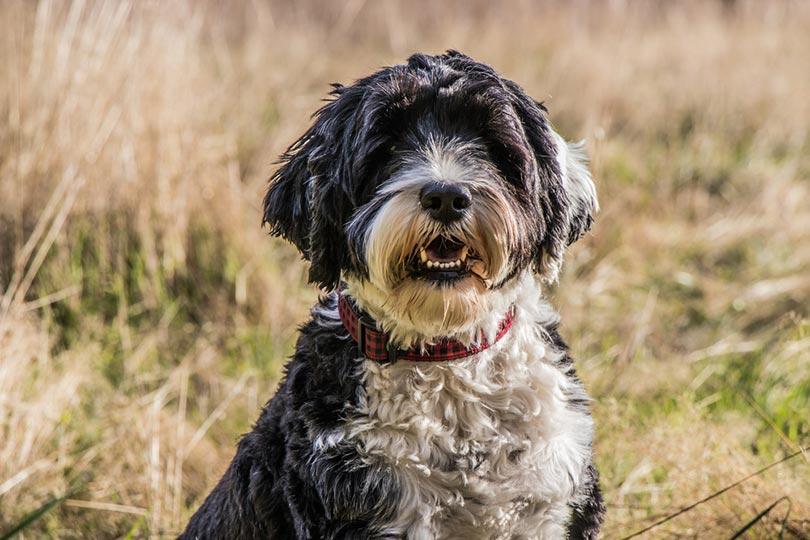
Water-resistant coat: PWDs have a thick, low-shedding coat that‘s either curly (compact, cylindrical curls) or wavy (falling in gentle waves). The coat is made up of a dense, woolly undercoat and a coarser outer coat, providing insulation in cold water.
-
Powerful hindquarters: PWDs are slightly longer than tall, with a deep chest and sturdy legs. Their muscular rear end provides strong drive while swimming.
-
Rudder-like tail: The tail is thick at the base and tapers to a point. It‘s usually carried in a ring shape over the back. This strong tail acts as a rudder, helping the PWD to navigate and make quick turns in the water.
-
Keen eyesight: PWDs have almond-shaped, medium-sized eyes that are set well apart. Their acute vision allowed them to spot items in the water from a distance.
Here are some key stats on Portuguese Water Dog size:
| PWD Size | Height (in) | Weight (lbs) |
|---|---|---|
| Male | 20-23 | 42-60 |
| Female | 17-21 | 35-50 |
Of course, individual dogs may fall outside these ranges. In general, PWDs are medium-sized but sturdy and substantial.
Some other notable physical traits of the breed:
- PWDs have pendulous, heart-shaped ears that fold forward.
- Their muzzle is slightly shorter than their skull, with a well-defined stop (forehead).
- PWDs have a level or scissors bite.
- Their eyes are black, brown, or various shades of amber.
- Coat colors include black, white, brown, or combinations of black or brown with white.
The Portie Personality: Hardworking, Hilarious, and Happiest in the Water
Portuguese Water Dogs are known for their delightful combination of tireless work ethic and clownish sense of humor. They are:
- Highly intelligent and trainable
- Eager to please and attuned to their humans
- Energetic and athletic
- Playful and fun-loving
- Confident and brave
As working dogs, PWDs need both physical exercise and mental stimulation to stay happy. They‘re not content to laze around the house all day – they want to be where the action is! Whether that‘s a hike, a swim, or an impromptu training session in the living room, PWDs are always ready to jump in and join you.
That said, PWDs don‘t have an "off" switch. They go and go and go some more! While they can adapt to apartment living with sufficient exercise, a home with a securely fenced yard is ideal. Daily walks, fetch sessions, swimming, and training time are a must for this busy breed.
True to their heritage, PWDs are bona fide water dogs. They LOVE to swim and will take every opportunity to splash around. Access to water – whether it‘s in the form of a backyard pool, a local beach, or a mud puddle – is key to keeping a PWD content.
Some other key Portie personality points:
- PWDs are loyal and bonded to their families but may be initially wary of strangers. Early and ongoing socialization is important.
- They get along well with kids and other dogs but have a strong prey drive. They may chase cats and other small animals.
- PWDs are mouthy and like to carry objects around. Providing safe chew toys is a must.
- While not yappy, PWDs will alert bark at noises and if they sense something is amiss.
- They tend to jump on people, so training them to greet politely is important.
As one long-time breeder put it: "PWDs are like potato chips. It‘s hard to have just one, and if you give them an inch, they‘ll take a mile. But their antics will keep you laughing for days."
Keeping Your PWD Healthy and Happy
Portuguese Water Dogs have a lifespan of 10-14 years on average. They are a generally healthy breed, but like all purebred dogs, they can be prone to certain genetic health conditions. Some issues seen in PWDs include:
- Hip dysplasia: A malformation of the hip joint that can lead to pain and mobility issues. Reported in 8.3% of PWDs according to the Orthopedic Foundation for Animals (OFA).
- Progressive Retinal Atrophy (PRA): A degenerative eye disease that can cause blindness. Approximately 4% of PWDs are carriers.
- Storage Disease: A metabolic disorder that affects the nervous system. About 15% of PWDs are carriers.
- Juvenile Dilated Cardiomyopathy: A heart condition that can cause sudden death in young dogs. Affects an estimated 1 in 125 PWDs.
Responsible breeders screen their dogs for these and other issues. The Portuguese Water Dog Club of America recommends the following health tests for all breeding dogs:
- Hip dysplasia: OFA or PennHIP evaluation
- Eye exam by a board-certified veterinary ophthalmologist
- GM1 storage disease DNA test
- Juvenile dilated cardiomyopathy DNA test
- Optigen prcd-PRA DNA test
As a PWD owner, you can support your dog‘s health by:
- Keeping them at a healthy weight
- Providing age-appropriate exercise
- Feeding a high-quality diet
- Brushing their teeth regularly
- Scheduling annual vet check-ups
- Staying up-to-date on preventative care like vaccines and parasite control
Your PWD‘s curly coat will also need regular attention. Plan to brush them at least weekly (more often if they have a long coat) and take them in for professional grooming every 4-6 weeks. Many owners opt for a "retriever clip" (1 inch long all over) or a "lion clip" (hindquarters and muzzle shaved short) to keep their PWD tidy and comfortable.
When it comes to training, Portuguese Water Dogs are bright and eager to learn but can also be a bit headstrong. They respond best to positive reinforcement techniques like praise, play, and treats. Harsh corrections will only shut them down.
Focus on teaching your PWD basic obedience commands, good leash manners, and household rules starting from puppyhood. Many PWDs also enjoy and excel at dog sports like agility, dock diving, nose work, and (of course) water trials.
Is a Portuguese Water Dog Right For You?
If you‘re considering adding a Portuguese Water Dog to your family, it‘s important to do your research and make sure the breed is a good fit for your lifestyle. PWDs can be wonderful companions for the right owners, but they‘re not the easiest breed to care for.
You may be a good match for a PWD if:
- You‘re an active person who enjoys outdoor adventures and spending time with your dog
- You‘re willing to commit to daily exercise and regular training sessions
- You don‘t mind a dog who wants to be involved in all your activities
- You have experience with dogs and understand the importance of socialization and positive training
- You‘re prepared to keep up with regular brushing and grooming
On the other hand, a PWD may not be the best choice if:
- You work long hours and can‘t be home with your dog for most of the day
- You prefer a calm, low-energy dog who‘s content to lounge on the couch
- You have young children and aren‘t prepared to closely supervise all interactions
- You‘re looking for a low-maintenance breed in terms of grooming
- You live in a small space without easy access to the outdoors
Of course, every dog is an individual. If you think a PWD may be the breed for you, be sure to spend time with several dogs in person, talk to experienced owners and breeders, and do your homework on the breed‘s needs and quirks.
Fascinating Facts About Portuguese Water Dogs
We‘ll leave you with a few final fun facts about this delightful breed:
-
PWDs have waterproof coats.
Both the outer and inner coat of a PWD work together to repel water and protect the dog from cold temperatures. -
They have a remarkable diving ability.
PWDs can dive as deep as 15-20 feet underwater to retrieve objects. Some have even been trained to work with marine biologists, collecting samples from the ocean floor! -
The Obamas had two PWDs during their time in the White House.
Bo joined the Obama family in 2009, and Sunny arrived in 2013. -
PWDs come in only five colors.
Black, white, brown, black and white, and brown and white are the only acceptable colors in the breed standard. -
They nearly went extinct in the 1930s.
Thanks to the efforts of wealthy Portuguese businessman Vasco Bensaude, the PWD breed was revived from just a few dozen individuals. -
PWDs have been useful in unexpected ways.
During World War II, PWDs carried messages between ships in the Portuguese navy. They‘ve also been trained as hearing assistance dogs. -
There are only two PWD haircut styles accepted in the show ring.
All that gorgeous hair can be clipped into one of two styles – the retriever clip and the more stylized lion clip. -
PWDs are multi-talented.
PWDs often excel in dog sports and have a special aptitude for nose work and tracking. Many PWDs work as therapy dogs thanks to their affectionate, intuitive nature. -
PWDs aren‘t actually from Spain.
While the Iberian Peninsula includes both Portugal and Spain, the breed originated solely in Portugal. Spain has its own water dog, the Spanish Water Dog or Turco Andaluz. -
PWDs don‘t shed much.
While no dog is truly hypoallergenic, PWDs are a good choice for allergy sufferers thanks to their low-shedding coat. Of course, regular brushing and grooming are still a must!
So there you have it – a comprehensive guide to the remarkable Portuguese Water Dog! From their webbed feet to their waterproof coats, PWDs are truly built for a life on the water. But these athletic, intelligent, affectionate dogs also make wonderful companions on dry land.
If you‘re looking for a dog who will keep you on your toes, make you laugh, and shower you with love (and probably some sea water), the Portuguese Water Dog may be the breed for you. These special pups have certainly left their mark on history – and on the hearts of all who know them.