More Than a Nose: The Remarkable Abilities of Truffle Hunting Dogs

In the high-stakes world of truffle hunting, success depends on a dog‘s nose and heart. Truffles, those pungent and prized fungi that can sell for thousands of dollars a pound, grow hidden beneath the earth, betraying their presence only by a subtle scent. To uncover these buried treasures, human hunters depend on an elite group of dogs with the scenting skills, determination, and desire to get the job done.
Truffle-hunting dogs are more than just tools – they are cherished partners, admired for their drive and celebrated for their skill. As truffle hunting has evolved from a countryside tradition to a competitive international industry, dogs have become the indispensable key to success. Let‘s explore what makes these remarkable dogs tick and how their unique abilities have elevated them to the top of the truffle hunting game.
The Nose Knows: A Truffle Dog‘s Scenting Superpowers
A dog‘s nose is a marvel of nature, with a sense of smell up to 100,000 times more acute than a human‘s. But even among dogs, truffle hunters are nasal standouts. Dr. Cynthia Otto, director of the Penn Vet Working Dog Center, explains that truffle dogs have a particular talent for detecting faint and complex odors.
"Truffle hunting requires a dog to pick out a very specific scent among a lot of other strong scents in the environment, like dirt, decaying leaves, and other fungi," she says. "The dogs that are best at it have a natural ability to discriminate between odors and hone in on the one they‘re looking for."
This finely-tuned sense of smell is partly innate and partly trained. Truffle dogs are often chosen from breeds with a strong natural scenting drive, like hounds, retrievers, and water dogs. But their abilities are also sharpened through extensive practice and positive reinforcement.
Sebastiano Stacchini, a truffle hunter from Tuscany, puts his Lagotto Romagnolo dogs through their paces every day. "We train constantly to keep their noses sharp," he says. "I hide truffles in the woods for them to find. We make a game of it, but it‘s also serious work. A missed truffle is missed income."
That drive to seek and find is hardwired into many truffle dogs. Dr. Otto notes that the dogs with the most scenting success often come from working lines originally bred to hunt or herd. "Those instincts to search and locate a target, whether it‘s a rabbit or a sheep or a truffle, are very strong," she says. "For these dogs, following a scent to its source is immensely rewarding."
Brains and Brawn: The Ideal Truffle Hunting Partner
But a good nose alone does not make a great truffle dog. The rigors of the work demand certain physical and mental characteristics as well.
Truffle hunting is an active, full-body job. Dogs may cover miles of rough and uneven terrain in a single outing, in all kinds of weather conditions. They need the strength and stamina to keep going for hours, as well as the agility to navigate obstacles and dig when necessary.
Stacchini‘s Lagottos, with their webbed feet and waterproof coats, are well-equipped for long days in Italy‘s damp oak and hazelnut forests. But he says endurance matters just as much as hardiness. "A dog that tires out after an hour is no good," he says. "Truffle hunting is an all-day affair."
Just as important as physical prowess is mental acuity. Truffle dogs work largely off-leash and out of sight, deciding for themselves where and how thoroughly to search. The most successful are the independent problem-solvers, the ones that can think on their feet.
"A good truffle dog has a mind of its own," says Ariane Vacheron, a truffle grower in France‘s Périgord region. "It won‘t just follow commands blindly. It will use its own judgment and intelligence to find the best spots to search."
At the same time, truffle dogs must be cooperative and responsive to their handlers. The human-canine bond is the core of the partnership. Vacheron spends almost all her time with her Beaucerons, a herding breed known for its loyalty and trainability. "We are a team," she says. "I trust them to do their job, and they trust me to lead them. It‘s a relationship based on mutual respect."
Indeed, the personality of the dog is as important as its scenting skill or stamina. Truffle dogs are often described as having a strong work ethic, with a desire to please and be useful. They are confident but not aggressive, energetic but not frantic, focused but not inflexible.
Giorgio Locatelli, a Michelin-starred chef and truffle aficionado, puts it this way: "A great truffle dog has a special sparkle. Yes, it has the physical characteristics and the training, but there is something more. A passion, a spirit. You can see it in their eyes and the way they carry themselves. They are doing what they love and they know they are good at it."
Bred for the Job: Traditional Truffle Hunting Breeds
While many types of dogs can succeed at truffle hunting, certain breeds have risen to prominence through a combination of natural ability and regional tradition. These include:
Lagotto Romagnolo
Hailing from the marshlands of northeast Italy, the Lagotto Romagnolo is the only breed specifically selected for truffle hunting. With a curly, waterproof coat and webbed feet, the Lagotto is well-adapted to working in damp conditions.
Centuries of selective breeding have honed the Lagotto‘s already keen nose and search drive to a laser focus on truffles. Stacchini, who has worked with Lagottos for over 30 years, says their scenting ability is unparalleled. "For a Lagotto, truffles are everything," he says. "It‘s like they were born knowing that scent."
Italian Pointer (Bracco Italiano)
Another iconic Italian breed, the Bracco Italiano was originally developed to point at game birds. But its powerful nose and tireless work ethic have made it a popular choice for truffle hunters as well.
Luca Campinoti, a third-generation truffle hunter in Tuscany, works his Braccos in the rolling hills around Pisa. He values their endurance and methodical search style. "A Bracco will cover every inch of ground until it finds what it‘s looking for," he says. "They are very thorough and very determined."
English Springer Spaniel
Prized by hunters for their keen noses and boundless enthusiasm, Springer Spaniels have become a go-to truffle hunting breed in the UK and beyond. Their friendly, people-pleasing personalities also make them a favorite with handlers.
"Springers absolutely live to work with their humans," says Sarah Adams, a truffle grower in Scotland who uses spaniels to search her oak and beech forests. "Their whole aim is to make you happy. And for them, nothing is more fun than following a scent."
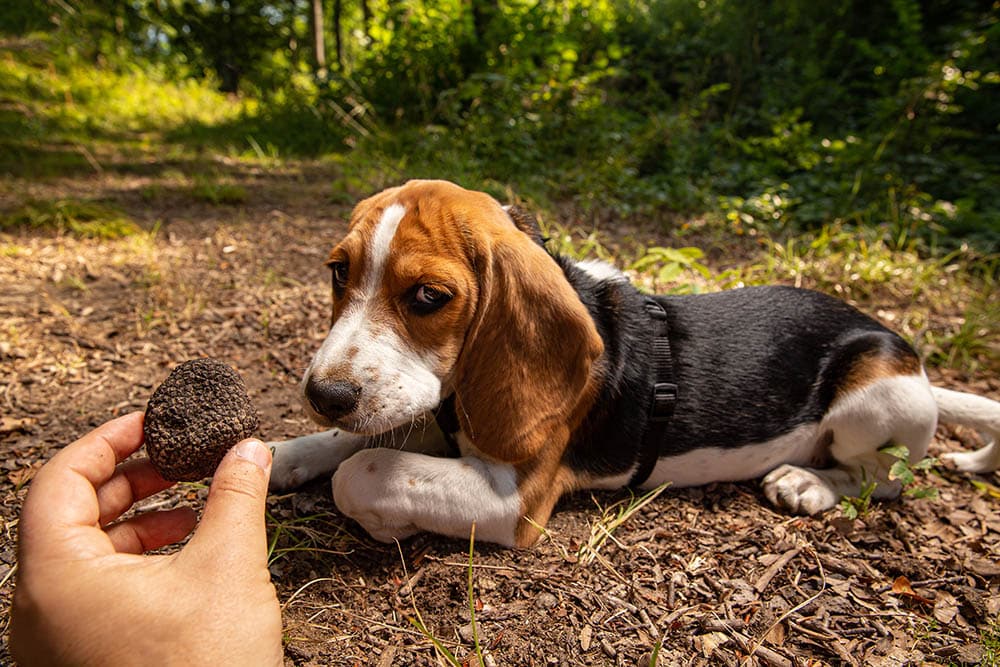
Beagle
These compact scenthounds may be better known for rabbit hunting, but their sensitive noses and determined personalities can be readily channeled into truffle work as well.
Pierre Sourzat, a pioneering researcher of truffle cultivation in France, has used Beagles in his work for decades. "Beagles are single-minded and stubborn, which are actually great qualities in a truffle dog," he says. "They won‘t give up until they puzzle out where that smell is coming from."
Crossbreeds and Mutts
Not every great truffle dog comes with a pedigree. Many hunters work with crosses, mixes, and rescues that have the necessary drive and abilities.
"Some of the best dogs I‘ve seen have been accidental finds," says Adams. "One of my spaniels is a stray that just showed up one day. He took to the work immediately and is now one of my top hunters."
What matters most, say truffle hunters, is not looks or lineage but heart. "A good truffle dog could be any color, any size, any mix," says Campinoti. "What counts is their passion and their bond with their human. With that, any dog can be a star."
Partners in Grime: The Truffle Hunter‘s Life
For all the focus on the dogs, truffle hunting is very much a joint venture. Behind every successful dog is a human partner who has invested countless hours in training, care, and relationship building.
Stacchini describes long days that start before dawn, hiking through the Tuscan hills with his Lagottos ranging ahead. He follows their cues, reading their body language to know when they‘ve caught a promising scent. He provides encouragement and direction, but also knows when to step back and let the dogs work.
When a dog starts to dig frantically at the soil, Stacchini is there in an instant with a spade, carefully unearthing the prize. Each truffle is a thrill, a treasure brought to light through teamwork. Dog and human celebrate together, perhaps with a morsel of cheese or sausage for the dog and a silent prayer of thanks from Stacchini.
It‘s a partnership built on deep trust and mutual respect, says Adams. "These dogs will do anything for us, and we for them. We are utterly reliant on each other out there. The relationship goes beyond just a working bond – it‘s a profound emotional connection."
For the dogs, the work itself is tremendously rewarding, engaging their senses and their minds. The joy is apparent in their quivering excitement as they snuffle through the undergrowth and in their full-body wags when they make a find.
But the truffle is only part of the reward. Equally satisfying is the interaction with their beloved humans, the praise and play. "It‘s a huge part of what motivates them," says Adams. "They are so eager to please us and be with us. The bond between truffle dog and handler is something very special."
Not Just a Job: Ensuring a Truffle Dog‘s Wellbeing
As demand for truffles grows and competition heats up, there are concerns about the welfare of truffle hunting dogs. In some regions, unscrupulous hunters have been known to push their dogs to exhaustion, deprive them of rest or water, or even abuse them in the name of productivity.
But experienced, ethical hunters know that a happy, healthy dog is not only a more effective hunter but a more cherished companion. "It‘s not just about the truffles," says Sourzat. "It‘s about the whole experience, the relationship with the dog. If you don‘t respect and care for your partner, you‘re doing it wrong."
Responsible truffle hunters ensure their dogs get plenty of rest, veterinary care, and off-season downtime. Training is based on positive reinforcement, never punishment. And a dog‘s unique personality and needs are honored.
"Every dog is different," says Vacheron. "Some want to work all day, others need more breaks. Some like a lot of cuddles, others prefer space. It‘s my job to understand what they need to thrive, both as working dogs and as individuals."
For Vacheron and her fellow hunters, the wellbeing of their dogs is not just an ethical obligation but a labor of love. "These dogs give us so much," she says. "Their skill, their dedication, their companionship. The least we can do is give them a good life in return."
A Nose for the Future: The Evolving World of Truffle Dogs
As the truffle industry has grown and changed, so too has the role of the truffle hunting dog. Once the purview of local hunters in a handful of regions, truffle dogs are now found all over the world, working with everyone from traditional foragers to cutting-edge cultivators.
Climate change and habitat loss have made wild truffles more scarce and unpredictable, leading many truffle businesses to establish their own plantations. Here, dogs are used not just to hunt mature truffles but to detect the underground presence of immature ones, helping monitor the health and development of the crop.
Technology is also changing the game. Some large-scale cultivators have experimented with electronic "e-noses" to sniff out truffles, but most find they are no match for a well-trained dog. "The sensitivity and discernment of a dog‘s nose is just unparalleled," says Sourzat. "I don‘t think we‘ll ever have a machine that can do what they do."
What is changing is how dogs are being selected and trained for the job. As truffle hunting has become more professionalized, so too has the breeding and education of the dogs. Some hunters are working with specialized breeders and trainers to develop dogs with the ideal mix of scenting ability, temperament, and physical traits for the job.
But even as the industry evolves, the heart of truffle hunting remains the bond between dog and human. "The technology, the science, the business – that‘s all important," says Stacchini. "But at the end of the day, it‘s still about a dog and a person, working together in nature, searching for this little miracle."
As long as there are truffles to be found, there will be dogs with the noses and the hearts to find them. And there will be humans who value these dogs as partners, friends, and fellow adventurers in the grand, fragrant hunt.
"Truffle hunting is not just a job. It‘s a way of life, a passion," says Campinoti. "And there‘s no one I‘d rather share that life and that passion with than my dogs. They are my everything."
Just how valuable is the truffle trade? Consider these figures:
- Black winter truffles, the most common variety, can sell for $800-$1500 per pound. The rarer white truffles go for $4000 a pound or more.
- The global truffle market is expected to reach $6.4 billion by 2027, up from $4.1 billion in 2019.
- France, Italy, and Spain are the top producers, accounting for over 80% of the world‘s truffle supply. But cultivation is expanding in countries like Australia, New Zealand, and the United States.
- Truffle production can be highly lucrative for landowners. A well-managed 1-acre truffle orchard can yield around 50 pounds of truffles per season, with a potential value of $175,000 or more.
- But cultivation is a long game. It takes 5-7 years for inoculated trees to start producing, and 10-12 years to reach peak yield.
- Dogs typically take 1-2 years to become fully trained and reliable truffle hunters. A proven dog can be worth $10,000 or more.
- In 2014, a Sabatino dog named Rocco unearthed a 1.5-pound white truffle, one of the largest ever found. While its value was not disclosed, a 2.5-pound white truffle sold for over $330,000 in 2010.